Introducing LTDF-graphene and three target applications: critical minerals and more
Avadain has developed a new graphene type called Large, Thin, Defect-Free (LTDF) graphene, which features flakes in the 25-100+ µm² range and averages under 5 atomic layers, aiming to enhance applications in critical minerals, rare-earth-free magnets, and high-power electronics. This advancement is significant because it addresses key limitations of commercial graphene, such as flake size, layer count, and defect density, potentially improving the performance of carbon-based materials in demanding applications.
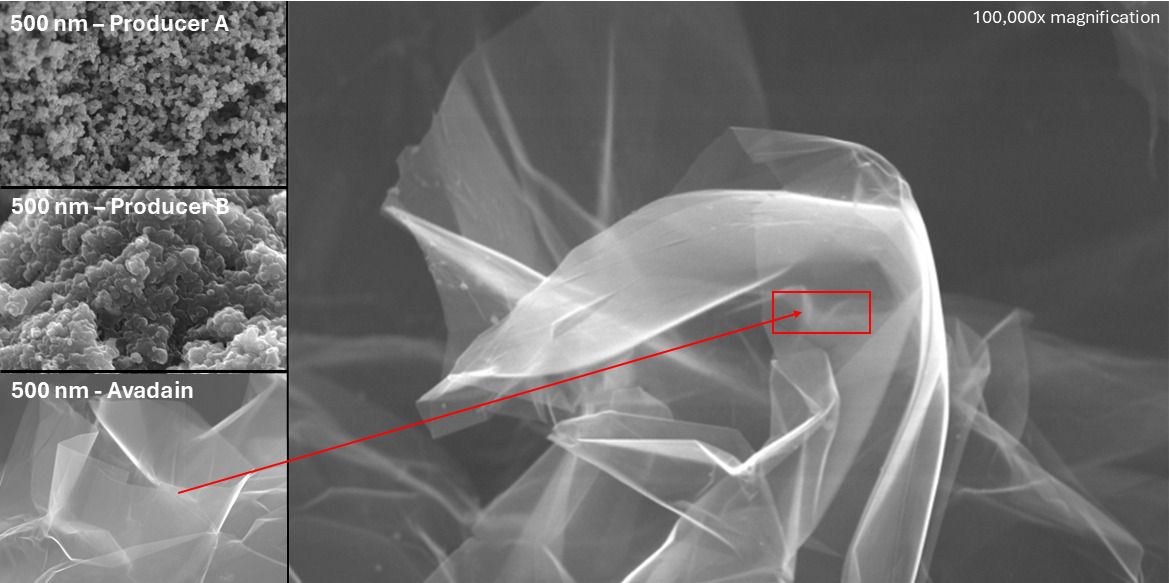
Avadain, a US-based company, has introduced a new type of graphene known as Large, Thin, Defect-Free (LTDF) graphene. This material is designed for high-value applications, including reducing reliance on foreign-sourced critical minerals, enhancing rare-earth-free iron nitride (Fe₂₁₆N₂) permanent magnets, and improving heat dissipation in high-power electronics.
Graphene's performance is determined by flake size, layer count, and defect density. Many commercial graphene products fall short in these areas, often behaving more like graphite or amorphous carbon. Avadain's LTDF graphene features flakes ranging from 25 to over 100 µm², significantly larger than the sub-micron nanoparticles common in the market, which tend to form discontinuous pathways.
The layer count is crucial as graphene's properties diminish with increased layers, resembling graphite. Many commercial products are multilayer nanoplatelets with 11 to over 100 layers. Avadain's LTDF flakes average under 5 atomic layers and less than 1 nm in thickness, offering closer to true graphene performance.
Defect density impacts graphene's conductivity and thermal stability. Avadain's electrochemical exfoliation process produces large, thin, and nearly defect-free flakes, avoiding the trade-offs seen in other methods. This quality positions LTDF graphene as a potential substitute in applications requiring conductivity and strength, reducing the need for critical minerals.
LTDF graphene could also enhance iron nitride (Fe₂₁₆N₂) magnets, a rare-earth-free alternative to neodymium and dysprosium-based magnets. It acts as a 2D scaffold, improving thermal management, grain alignment, and microstructure stability. This application is still under development.
In high-power electronics, thermal management is a challenge. Avadain claims LTDF graphene significantly improves thermal conductivity, potentially reducing operating temperatures and cooling costs. The company plans to license its technology, with Harcros Chemicals as an early partner, aiming for industrial-scale production. Independent validation of LTDF graphene's performance in these applications will be essential for its commercial success.
Source: Graphene Feed