Large-area textile-based piezoresistive sensor array developed
Researchers developed a large-area textile-based piezoresistive sensor array using MXene nanosheets and PEDOT:PSS, enhancing its performance for potential applications.
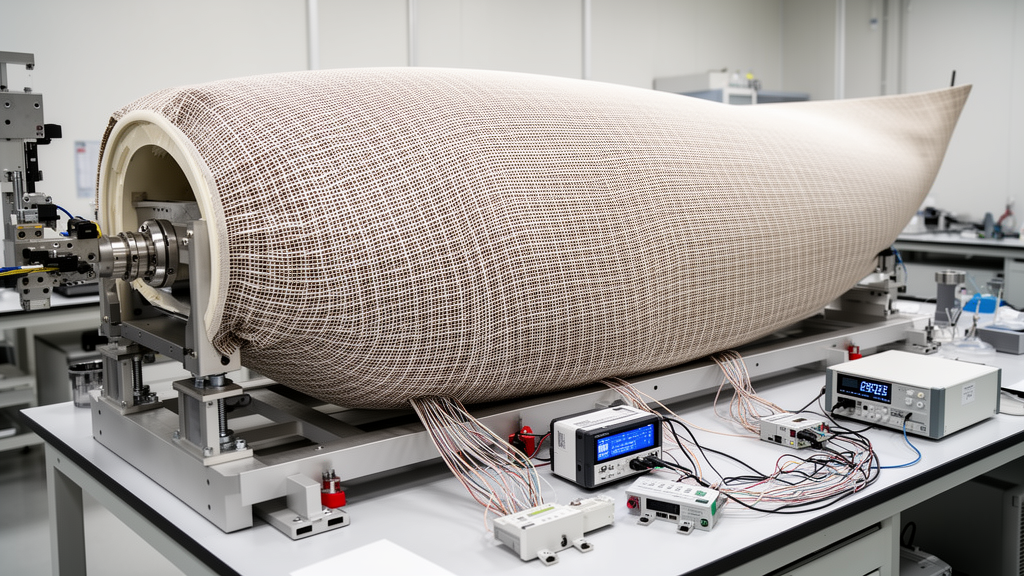
A textile-based piezoresistive sensor array has been developed for comprehensive stress mapping on ship hulls. This flexible 5 × 5 array successfully reconstructed stress patterns that align closely with finite element simulations, achieving a coefficient of determination of R² = 0.96. The sensor array effectively captured both low-amplitude wave-induced stresses and high-amplitude slamming transients when installed on stress-concentrated areas of a ship hull, as detailed in the Journal of Materials Science.
Traditional structural monitoring systems, such as strain gauges and fiber Bragg gratings, offer limited coverage due to their discrete nature and complex system requirements. These systems often struggle with conforming to curved hull surfaces. The new sensor array addresses these challenges with a textile-compatible design featuring grid-structured sensing electrodes, allowing for extensive area coverage and real-time signal acquisition.
The electrodes are enhanced with MXene nanosheets and PEDOT:PSS, providing flexibility and numerous conductive pathways under pressure. This enables the sensor to detect changes in electrical resistance corresponding to applied loads. Screen-printed silver interdigitated electrodes facilitate signal readout, while thin poly(vinylidene fluoride) encapsulation layers protect the sensor from water without sacrificing flexibility.
A row–column addressing system manages the 25 pixels, minimizing crosstalk and enabling accurate spatial stress distribution reconstruction. Each pixel exhibits a sensitivity of 1,143.5 kPa⁻¹, with rapid response and recovery times of 10 milliseconds and a detection limit of 1 pascal. The array's performance closely matched finite element simulations, with an R² = 0.96.
The sensor array's marine durability was tested, retaining over 95% of its initial sensitivity after 15 days of salt-spray exposure and maintaining baseline drift below 3% during dynamic seawater cycling. While these results are promising, they do not guarantee equivalent durability across different hull designs or environmental conditions. The study offers a proof-of-concept for scalable, flexible ship structural health monitoring, rather than comprehensive operational performance data.
Source: MXenes