Machine learning proves graphene is hydrophobic
Researchers at the Institute for Basic Science and Korea University used machine-learning interatomic potentials to demonstrate that pristine graphene is intrinsically hydrophobic, with apparent hydrophilic behavior in prior experiments caused by water molecules intercalating beneath monolayer graphene and canceling spectroscopic signals. The findings clarify graphene's true interfacial properties, with direct implications for graphene-based desalination membranes, nanofluidic devices, and fuel cells where unintended water intercalation must be accounted for in design.
Graphene, the one-atom-thick material noted for its exceptional properties, has long puzzled scientists regarding its interaction with water. For over a decade, experiments have shown conflicting results about whether graphene is hydrophobic or hydrophilic, impacting its applications in areas such as desalination membranes and hydrogen fuel cells.
A collaborative research team led by Director Cho Minhaeng and Professor Stefan Ringe at the Center for Molecular Spectroscopy and Dynamics, Institute for Basic Science, alongside Korea University, has addressed this issue using machine-learning-enhanced molecular simulations. Their findings, published in Nature Communications, confirm that pristine graphene is intrinsically hydrophobic.
The concept of wetting transparency, where graphene acts like an invisible window due to its atomic thickness, was proposed to explain previous contradictory findings. This theory suggested that graphene does not have a defined wettability, as water interacts with the substrate beneath rather than the graphene itself.
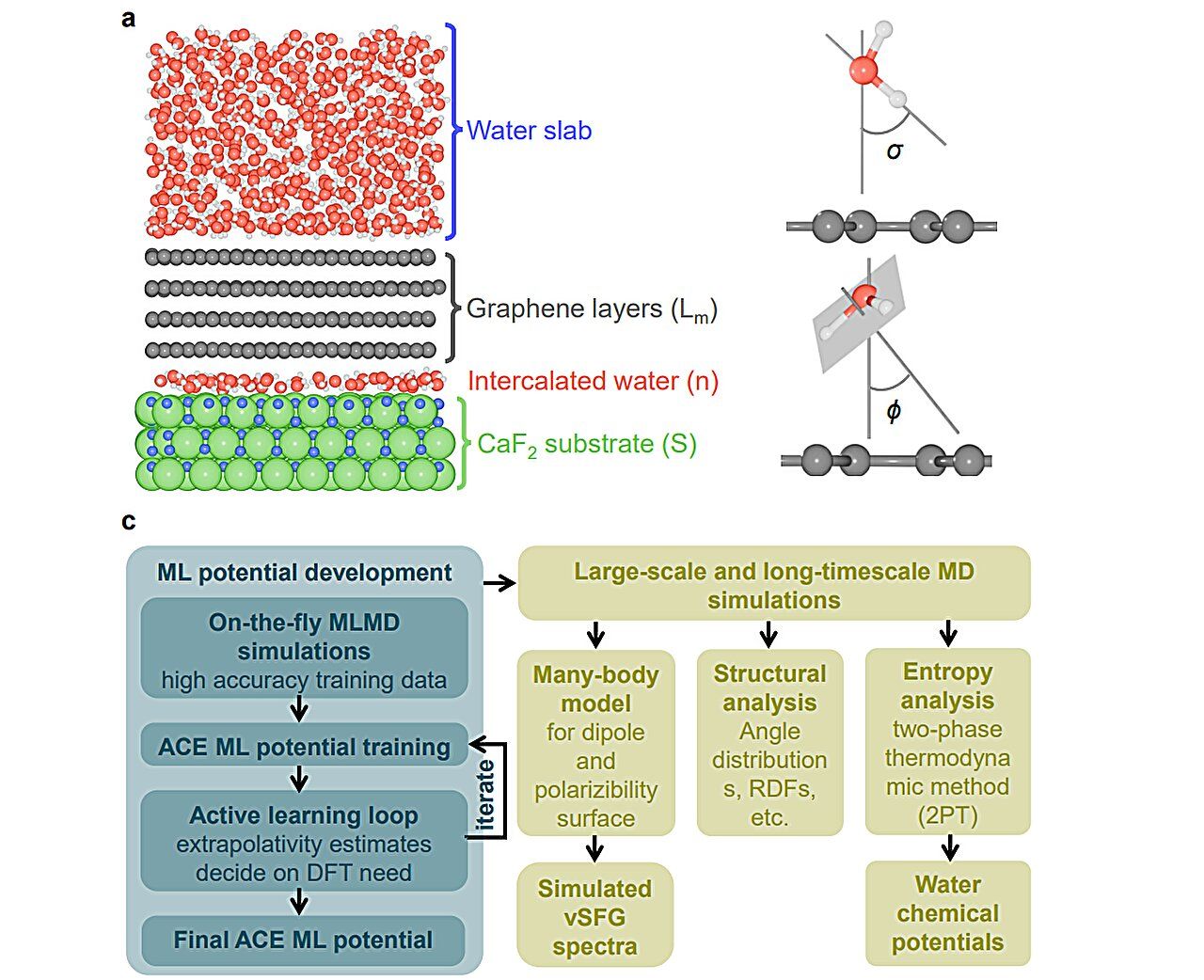
Testing this hypothesis at the atomic level has been challenging. Traditional measurements provide only macroscopic insights, failing to capture the behavior of individual water molecules at the interface. The research team developed machine-learning interatomic potentials, achieving near first-principles accuracy in simulations, to model water's structure and behavior at graphene interfaces.
The simulations revealed that water molecules near graphene exhibit characteristics of hydrophobic surfaces, such as dangling O–H bonds. These features become more pronounced with increased graphene layers, indicating stronger hydrophobicity in thicker graphene.
The study identified that intercalated water, trapped between graphene and its substrate, plays a key role. In monolayer graphene on hydrophilic substrates, water can slip beneath, forming a confined interfacial layer. This affects experimental readings, creating the illusion of hydrophilicity due to signal cancellation.
Professor Stefan Ringe noted that the apparent hydrophilic behavior of supported graphene is due to trapped water, not the graphene itself. The study also highlights a thickness-dependent transition, with multilayer graphene acting as a robust water-repellent barrier, while monolayer graphene appears hydrophilic under certain conditions.
Director Cho emphasized the practical implications for graphene-based technologies, which rely on controlling water at interfaces. The study shows the necessity of considering unintended water intercalation in device design. It also underscores the importance of experimental conditions, as water can re-enter beneath monolayer graphene during measurements.
The research demonstrates how machine-learning-enhanced simulations can resolve complex interfacial phenomena. By bridging quantum accuracy and large-scale modeling, the team isolated the effects of substrates, graphene thickness, and confined water. The findings redefine graphene as an active, intrinsically hydrophobic material influenced by nanoscale water layers.
Source: original article