Microwave curing of carbon composites depends on fiber alignment
Researchers used a modified domestic microwave to cure carbon fiber composites, finding fiber orientation significantly affects power absorption and temperature distribution. Y-oriented panels required 21% less energy.
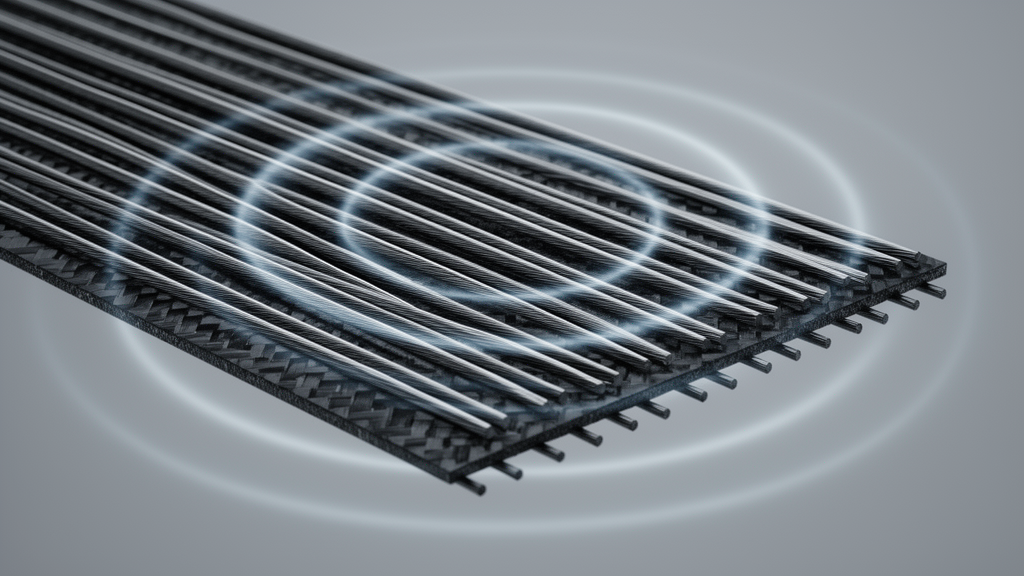
The production of high-performance carbon fiber reinforced polymer composites has traditionally depended on industrial autoclaves. These systems consolidate layers under high pressure and heat, ensuring low void content and strong mechanical integrity, crucial for aerospace applications where strength-to-weight ratios are critical. However, autoclaves are costly, energy-intensive, and time-consuming. As a result, researchers have been investigating alternative methods, such as microwave curing, which heats materials volumetrically through electromagnetic interaction rather than surface convection. Despite its promise, industrial microwave systems can be complex and expensive, prompting research into simpler setups using modified domestic microwave ovens. Recent studies have shown that the alignment of conductive fibers relative to the electromagnetic polarization in the microwave cavity significantly affects power absorption, thermal gradients, and polymer crosslinking.
A research team conducted experiments on sixteen-layer unidirectional carbon fiber composite laminates made from aerospace-grade Cycom 5320-1 epoxy prepreg. Each laminate was 250 mm by 250 mm with a thickness of 2.5 mm, prepared using hand lay-up techniques and debulked under 14 psi of vacuum pressure before thermal processing. The panels were cured in a modified Panasonic NN-SN966S microwave oven, with a cavity size of approximately 470 mm square by 278 mm in height, operating at 2.45 GHz with a peak power output of 1250 watts. The standard turntable was removed to fit fiber optic temperature sensors, and a custom metallic paddle stirrer was used to promote uniform heating by rotating at 12 RPM.
Due to the computational demands of resolving electromagnetic wave propagation, heat transfer, and chemical kinetics simultaneously, the researchers developed a two-part multiphysics model using COMSOL Multiphysics. The first model solved the frequency-domain Maxwell equations at 2.45 GHz, establishing electric field distributions and power dissipation. This data was then used in a time-domain model to simulate transient heat conduction and cure kinetics within the laminate and surrounding materials. This approach allowed for a detailed computational mesh within the composite plies, capturing steep gradients without excessive memory use.
The electromagnetic model accounted for the anisotropic properties of unidirectional carbon fiber systems. The epoxy matrix heats through dielectric relaxation, while the carbon fibers experience resistive Joule heating. Electrical conductivity along the fiber direction was set at 500 siemens per meter, with transverse conductivity at 7.5 siemens per meter. These parameters resulted in an electrical penetration depth of 455 microns along the fiber axis and 3.8 mm across the transverse direction. This meant that when electric fields aligned with the fibers, interactions were limited to the outermost layers, while transverse fields penetrated the entire laminate.
Experimental results showed that panel orientation within the cavity significantly impacted heating efficiency and power consumption. Panels with fibers aligned parallel to the x-axis required 332 watts of power, while those aligned in the y-direction needed only 274 watts, a 21% reduction. Temperature monitoring revealed that x-oriented panels had temperature differentials of up to 50°C, while y-oriented panels maintained a gradient of about 13°C. The thermal predictions closely matched experimental data, with a root mean square error below 3%.
The electromagnetic model accurately predicted power absorption ratios between orientations, with y-oriented panels absorbing 1.289 times more power than x-oriented ones, closely matching the experimental ratio of 1.212. Conservation checks confirmed that the Poynting flux through the waveguide port matched the volume dissipation within the laminate to within 0.53%. The time-averaging method was validated as the stirrer's rotation period was much shorter than the thermal diffusion time, limiting temperature fluctuations.
The study found that the rotating mode stirrer could not homogenize absorption due to the material's electrical conductivity tensor. In x-oriented panels, power absorption was split between fiber and transverse directions, while y-oriented panels absorbed more energy transversely. Despite high axial conductivity, electromagnetic field exclusion along the fiber axis limited absorption, making field alignment crucial for uniform curing.
Simulations of polymer reaction kinetics showed that uneven energy absorption affected matrix crosslinking. The x-oriented panel had uneven cure progression, while the y-oriented panel achieved more uniform curing. This highlights the risk of producing components with heterogeneous resin conversion and residual stresses if field alignment is inadequate.
Parametric and sensitivity analyses were conducted to test the robustness of the findings. Adjusting the stirrer height affected electric field strength, and varying carbon fiber properties showed minor effects on absorption ratios. Grid refinement confirmed numerical convergence, with power absorption changes of about 1% and increased computation times.
The research demonstrated the potential of modified domestic microwave curing for 2.5-mm composite laminates but noted technical constraints remain.
Source: Carbon Fiber Feed