Basalt fibers boost polymer strength and enable carbon nanotube self-sensing
Researchers enhanced polymer composites by adding basalt fibers to a carbon nanotube matrix, achieving a three-order-of-magnitude increase in electrical conductivity at 40% basalt fiber content.
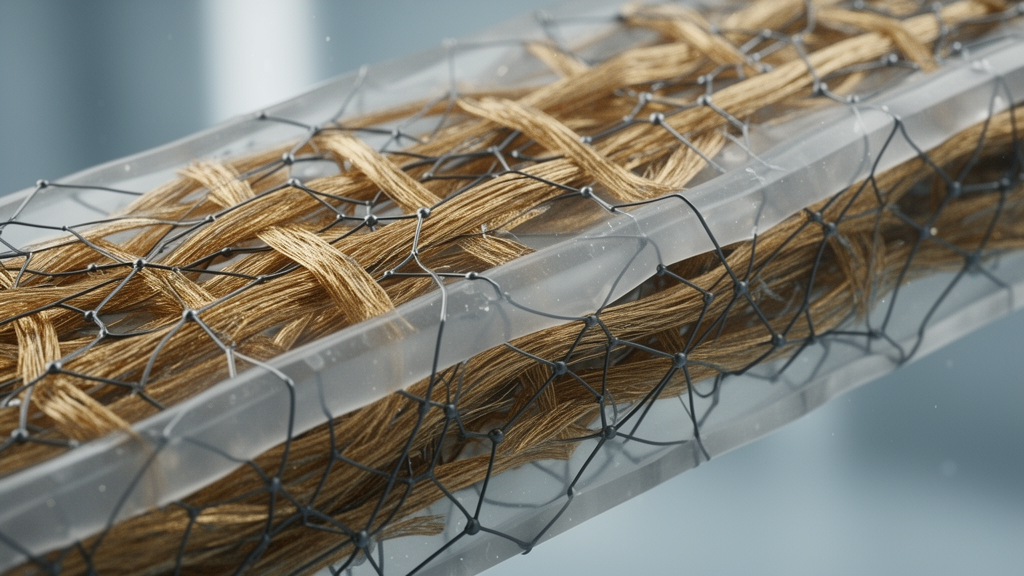
A recent study published in the Journal of Materials Science: Composites has revealed that integrating basalt fibers into a carbon nanotube and polyarylene ether nitrile matrix significantly enhances mechanical properties and enables real-time electrical damage self-sensing. Researchers Libing Liu, Dong Xiang, Jingxiong Ma, Zhiyuan Liu, Guoqian Xie, Yusheng Gong, Chunxia Zhao, Hui Li, Bin Wang, and Yuanpeng Wu conducted the study by maintaining the multi-walled carbon nanotube content at 0.5 weight percent while varying the basalt fiber content from 10 to 50 weight percent. This approach capitalized on a volume exclusion effect within the thermoplastic matrix, allowing the carbon nanotubes to form continuous percolating networks at minimal filler fractions. The composite demonstrated simultaneous improvements in tensile strength, flexural strength, and flexural modulus, along with a three-order-of-magnitude increase in electrical conductivity when the basalt fiber content reached 40 weight percent.
Fiber-reinforced polymer composites are widely used in aerospace, rail transportation, civil construction, and energy equipment due to their high specific strength, lightweight nature, and corrosion resistance. However, components made from basalt fiber reinforced polymer composites face repeated mechanical loading and operational stresses, potentially leading to undetectable microscopic damage and matrix microcracks. These internal damages, if unchecked, can pose severe safety hazards and risk catastrophic component failure. While online structural health monitoring is crucial for early fracture warnings, traditional detection methods have significant drawbacks. Acoustic emission testing is susceptible to ambient noise and requires stable sensors and experienced personnel, while piezoelectric and fluorescence monitoring techniques have limited sensitivity.
Piezoresistive resistance measurement technology offers a promising alternative for structural health monitoring due to its simplicity and high diagnostic sensitivity. This method involves distributing electrically conductive nanomaterials throughout an insulating polymer matrix to create a percolating conductive network. Mechanical strains and microscopic damage alter these pathways, allowing engineers to evaluate structural integrity through measurable shifts in electrical resistance. However, since basalt fibers and polyarylene ether nitrile matrices are electrically insulating, conductivity usually requires the infusion of conductive carbon nanomaterials. Previous attempts involved coating basalt fabrics with graphene oxide or depositing carbon nanotubes electrophoretically, but these methods often left the bulk resin matrix without sensing capabilities.
To address the balance between mechanical reinforcement and electrical sensing without excessive conductive additives, the research team developed a composite formulation using bisphenol A type polyarylene ether nitrile, multi-walled carbon nanotubes, and chopped basalt fibers. The carbon nanotubes, sourced from Nanocyl S.A., had an average outer diameter of 9.5 nanometers and an average length of 1.5 micrometers. The basalt fibers, provided by Sichuan Qianyi Composites Company, had an average filament diameter of 15 micrometers and a length of 3 millimeters. The polyarylene ether nitrile resin was supplied by Sichuan Energy Investment New Chemical Materials Company. The multi-walled carbon nanotube concentration was kept at 0.5 weight percent, while the basalt fiber fraction varied from 10 to 50 weight percent.
The composites were prepared using a sequential melt-mixing and two-step hot-pressing process to minimize defects and ensure uniform filler distribution. Before compounding, the basalt fibers underwent desizing, and the carbon nanotubes were pre-mixed with the resin powder. This mixture was processed in a computer-controlled torque rheometer, where the basalt fibers were added to the molten blend. Compounding occurred at 280 degrees Celsius with a rotor speed of 60 revolutions per minute for 15 minutes. The blend was then hot-pressed at 280 degrees Celsius and 10 megapascals for 10 minutes to form a composite film. After cooling, the sheet was granulated and hot-pressed again under the same conditions for 60 minutes to produce test specimens.
Mechanical performance was assessed through tensile and three-point flexural tests at room temperature using a universal testing machine with a 10-kilonewton load cell, following ISO 527 and GB/T 1449-2005 standards. Results showed that increasing basalt fiber content improved strength and flexural stiffness. The composite with 10 weight percent basalt fiber had a tensile strength of 105 megapascals, flexural strength of 137 megapascals, and flexural modulus of 3553 megapascals. At 50 weight percent, tensile strength rose to 146 megapascals and flexural strength to 173 megapascals, with a 167.7 percent increase in flexural modulus to 9512 megapascals.
Scanning electron microscopy at 20 kilovolts after gold sputtering provided insights into the fracture surfaces and filler architecture. Micrographs showed uniform dispersion of basalt fibers, with density increasing with fiber content. The BF-10% composite displayed a rough, ductile failure zone, while higher fiber content composites showed smooth, brittle fracture surfaces. Damage modes included fiber-matrix debonding, fiber pull-out, and matrix microcracking, with fiber agglomerates acting as stress concentration sites.
Electrical conductivity measurements using a two-point method revealed a non-monotonic relationship with basalt fiber concentration. The BF-10% composite had a conductivity of 1.2 × 10^-8 Siemens per meter. Conductivity increased with fiber content, reaching 9.6 × 10^-5 Siemens per meter at 40 weight percent, a three-order-of-magnitude improvement. Current-voltage curves confirmed ohmic behavior, with BF-40% showing the lowest resistance. Morphological analysis indicated that non-conductive basalt fibers restricted the matrix volume, forcing carbon nanotubes into conducting pathways, while 50 weight percent disrupted network continuity.
The BF-40% composite was selected for real-time damage detection under tensile and flexural stresses, synchronizing resistance measurements with acoustic emission monitoring. Under tensile testing, deformation progressed through elastic, damage initiation, and fracture stages. Relative resistance change increased linearly in the elastic stage, with acoustic signals around 35 decibels. In the damage stage, resistance fluctuated sharply as acoustic counts rose, and in the fracture phase, resistance spiked with acoustic bursts reaching 100 decibels.
Cyclic electromechanical evaluations confirmed the BF-40% composite's diagnostic reliability and signal stability under varying conditions. Cyclic tensile loading at 1.0 percent strain across different rates showed identical resistance profiles, indicating rate independence and no hysteresis. Endurance testing verified stable piezoresistive signaling across 1500 tensile and bending cycles. The study highlighted the composite's multifunctional performance without costly nanofiller loading, though the authors noted weak interfacial bonding between basalt fibers and the matrix, suggesting future research directions.
Source: Carbon Nanotubes Feed