Biochar and river mud recycling reduce emissions in traditional silk dyeing
Researchers found that integrating microbial river mud recycling and biochar production in gambiered silk manufacturing reduces emissions by 30.7%, transforming the process into a net-positive carbon system.
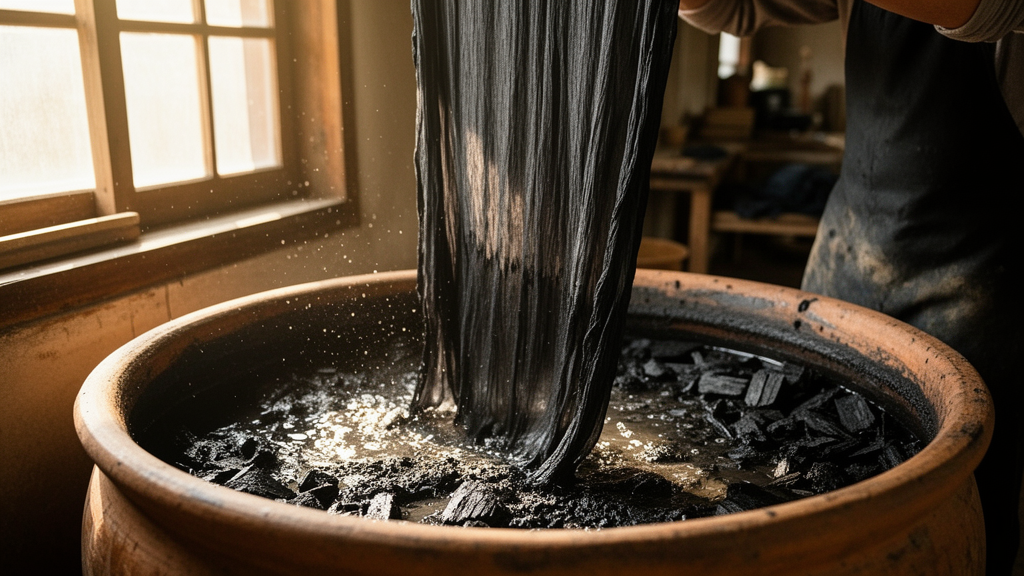
A detailed life cycle assessment of gambiered silk production has shown that combining microbial river mud recycling with biochar conversion from plant residues can transform this energy-intensive traditional textile craft into a sustainable system with a net-positive carbon budget. Gambiered silk, also known as xiangyunsha, is a natural-dye-based textile from southern China that primarily uses natural bio-based materials instead of synthetic chemicals. While natural dyeing is gaining global interest as an eco-friendly alternative to synthetic textiles, there have been few quantitative evaluations of its environmental impact. Researchers conducted a rigorous life cycle inventory at a facility in Shunde District, Foshan City, to assess ecological hotspots, economic costs, and greenhouse gas balances in both baseline and optimized manufacturing setups. The study found that while current practices have significant ecological impacts, circular resource strategies offer substantial mitigation benefits.
Xiangyunsha production, originating in southern China, involves a multi-step artisanal process that combines organic plant extracts with mineral-rich sediment. The process starts with harvesting dye yam tubers, scientifically known as Dioscorea cirrhosa Lour., from the mountainous terrain of Fangchenggang in Guangxi Province. These tubers, containing tannin concentrations of 11 to 31 percent, produce a reddish-brown dye valued for its antibacterial and insect-repelling properties. The raw tubers are transported approximately 600 kilometers to Shunde District. The dye extraction yield from these yams is only 13.53 percent, resulting in large amounts of fibrous biomass residue, which has traditionally been burned or composted.
The fabric processing involves repeated immersion of pre-scoured silk textiles in diluted dye baths, followed by manual handling to enhance tannin penetration. The soaked fabric is spread across grassy fields under intense sunlight, promoting the oxidative condensation of catechin-based polyphenols. Depending on the desired textile grade, this cycle of dyeing, handling, and sunning is repeated 14 to 28 times, layering tannins and deepening the red-brown color. After sunning, the fabric undergoes mud coating, where iron-bearing river mud acts as a mordant. The ferrous and ferric ions in the mud chemically react with the tannins to form durable iron-tannin complexes, giving the fabric its deep hue, silky sheen, and additional properties like ultraviolet protection.
Despite using renewable inputs, traditional gambiered silk manufacturing has significant environmental burdens related to raw material sourcing and mechanical processing. In the baseline system, called Scenario 1, producing 350,000 meters of fabric annually resulted in a cumulative ReCiPe endpoint impact of 14.06 thousand points, or 0.0402 points per meter. Electricity consumption was the largest environmental hotspot, responsible for 8.82 thousand points or 63 percent of the total score. This is due to machinery used for grinding dye yam tubers, extracting plant juices, washing mud, and distributing it mechanically. Transporting raw plant tubers over 600 kilometers was the second largest contributor at 26.9 percent, with diesel fuel combustion accounting for 10.1 percent, mainly from dredging vessels extracting river sediments.
The traditional mordanting step requires large volumes of river mud from the Pearl River Delta. The ferrous iron content in these sediments is low, between 0.68 and 1.43 milligrams per gram, necessitating large sediment harvests. Only 5 to 10 percent of the iron in the mud reacts during fabric coating. Spent mud is typically discarded after one use, leading to continuous dredging that disrupts aquatic habitats and consumes fossil fuels. Dredging sites are left fallow for two to three years to recover, highlighting the need for closed-loop mineral management.
To address single-use extraction losses, researchers developed Scenario 2, which includes an on-site closed-loop system for regenerating spent sediment using microbial bioaugmentation. Runoff mud suspensions from fabric rinsing are directed into sedimentation basins, where mineral particles settle. The supernatant is discharged, and the mud slurry is pumped into bioreactors with the iron-reducing bacterium Shewanella decolorationis strain S12. This culture reduces ferric iron to ferrous iron over a seven-day cycle. Calculations indicate that complete utilization of mineral reserves could allow river sediment to be reused about 14 times.
Implementing microbial mud reactivation in Scenario 2 led to significant environmental improvements. The overall ReCiPe endpoint damage decreased by 28.9 percent compared to baseline conditions. Greenhouse gas emissions fell from 142,773.33 kilograms of carbon dioxide equivalent in Scenario 1 to 98,846.17 kilograms in Scenario 2, a 30.7 percent reduction.
Producing one metric tonne of biochar requires about 3.3 tonnes of dry yam biomass and 12 kilowatt-hours of energy. Pyrolyzing this waste under oxygen-limited conditions creates a stable, carbonaceous matrix that resists decomposition. Integrating biochar production increased the ReCiPe endpoint impact to 16.7 thousand points. Biochar equipment accounted for 40.2 percent of the damage, while electricity and transport contributed 36.6 percent and 22.6 percent, respectively. Midpoint emissions rose by 65.4 to 74.6 percent due to thermal processing.
Despite these emissions, carbon footprint analysis showed climate mitigation benefits. In the baseline system, operations released 142.7 tonnes of carbon dioxide equivalent with no sequestration. Mud recycling in Scenario 2 reduced net emissions to 98.8 tonnes. Scenario 3, with biochar production, added 68.2 tonnes of emissions but sequestered 173 tonnes of carbon dioxide equivalent, resulting in a net carbon sink of 6.0 tonnes.
Economic modeling showed differences between fiscal costs and environmental hotspots. Producing 350,000 meters of silk annually costs about 0.76 million USD. Manual labor accounts for 78.1 percent of costs, with raw tubers at 18.2 percent. Scenario 2 reduced costs to 0.75 million USD by decreasing mud procurement. Scenario 3 was the most economical at 0.73 million USD, as biochar sales offset textile manufacturing costs.
Sensitivity analyses focused on raw material transport and sediment reuse. Extending transport distance for yams from 200 to 800 kilometers increased ReCiPe scores from 14.1 to 17.9 thousand points, impacting human health. Increased trucking negated biochar sequestration, turning the factory from a net sink to a net source of emissions. Increasing mud reuse from one to 14 cycles reduced endpoint damage from 20.8 to 16.7 thousand points, shifting the carbon balance from minus 38.0 tonnes to positive 6.0 tonnes. However, improvements plateaued, indicating practical recycling targets must balance reactivation kinetics, color quality, and fabric feel.
Applying these findings to China's gambiered silk sector, which produces 50 million meters annually, circular interventions could conserve resources significantly. Meeting demand requires 33,660 tonnes of sediment and 92,857 tonnes of yams annually. Extending sediment reuse by one cycle would save 16,830 tonnes of dredging, while two cycles would save 22,440 tonnes. Nationally, sediment recycling could prevent 6,258 tonnes of carbon dioxide equivalent annually, while biochar conversion could sequester 857 tonnes. Beyond carbon mitigation, biochar can immobilize heavy metals in soils and purify wastewater, offering a framework for preserving cultural heritage alongside environmental sustainability.
Source: Biochar Feed