MXene-patterned electrode enhances flexible humidity sensor sensitivity
Researchers created a flexible, metal-free humidity sensor using Ti3C2Tx MXene electrodes and a TiO2 nanosheet layer, achieving 4.41 × 10^5 ohms/percent sensitivity at 1 kHz.
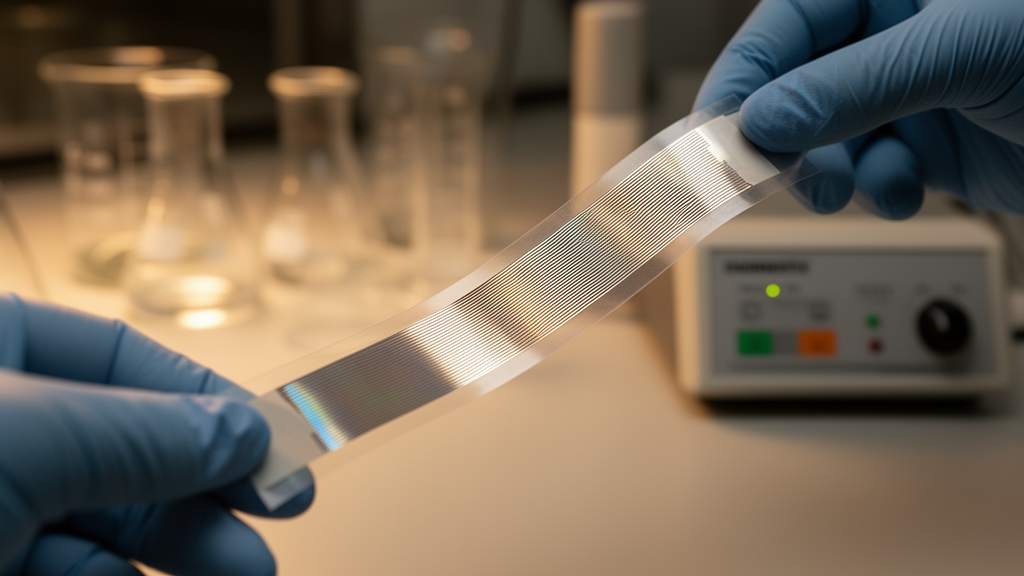
Researchers have introduced a flexible, metal-free humidity sensor that integrates lithographically patterned electrodes made from two-dimensional Ti3C2Tx MXene nanosheets with an ultrathin active layer of 2D anatase TiO2 nanosheets. This innovative device is constructed on a cyclic olefin copolymer substrate and is detailed in the journal Advanced Composites and Hybrid Materials. It offers a highly linear and reversible impedance and capacitance response over a wide humidity range of 6 to 86 percent relative humidity.
The sensor's performance metrics are noteworthy, achieving a sensitivity of 4.41 × 10^5 ohms per percent relative humidity at a measurement frequency of 1 kilohertz. It exhibits low hysteresis and minimal output variation over a 24-hour period. The research team attributes the sensor's fast and repeatable response and recovery characteristics to the rapid transport of protons through the water adsorbed on the sensing layer.
Each component in the sensor's stack has a specific function. The solution-processed MXene interdigital electrodes deliver high electrical conductivity, mechanical strength, and scalable patterning, which replaces traditional metal electrodes and ensures the device remains free of metallic components. The TiO2 nanosheet film provides a continuous, hydroxyl-rich, and chemically robust surface network that facilitates reversible water adsorption, crucial for humidity detection.
To further understand the device's superior performance, the researchers employed computational modeling. These theoretical insights closely align with the experimentally observed fast and repeatable response and recovery behavior, offering a mechanistic explanation for the sensor's high performance.
The choice of substrate is as important as the materials used. The sensor, built on a flexible cyclic olefin copolymer film and utilizing an all-two-dimensional-materials architecture, can bend and flex without losing functionality, making it ideal for wearable applications.
Linearity has been a longstanding challenge in resistive and impedance-type humidity sensing, where poor linearity hampers rapid and precise detection. This sensor addresses the issue by maintaining a linear impedance response across its operating range, which the authors highlight as crucial for next-generation wearable electronics and environmental monitoring.
The research also suggests a broader design strategy. By combining patterned MXene electrodes with an engineered two-dimensional sensing layer, the researchers present a scalable approach to creating metal-free, flexible humidity sensors.
The study is published as open access, with the version shared early to provide quicker access to peer-reviewed, accepted research. It includes a permanent DOI and may undergo further edits before the final version of record is published. For researchers focused on wearable and intelligent sensing systems, this sensor offers a promising platform: a fully two-dimensional, flexible, metal-free device with measured sensitivity, linearity, and fast response supported by both experimental characterization and simulations.
Source: MXenes