Nanotube chirality set early and preserved during growth shows structural memory
Researchers found that the chirality of carbon nanotubes is established early in their formation and remains unchanged throughout growth.
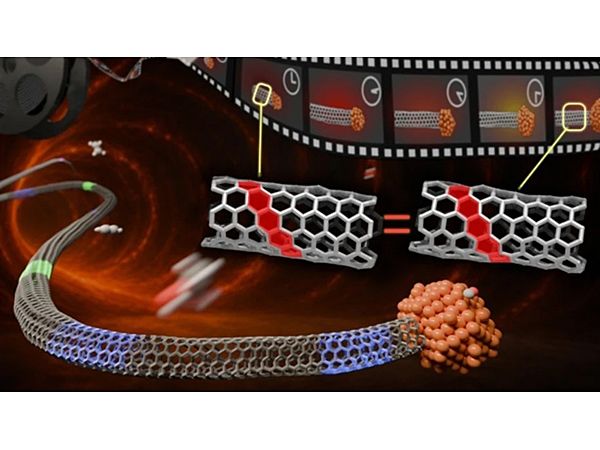
Researchers at the University of Tokyo, led by Assistant Professor Keigo Otsuka, have demonstrated that the chirality of carbon nanotubes is established early and remains unchanged during growth, even as catalyst particles change in size and environmental conditions fluctuate. This discovery, published in Nature Communications, suggests that the structural determination and elongation processes of nanotubes can be independently designed.
Carbon nanotubes exhibit either metallic or semiconducting properties based on their chirality, making precise structural control crucial for specific applications. The floating catalyst chemical vapor deposition (FCCVD) process, commonly used in industry, involves synthesizing nanotubes as catalyst nanoparticles traverse a reaction tube, experiencing varying temperatures and feedstock gas concentrations. Traditionally, it is believed that larger catalyst particles yield wider nanotubes, with previous studies indicating that nanotube diameters can change in response to these variables.
The research team investigated whether nanotube structure is affected by catalyst particle growth. Given the difficulty of directly monitoring catalyst particles during growth, they used nanotube growth rates as a proxy for catalyst size, as growth rate correlates with catalyst particle surface area. By applying a digital isotope labeling technique, they recorded the growth history of each nanotube, using carbon isotope labels and Raman scattering spectra to gather data on both catalyst particles and nanotubes.
Using iron catalyst particles on a substrate, the team synthesized carbon nanotubes while varying furnace temperatures between 800℃ and 873℃. They observed that even when the growth rate doubled due to catalyst coarsening, the nanotube maintained its chirality over a length exceeding 150 µm. Analysis of a total nanotube length of 9.4 mm showed chirality changes occurred only once every 400 µm on average, akin to steady-state growth conditions.
Molecular dynamics simulations confirmed that nanotubes continued to elongate while preserving chirality, despite increasing catalyst particle size. Chirality changes require defects like five- and seven-membered carbon rings, but these defects are removed on the catalyst surface before incorporation into the nanotube wall, maintaining the initial chirality.
The findings reveal a structural memory in carbon nanotubes, where chirality is set early and retained throughout growth, even with evolving catalyst particles. This suggests that post-growth observations alone cannot fully explain how nanotube diameter is influenced by catalyst size. From an industrial standpoint, the research supports strategies for independent control of nanotube structure and yield optimization, potentially guiding synthesis processes for high structural quality and productivity.
Source: Carbon Nanotubes Feed