Porous graphene networks improve lithium-ion battery speed and efficiency
Researchers at Yokohama National University improved lithium-ion battery performance by adding graphene mesosponge, enhancing energy and power densities through better electron and ion transport.
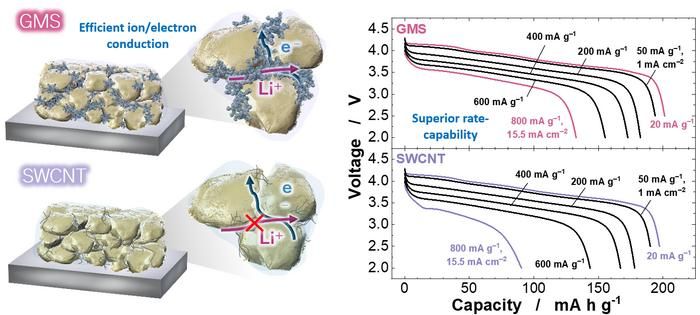
Researchers at Yokohama National University have demonstrated the potential of graphene mesosponge (GMS) to enhance the performance of commercial lithium-ion batteries. The unique mesoporous structure of GMS facilitates three-dimensional electron and ion transport in densely packed battery electrodes, thereby improving energy and power densities. This advancement addresses the challenge of maintaining efficient electron and ion movement in high-loading electrodes, which is crucial for high-energy-density lithium-ion batteries.
The study, published in Advanced Energy Materials on October 8, 2026, highlights the role of GMS in enabling fast discharge rates by providing a conductive carbon framework that supports electronic conduction. The mesopores within GMS accommodate electrolytes, promoting ionic transport and enhancing rate performance under high current densities.
In pursuit of more sustainable energy solutions, scientists are focused on developing lithium-ion batteries with higher energy densities. Current commercial batteries are limited by the positive electrode, which restricts energy density. Researchers are exploring high-performance active materials for these electrodes, but challenges remain, particularly with materials like pure nickel oxide, which degrade under high voltage.
To improve battery energy density, scientists aim to increase active materials while reducing non-conductive components like additives and binders. However, this often results in inefficient electron flow. "Achieving efficient electron and ion transport in high-loading, densely packed electrodes remains a major challenge for high-energy-density lithium-ion batteries," explained Naoaki Yabuuchi, a professor at Yokohama National University.
The research team compared three carbon materials—acetylene black, single-walled carbon nanotube, and graphene mesosponge—as potential conductive additives. They found that GMS, with its sponge-like mesoporous framework, effectively enhances electrode microstructure. A small addition of GMS forms three-dimensional networks that improve battery efficiency by allowing electrolytes to penetrate deeply into energy-storing regions. "The porous GMS architecture forms a three-dimensional electron- and ion-transport network, with electrolyte retained within its mesopores facilitating ion transport and resulting in superior rate capability," said Yabuuchi.
Using FIB-SEM tomography, the team demonstrated that GMS creates a uniformly distributed internal structure in battery electrodes. This nanoscale sponge-like structure allows electrons to move freely, offering a promising strategy for maximizing battery performance. "Our results demonstrate that graphene mesosponge is a transformative conductive additive for simultaneously improving energy and power densities in practical lithium-ion batteries through rational microstructural design of dense composite electrodes," Yabuuchi noted.
The research team, including members from Yokohama National University, Yonsei University, and 3DC Corporation, continues to explore the potential of GMS. "Our ultimate goal is to achieve fast-charging capability with a graphite negative electrode, thereby enabling the development of practical lithium-ion batteries that combine high energy density, high power density, and fast-charging capability," Yabuuchi added.
This research is supported by the Japan Society of the Promotion of Science and the Japan Science and Technology Agency.
Source: Graphene Feed