Researchers use reduced graphene oxide electrodes to build compact tunable soft lens
Researchers at Queen Mary University of London created compact, electrically tunable soft lenses using transparent electrodes made from reduced graphene oxide.
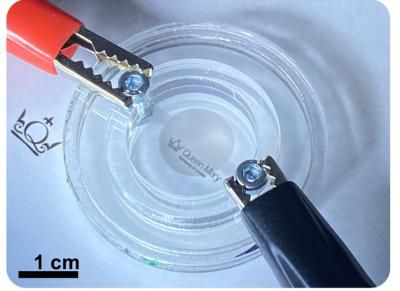
Researchers at Queen Mary University of London have developed transparent electrodes using reduced graphene oxide (rGO) for dielectric elastomer actuators (DEAs), facilitating a compact, electrically tunable soft lens. This innovation addresses a design challenge in electrostatically actuated lenses, where opaque electrodes traditionally needed placement around the lens periphery, rather than on the optical path.
DEAs function as soft electromechanical transducers, similar to artificial muscles. A dielectric elastomer membrane, positioned between compliant electrodes, contracts in thickness and expands laterally when an electric field is applied. These actuators are being explored for applications in tunable lenses, adaptive filters, and other reconfigurable optical devices. The use of transparent electrodes allows the electrode to sit directly on the optical axis, eliminating the need for a separate actuation ring and reducing the device's footprint.
The research team applied an rGO ink, dispersed in THF, to a pre-stretched acrylic elastomer membrane (VHB 4905), creating electrodes with surface densities ranging from 0.10 to 0.17 µg/mm². Increasing the rGO density reduced sheet resistance from approximately 600 to 15 kΩ/sq but also decreased optical transmittance at 550 nm from about 42% to 17%, highlighting the trade-off between conductivity and transparency in thin conductive coatings.
For their lens demonstration, the researchers chose a surface density of 0.12 µg/mm², achieving around 32% transmittance and an area strain of about 10% at a driving field of 50 V/µm. The rGO-coated DEA was bonded to a 12.5 mm-wide plano-convex PDMS lens. Applying voltage stretches the lens radially, increasing its focal length and shifting the focus point across a 30-36 mm range in the prototype. The transparent electrode's direct placement on the lens maintains a compact form factor.
The study's first author, Giacomo Sasso, noted potential future applications in autofocus cameras, wearable displays, and virtual reality headsets, where traditional focusing systems add weight and complexity. Second author Alec Lamoreux emphasized that combining electrically active polymers with graphene's properties offers new design approaches for optical systems.
The authors identified electrode uniformity as a key area for improvement. Current limitations due to agglomeration and non-planar orientation of rGO flakes affect transmittance and actuation strain. Enhancing coating uniformity could improve performance and potentially expand the lens's focusing range.
Source: Graphene Feed