Sterilization Alters Properties of FDM-Printed Carbon Fiber Composites
Researchers found that sterilization processes can alter the properties of carbon fiber-reinforced polycarbonate parts made through fused deposition modeling, impacting their suitability for medical use.
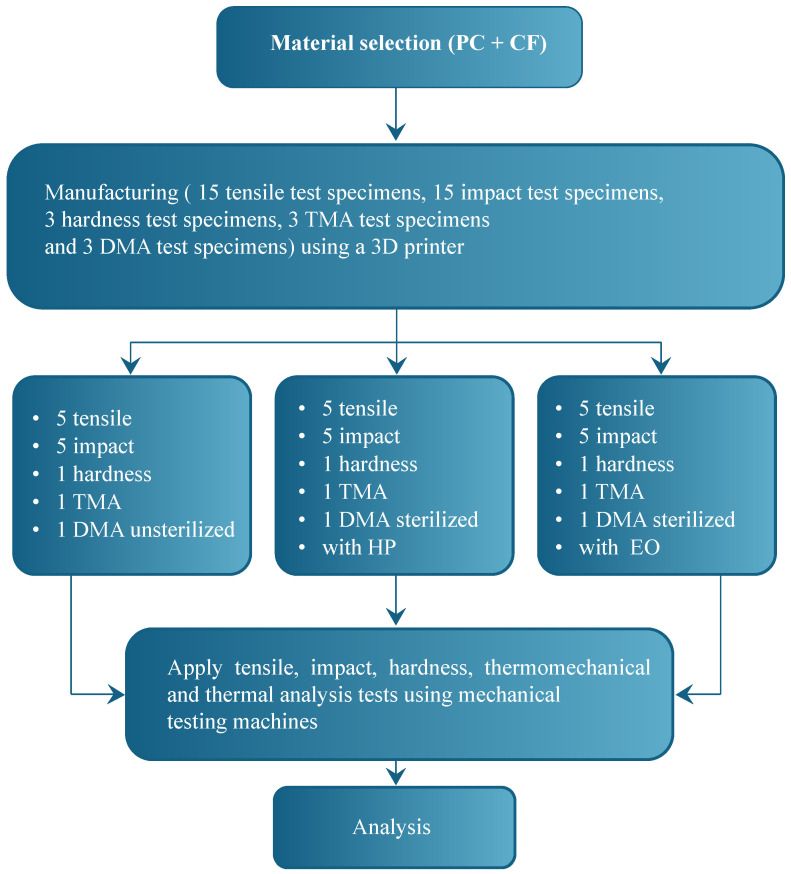
Fused deposition modeling (FDM) of carbon fiber-reinforced polycarbonate (PC-CF) is gaining traction in medical applications due to its favorable strength-to-weight ratio and adaptability for custom geometries. However, sterilization is a critical step that may affect the structural integrity of polymer composites. This study examines the impact of two low-temperature sterilization methods—ethylene oxide (EO) and hydrogen peroxide vapor (HP)—on the mechanical, thermal, and viscoelastic properties of FDM-printed PC-CF parts. Characterization included tensile, impact, and hardness tests, as well as thermomechanical analysis (TMA) and dynamic mechanical analysis (DMA). EO sterilization resulted in approximately 20% reduced elongation at break and lower glass transition temperature, indicating a loss of ductility and thermal stability. HP-treated samples showed reduced stiffness (16% in Young's modulus) but increased Tg and reduced thermal expansion, suggesting improved dimensional stability. DMA results confirmed distinct viscoelastic behavior between treatment types. These findings provide evidence for selecting appropriate sterilization protocols for FDM-manufactured PC-CF components used in functional medical devices.
Additive manufacturing (AM), particularly FDM, has emerged as a transformative technology in various fields, including biomedical engineering. Its ability to fabricate customized components with complex geometries from a wide range of materials has redefined the design and production of medical devices, enabling personalized solutions that meet the anatomical and functional needs of individual patients.
A critical challenge in the implementation of 3D-printed medical components is sterilization, a mandatory step to eliminate pathogenic microorganisms and ensure safety in clinical environments. However, sterilization procedures, especially those involving chemical or thermal agents, may significantly alter the thermal, mechanical, and morphological properties of polymer-based materials, potentially compromising their structural integrity and long-term performance.
Among the advanced materials suitable for 3D printing in healthcare, carbon fiber-reinforced polycarbonate (PC-CF) has gained attention due to its superior mechanical strength, stiffness, and dimensional stability. These properties make PC-CF an attractive candidate for functional medical components such as surgical guides, orthotic structures, and support fixtures. When processed by FDM, PC-CF offers a favorable strength-to-weight ratio and excellent thermal behavior, although its anisotropic, layered microstructure may influence its response to external post-processing treatments, including sterilization.
Despite the growing interest in PC-CF for medical applications, there is a notable lack of systematic studies assessing the effects of widely used sterilization methods on its functional properties. In particular, the influence of low-temperature sterilization techniques such as ethylene oxide (EO) gas and hydrogen peroxide vapor (HP) remains poorly understood. These methods are commonly employed in hospital settings due to their compatibility with thermosensitive devices, but they may induce chemical, morphological, or structural changes in polymer composites. The absence of comprehensive data on their effects limits the safe and regulated deployment of FDM-fabricated PC-CF parts in clinical scenarios.
While sterilization effects have been extensively investigated in commonly used 3D-printed polymers such as PLA, ABS, and unfilled polycarbonate, carbon fiber–reinforced thermoplastic composites fabricated via FDM remain comparatively underexplored. The incorporation of short carbon fibers modifies heat transfer pathways, interfacial bonding mechanisms, stress distribution, and viscoelastic behavior, potentially altering the material’s response to chemical sterilization agents. Therefore, degradation mechanisms reported for neat polymers cannot be directly extrapolated to fiber-reinforced systems. Furthermore, direct comparative analyses between EO and HP sterilization in FDM-printed PC-CF composites are scarce, leaving uncertainty regarding their relative impact on structural and thermomechanical integrity.
To address this knowledge gap, the present study investigates the effects of EO and HP sterilization on the mechanical, thermal, and morphological behavior of PC-CF specimens fabricated by FDM. It is hypothesized that sterilization may induce physicochemical changes capable of altering the performance of the material. Accordingly, a full characterization was conducted before and after sterilization, including tensile, impact, and hardness tests; thermomechanical analysis (TMA); and microstructural evaluation.
By providing empirical evidence on material behavior under clinically relevant sterilization protocols, this research contributes to informed decision-making in the qualification of 3D-printed polymer composites for regulated medical use. The findings support the advancement of additive manufacturing technologies in healthcare by promoting safety, durability, and performance of printed components.
Source: Carbon Fiber Feed