The invisible layer that determines composite failure: interface science
Researchers are enhancing composite materials by integrating carbon nanotubes and graphene-based sheets at the interlaminar regions, potentially improving their failure resistance.
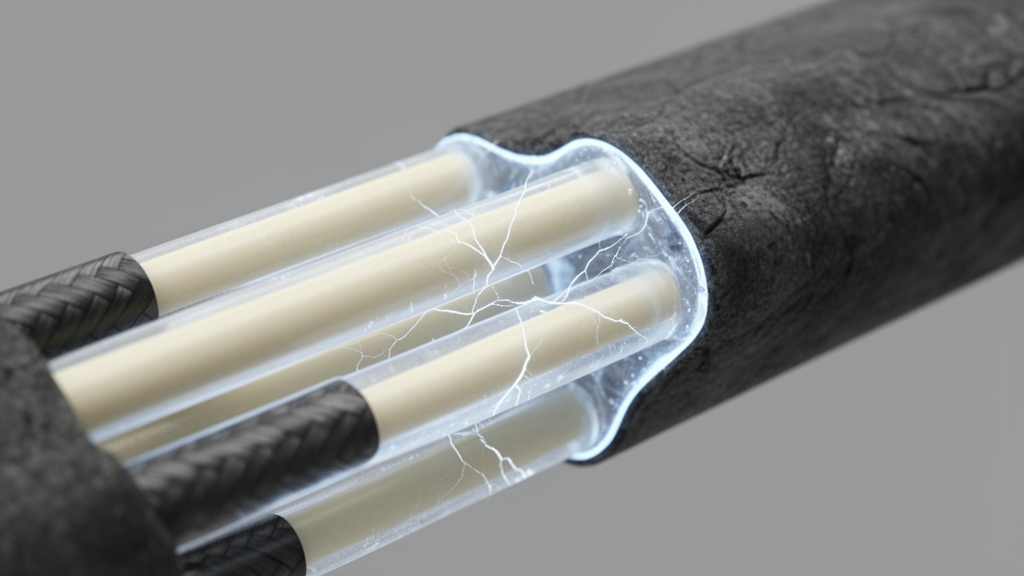
The interface between reinforcing fibers and the surrounding polymer matrix in carbon-fiber composites is critical to the performance of these materials. A recent review in Advanced Composites and Hybrid Materials, authored by Xinjie Mao, Zhiyong Zhao, and Ruobin Yan of Shandong University, highlights the importance of this interfacial region in fiber-reinforced polymer composites. The review examines the physicochemical mechanisms of bonding and failure, strategies for modifying the interface, and the potential for transforming it into a multifunctional platform.
The interfacial region is essential for load transfer from the compliant matrix to the strong fibers, which determines the composite's performance. A well-behaved interface allows composites to achieve near-theoretical strength and stiffness, while a poorly performing interface can lead to catastrophic failure. Understanding the behavior of this region is crucial for advancing composite technology.
The complexity of bonding at the interface arises from various mechanisms, including mechanical interlocking, van der Waals interactions, hydrogen bonding, and covalent bonds. These mechanisms depend on fiber type, sizing chemistry, matrix formulation, and processing conditions. The review emphasizes that interfacial design must be tailored to each material system, as no single bonding mechanism is universally dominant.
Failure modes at the interface are also analyzed, showing how they relate to overall material performance. A weak interface can lead to debonding and underperformance, while an overly strong interface can cause brittle failure. The review suggests that a balanced approach, where the interface is strong enough for efficient load transfer yet capable of dissipating energy, is most desirable.
The review compares various modification strategies, such as chemical treatments, plasma treatments, and coatings. Each method has its advantages and limitations. Chemical treatments offer precision but may degrade fibers, while plasma treatments are clean but may lack penetration. Coatings provide design flexibility but add cost and processing steps.
Nanoparticles and nanofilms represent an active area of research for enhancing interlaminar performance. By incorporating carbon nanotubes or graphene sheets at the interface, researchers can improve fracture toughness without adding weight. These nanoscale reinforcements can bridge cracks and deflect delamination paths, enhancing the composite's durability.
The review also explores the potential for the interface to serve additional functions, such as damage sensing, heat management, and self-healing. This multifunctional approach could transform the interface into a network that monitors and protects the composite throughout its service life. However, challenges remain in scaling these innovations for industrial applications and ensuring long-term reliability.
Supported by the National Natural Science Foundation of China and the Aviation Science Funds of China, the review reflects a shift in composite research. The focus is moving from simply achieving strong bonds to designing interfaces with specific structures and functions. As the industry seeks lighter and more intelligent materials, the interfacial region's role is increasingly pivotal.
Source: Carbon Nanotubes Feed