Waste cotton stalks and eggshells turned into biochar for antibiotic removal
Microwave-assisted, cyclodextrin-modified biochar made from waste cotton stalks and eggshells removes tetracycline from wastewater, with machine learning and life cycle assessment used to evaluate the route.
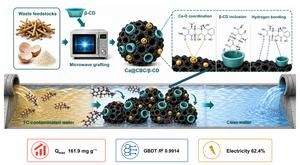
Researchers have developed an innovative biochar material using waste cotton stalks and eggshells to remove tetracycline, a common antibiotic pollutant, from water. This material, known as Ca@CBC/β-CD, is a β-cyclodextrin modified calcium-rich cotton-stalk biochar created through a microwave-assisted process. The study, published in Biochar, highlights the potential of this adsorbent for environmental remediation.
The biochar combines a porous carbon framework from cotton stalks with active mineral sites from eggshell-derived calcium. β-cyclodextrin, a starch-derived molecule, adds structures that enhance the capture of organic pollutants like tetracycline. Laboratory tests revealed that the material performs optimally at a pH of 6, with a maximum adsorption capacity of 161.91 mg g⁻¹ at 45 °C. It also demonstrated resilience to common ions in water and retained 84 to 86% of its adsorption capacity after five reuse cycles.
Spectroscopic analyses and density functional theory calculations showed that tetracycline removal involves calcium-mediated complexation, β-cyclodextrin inclusion, and hydrogen bonding. These interactions work together to effectively capture tetracycline molecules on the biochar surface.
Machine learning was employed to predict adsorption behavior under various conditions, with the gradient boosting decision tree model achieving a test-set R² of 0.9914. This model identified key factors such as initial tetracycline concentration and contact time as critical to adsorption capacity. A Python-based interface was also developed to facilitate rapid predictions and experimental planning.
A life cycle assessment of the adsorbent's production revealed an environmental footprint of 5.44 kg CO₂-equivalent per kg, primarily due to electricity use. The study suggests that reducing energy consumption during production could enhance sustainability. Future research will focus on optimizing the material's composition and testing it in continuous-flow systems, offering a promising waste-to-resource strategy for antibiotic pollution control.
Source: Biochar Feed