Water in biomass may help shape better biochar, study finds
A study published in *Biochar* (2026) found that both free and bound water in lignocellulosic biomass slow pyrolysis reaction intensity and increase biochar yield, with ~30% moisture content identified as a practical optimum balancing yield and energy demand. For the biochar sector, the findings provide a molecular-level basis for using feedstock moisture as a controllable process variable to tailor biochar yield and properties without pre-drying.
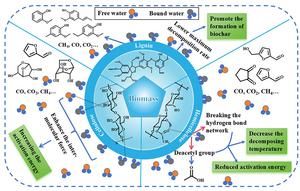
A recent study in the journal Biochar reveals that the water content in plant biomass plays a crucial role in its breakdown during pyrolysis, the oxygen-limited heating process used to produce biochar, bio-oil, and gases. This research challenges the common practice of drying biomass before pyrolysis by demonstrating that both free and bound water can influence pyrolysis reactions and enhance biochar yield.
The study, conducted by researchers including Bo Pan, examined cellulose, lignin, and rice straw with varying water contents. It found that free water, which evaporates easily, and bound water, which is linked to plant polymers via hydrogen bonds, both slow down pyrolysis reactions. This interaction results in increased biochar production.
Using advanced analytical techniques such as thermogravimetric analysis and in situ infrared spectroscopy, the researchers observed that bound water reduces the activation energy of hemicellulose, facilitating its decomposition. This process accelerates the release of acetic acid at lower temperatures. Conversely, bound water increases the activation energy of cellulose, enhancing its thermal stability during pyrolysis.
The study also identified a sequence in which water affects functional groups during rice straw pyrolysis: hydroxyl groups react first, followed by carboxyl C=O, aliphatic C-H, carbohydrate C-O-C, and aromatic rings. This sequence suggests that water can aid in forming condensed aromatic carbon structures, a key feature of stable biochar.
The researchers noted that higher water content generally increased biochar yield across different biomass types, with lignin-derived biochar achieving yields up to 78%. However, higher water content also raised energy consumption due to the need for additional heat to evaporate water. The study proposes that a biomass water content of approximately 30% may offer an optimal balance between biochar yield and energy efficiency.
These findings provide a molecular-level understanding of how water influences biomass pyrolysis, offering a theoretical basis for adjusting feedstock moisture to optimize biochar production. This research could advance the sustainable use of agricultural residues and other lignocellulosic biomass resources by treating water content as a factor for controlling biochar yield and properties.
Source: Biochar Feed