Water loses hydrogen bonds when squeezed into nanotubes, study shows
Researchers used nanoscale vibrational spectroscopy to observe water losing its hydrogen-bond network when confined inside carbon nanotubes.
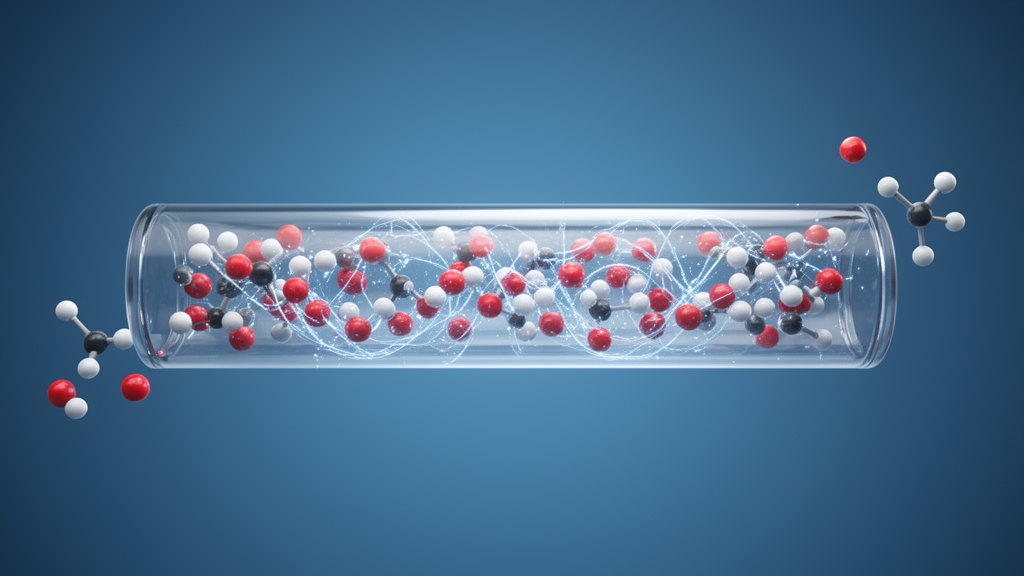
A recent study published in Nature provides a detailed molecular-level examination of hydrogen bonding in water confined within carbon nanotubes. Led by researchers from Stanford University, MIT, Vanderbilt University, and Oak Ridge National Laboratory, the team employed vibrational electron energy loss spectroscopy (vEELS) to measure the O–H stretching vibrations of water molecules inside single carbon nanotubes. The findings indicate that at sufficiently small diameters, the typical hydrogen-bond network of liquid water disintegrates.
Hydrogen bonds are crucial for the properties of liquid water, influencing its boiling point and solvent capabilities. In bulk water, each molecule forms hydrogen bonds with its neighbors, affecting the O–H bond's vibrational frequency. When water molecules lack hydrogen-bond partners, their O–H stretch frequency increases, resembling that of water vapor. This study's use of vEELS allowed for precise measurement of these frequencies, offering insights into the local hydrogen-bonding conditions.
Traditional optical vibrational studies have suggested that water behaves differently near interfaces and within small pores, but lacked the resolution to observe individual molecular structures. By integrating vibrational spectroscopy with transmission electron microscopy, the researchers could focus on single nanotubes and record electron energy loss with nanoscale spatial resolution, overcoming previous limitations.
The experimental setup involved growing individual carbon nanotubes, cutting them with a focused ion beam, and exposing them to high humidity to fill the tubes with water. The nanotubes were then sealed and analyzed using an electron microscope. The vEELS spectra collected revealed broader vibrational peaks than the instrument's resolution, confirming that the measurements reflected the physics of confined water.
Results showed that in larger nanotubes, with diameters around 2.3 nanometers, water maintained its hydrogen-bond network. However, in narrower tubes of about 1.4 nanometers, the O–H stretch frequency shifted to resemble that of water vapor, indicating a non-hydrogen-bonded environment. This suggests that water confined in such narrow spaces behaves more like isolated molecules.
The researchers used theoretical models to interpret the spectra, employing a Morse potential to relate the O–H bond's vibrational frequency to hydrogen-bond strength. Molecular dynamics simulations, enhanced by machine-learning potentials, supported the experimental findings, showing how the balance between bonded and free O–H modes varies with tube diameter and water density.
The study also explored the energetics of water confinement in hydrophobic carbon nanotubes, a phenomenon relevant to mass transport through nanopores. Theoretical analysis highlighted the dynamic nature of hydrogen bonds under confinement, contrasting with the connected network in bulk water. Temperature-dependent measurements further revealed structural phase transitions in confined water, with potential implications for understanding exotic phases such as ice nanotubes.
This research has broader implications for fields like nanofluidics, filtration, and electrochemistry, where confined water plays a critical role. The ability to directly observe hydrogen bonding at the nanoscale provides a new tool for refining models in these areas. The study also showcases the advancements in electron microscopy as a spectroscopic tool, offering spatially resolved vibrational information for individual nanostructures.
Source: Carbon Nanotubes Feed