Antibacterial and anticancer potentials of graphene-silicon nitride nanomaterials explored
KeAi Communications Co., Ltd. reports on the antibacterial and anticancer capabilities of polymer nanocomposites enhanced with graphene-silicon nitride nanomaterials.
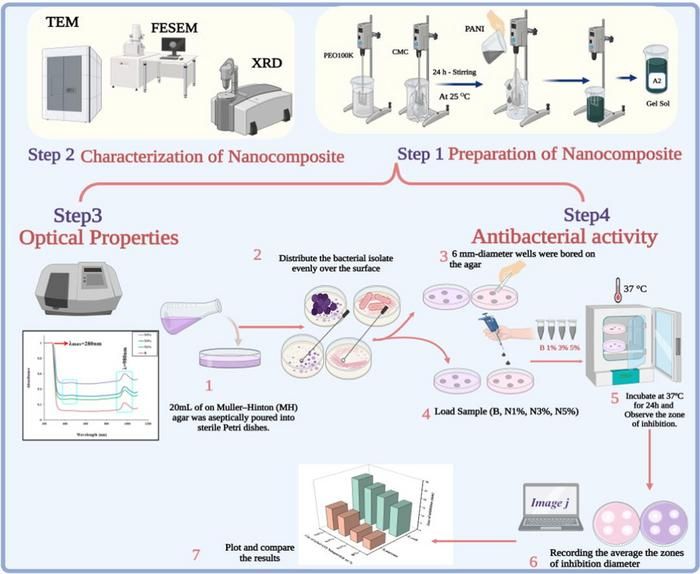
Researchers in Iraq have developed graphene-silicon nitride (GO–Si₃N₄) hybrid nanomaterials to enhance the antibacterial and anticancer properties of PEO–CMC–PANI ternary polymer nanocomposites. These composites, created using sol–gel-ultrasonic synthesis, were characterized by XRD, FTIR, FESEM, TEM, and UV–vis spectroscopy to assess their structural, morphological, and optical properties. Antibacterial and anti-A549 lung cancer activities were evaluated using agar diffusion and MTT assays.
The study confirmed semi-crystalline structures in all samples, with FTIR indicating strong hydrogen-bond interactions between polymers and nanofillers. Microscopic analysis showed uniform dispersion of GO and Si₃N₄ within the matrix. Notably, increased GO–Si₃N₄ loading enhanced UV absorption and narrowed optical band gaps, with indirect gaps decreasing from 3.55 eV to 3.10 eV and forbidden gaps from 3.45 eV to 2.75 eV due to mid-gap energy levels generated by the nanofillers.
Antibacterial efficacy was found to be concentration-dependent, with the 5% composite achieving maximum inhibition zones of 26 mm against E. coli and 14 mm against S. aureus. The antibacterial mechanism involved reactive oxygen species overproduction, mechanical membrane rupture by sharp GO edges, and anti-adhesion effects from rough Si₃N₄ surfaces.
The 5% nanocomposite also demonstrated effective induction of apoptosis in A549 cancer cells, with GO and Si₃N₄ synergistically causing oxidative stress, mitochondrial dysfunction, DNA damage, and cell cycle arrest. Photothermal effects under light irradiation further contributed to tumor cell elimination.
The polymers PEO, CMC, and PANI were chosen for their biocompatibility. Previous research on GO–Si₃N₄ composites primarily focused on mechanical stability, with limited biomedical exploration. In this study, polymers were dissolved separately, mixed stepwise, and blended with GO–Si₃N₄ suspensions to ensure homogeneity through extended stirring and sonication.
Standard spectroscopic, microscopic, and biological evaluation methods were employed, with tests conducted in triplicate. The GO–Si₃N₄ fillers significantly enhanced the optical absorption, bactericidal, and anticancer capabilities of the polymer blend. The 5% loading sample exhibited optimal performance across these metrics.
The researchers suggest that these nanocomposites, with their adjustable optical and biological functions, hold potential for applications in biosensors, medical antibacterial coatings, and photodynamic therapy devices.
Source: Graphene Feed