Binding and spontaneous condensation of excitons in narrow-gap carbon nanotubes
Researchers at the University of Modena and Reggio Emilia have demonstrated that narrow-gap carbon nanotubes function as excitonic insulators, with exciton binding energy scaling inversely with tube radius. This finding is significant for the study of carbon nanotubes, as it reveals the potential for spontaneous exciton condensation, which could influence the electronic properties and applications of these materials in advanced carbon technologies.
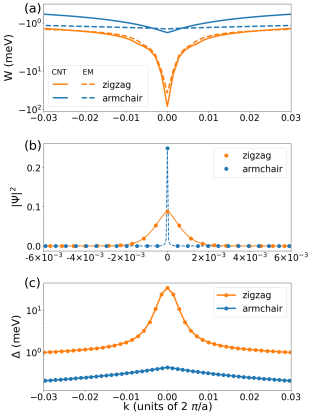
Narrow-gap carbon nanotubes exhibit excitonic insulating properties, according to recent theoretical findings. These properties persist regardless of the nanotube size, extending previous research focused on gapless armchair tubes. The study derives the scaling law of exciton binding energy with respect to tube radius and chirality, using a two-band model enhanced by accurate screening treatments validated from first principles. This research highlights the relationship between exciton length scale and the stability of the excitonic phase.
Low-dimensional carbon allotropes, including carbon nanotubes, demonstrate unique electronic and mechanical properties. They can host strongly interacting electron phases, such as Wigner crystals and Luttinger liquids, which are typically not found in oxides and narrow-band materials. These phases are influenced by factors like magnetic fields and layer twisting, which can flatten energy bands.
A key question in carbon allotropes is the intrinsic electronic correlations that occur without external influences. These correlations are marked by a many-body gap at the Dirac point, observed in suspended nanotubes and graphene bilayers. The origin of this gap is debated, with theories ranging from Mott insulators to excitonic insulators (EI). The EI is a Bose-Einstein condensate of excitons, with a gap resulting from exciton binding energy.
The study focuses on narrow-gap carbon nanotubes, demonstrating that all mechanically stable tubes are excitonic insulators. This finding emphasizes the role of exciton length scale in binding and provides insights into other carbon-based systems. Band theory suggests that two-thirds of single-walled nanotubes are semiconductors, with a gap larger than the exciton binding energy, making them simple band insulators. The remaining tubes, with a smaller gap, are susceptible to spontaneous exciton generation.
The research uses the Bethe-Salpeter equation to compute exciton binding energies, showing a dependence on tube radius and chirality. For gapless tubes, the exciton binding energy does not vanish but scales with radius, indicating instability against exciton condensation. The study also examines the EI phase's transport gap, which opens due to interband coherence, evaluated at the Dirac point.
The findings suggest that exciton condensation in narrow-gap tubes provides insights into graphene, where the gap is too small for experimental detection. The transition to the EI phase is an electronic reconstruction of the ground state, potentially coupled with lattice distortion. This coupling is significant in small tubes but negligible in larger ones, where the predicted value for interband coherence matches the transport gap size.
Source: Carbon Nanotubes Feed