Biochar strategy offers new hope for removing PFOS from water
Researchers at an unnamed institution have developed a photoregenerable β-Ga₂O₃-functionalized biochar that captures and breaks down PFOS, a persistent "forever chemical," under UV light. This advancement could significantly enhance the use of biochar in water treatment applications, addressing contamination by PFOS and potentially other similar pollutants.
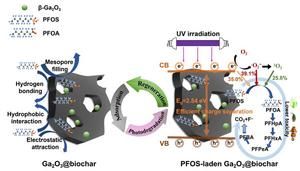
Researchers have developed a biochar-based material that effectively removes and degrades perfluorooctane sulfonate (PFOS) from water. PFOS, a persistent member of the PFAS family, is challenging to eliminate due to its strong carbon-fluorine bonds. The new material, a β-Ga₂O₃-functionalized biochar, captures PFOS and uses ultraviolet light to degrade it.
The study, led by Prof. Yanyan Gong from Jinan University and Prof. Dongye Zhao from San Diego State University, introduces Ga₂O₃@biochar. This material adsorbs PFOS, concentrating it on its surface, and then initiates photocatalytic degradation with UV light. The biochar matrix, derived from wheat straw, integrates β-Ga₂O₃, enhancing the material's properties and performance.
The composite with 1% gallium demonstrated superior performance, altering the biochar's pore structure and electronic properties. These changes improved PFOS adsorption and degradation, achieving over 99% adsorption within 30 minutes and 80.8% photodegradation within 8 hours. The process also resulted in 70.5% defluorination, indicating effective carbon-fluorine bond cleavage.
Density functional theory calculations revealed efficient electron transfer from biochar to β-Ga₂O₃, enhancing photocatalytic reactions. The biochar not only supports but also concentrates PFOS near photocatalytic sites, improving degradation efficiency. The material's performance was validated in real groundwater, though natural water chemistry may affect efficiency.
The study highlights a sustainable approach to PFAS treatment by combining adsorption, photocatalytic destruction, and photoregeneration. Future research will explore the technology's application under complex conditions and its impact on other PFAS compounds.
Source: Biochar Feed