CCIC and UNNC develop low-cost, low-carbon CFRP through continuous RCF innovation
CCIC and UNNC have introduced a recycled carbon fiber manufacturing platform at the SAMPE China 2026 Conference, addressing four major industry challenges including extreme energy use. This innovation is significant for the carbon fiber reinforced polymer (CFRP) sector as it promises to reduce costs and carbon emissions associated with production.
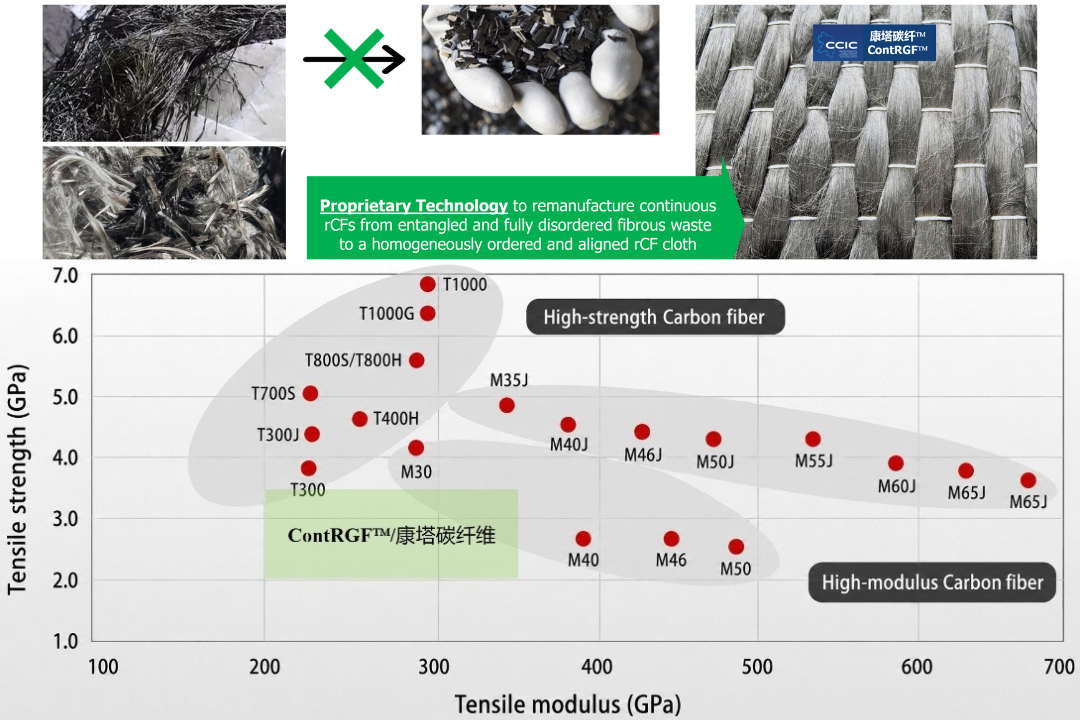
The Yangtze River Delta Carbon Fiber and Composite Material Innovation Center (CCIC) and the University of Nottingham Ningbo (UNNC) have introduced a closed-loop recycled carbon fiber manufacturing platform. This innovation, presented at the SAMPE China 2026 Conference, addresses critical industry issues such as high energy use, carbon emissions, raw material costs, and waste downcycling.
The ContRGF process, patented by CCIC and UNNC, transforms fragmented recycled carbon fiber (rCF) into continuous rovings, meeting industry standards. These rovings achieve tensile strengths of 2.0-3.5 gigapascal (GPa) and moduli of 200-350 GPa, aligning with China's T/CSTM 00882-2023 standard. The cost of production is significantly lower, at approximately $5-6 per kilogram, compared to virgin carbon fiber.
This process, combined with bio-based epoxy resins from the China-EU ECO-COMPASS project, results in ContRPMC composites. These materials are suitable for aerospace and automotive applications using various manufacturing technologies. They also allow for secondary recycling through mild catalytic degradation.
The innovation includes four proprietary technologies: continuous recycled fiber spinning and weaving, catalytic matrix-fiber recovery, degradable bio-resin synthesis, and green composite processing. Prototypes have demonstrated the feasibility of manufacturing lightweight automotive structures and aerospace components.
This technology enhances sustainability in China's carbon fiber reinforced polymer (CFRP) sector, supporting national carbon reduction goals and improving competitiveness in global markets. It provides cost-effective, high-performance, recyclable carbon fiber materials for wind, automotive, and aerospace industries.
Composite materials, known for their strength-to-weight ratio and durability, are crucial to advancements in space exploration and other high-demand applications. Meanwhile, HP Composites' AirPower technology offers energy-efficient CFRP production for automotive applications.
Source: Carbon Fiber Feed