Cobalt sulfide and rare earth oxide used in new train supercapacitor
Researchers in China developed a supercapacitor using a CoS2/Nd2O3 composite and sulfur-treated carbon nanotubes for train applications.
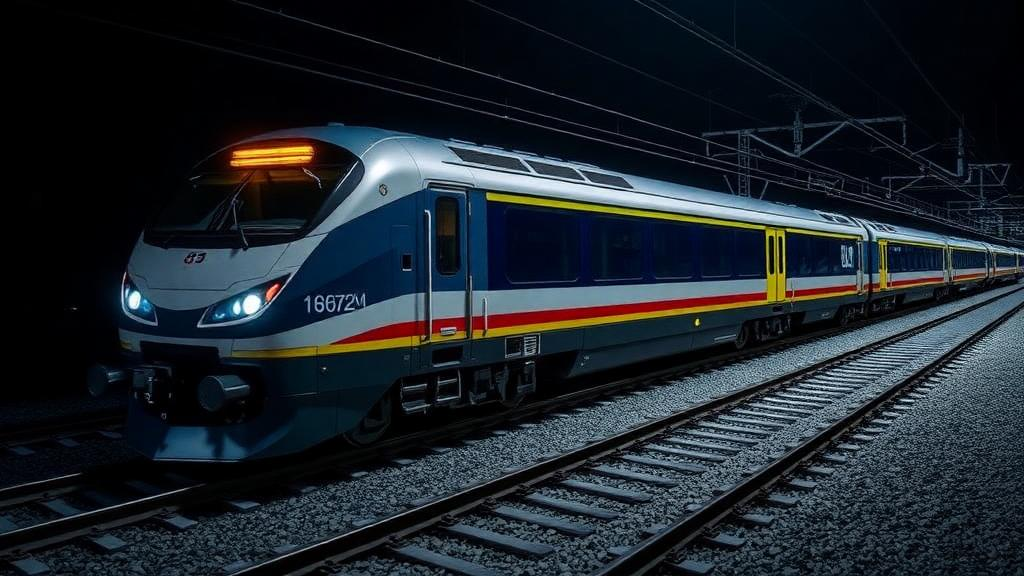
Researchers at Heilongjiang Communications Polytechnic in Qiqihar, China, have developed a new composite material for supercapacitors designed to handle the demanding power fluctuations of metro trains. The study, published in the journal Ionics, introduces a composite of cobalt disulfide (CoS2) and neodymium oxide (Nd2O3) on the positive electrode, paired with sulfur-treated carbon nanotubes (S-CNTs) on the negative electrode. This combination forms an aqueous asymmetric supercapacitor ideal for the rapid charge and discharge cycles required in rail transit.
Cobalt disulfide was selected for its metallic-like conductivity and fast electron transfer, while neodymium oxide enhances chemical stability and charge-transfer kinetics. The researchers optimized the composite's synthesis, achieving a cobalt-to-neodymium molar ratio of 2:1, resulting in a mesoporous structure with a surface area of 213.21 square meters per gram. This structure allows for efficient ion penetration and rapid charge delivery.
In testing, the CoS2/Nd2O3 composite achieved a specific capacitance of 1961 farads per gram at 1 ampere per gram, maintaining 1401 farads per gram even at 20 amperes per gram. The material retained 87.6 percent of its capacitance after 10,000 cycles, demonstrating its durability. On the negative side, sulfur-treated carbon nanotubes showed a 28.7 percent increase in capacitance over untreated nanotubes, maintaining 81.0 percent capacitance at high current densities.
The asymmetric supercapacitor design exploits the different voltage windows of the electrodes, allowing for a higher total cell voltage than either electrode could achieve alone. The device retained 73.3 percent of its capacitance from 1 to 15 amperes per gram and 95.0 percent after 10,000 cycles. The study highlights the need for further optimization of electrode mass ratios and impedance characterization to enhance performance under real-world conditions.
The research aims to address the challenges of regenerative braking energy capture in rail transit, where rapid power fluctuations require storage devices with high-rate capability and stable cycling. The study was supported by the Key Project of the 2025 Educational Science Program of Heilongjiang Province under the 14th Five-Year Plan.
Source: Carbon Nanotubes Feed