Combining Iron Manganese Biochar with Strategic Irrigation Minimizes Grain Cadmium
Tong Sun and colleagues published a study in *Biochar* (2026) showing that iron-manganese oxide modified biochar combined with either continuous flooding or aerobic irrigation reduces grain cadmium to 0.05 mg/kg and total mercury to 0.02 mg/kg in co-contaminated rice paddies. The findings demonstrate a functional agricultural application for engineered biochar, where surface chemistry modifications directly determine remediation performance across competing heavy-metal pathways in soil.
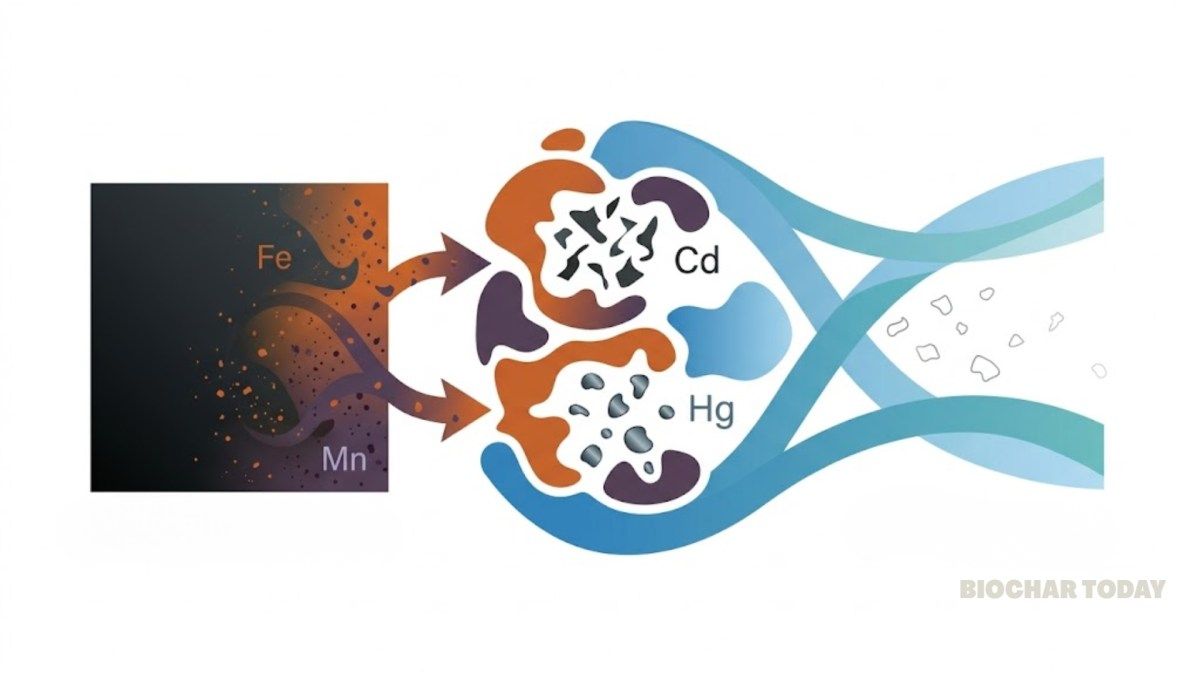
A study published in Biochar by researchers Tong Sun, Wenhao Yang, Yuebing Sun, Lin Wang, and Xuefeng Liang highlights the effectiveness of iron manganese treated biochar in conjunction with strategic water management to reduce grain cadmium and mercury levels in contaminated soils. The research demonstrates that this combination can lower grain cadmium to 0.05 milligrams and total mercury to 0.02 milligrams per kilogram.
Biochar, a carbon-rich material derived from biomass decomposition under low-oxygen conditions, plays a crucial role in this study. Known for its applications in environmental remediation and agriculture, biochar's ability to bind toxic elements through surface adsorption and precipitation is enhanced when modified with iron-manganese oxides. This modification optimizes its porous structure and enriches it with oxygen-containing functional groups.
The study addresses the challenge of managing heavy metal contamination in rice paddies. Traditional water management practices have conflicting effects on cadmium and mercury uptake. Continuous flooding prevents cadmium absorption but encourages mercury conversion to a toxic form, while aerobic irrigation reduces mercury transformation but increases cadmium uptake. The integrated approach using modified biochar and precise water regimes mitigates these issues.
Under continuous flooding, the biochar minimizes cadmium availability and suppresses anaerobic microbes responsible for mercury methylation. Conversely, in aerobic irrigation scenarios, the biochar restricts cadmium uptake and immobilizes inorganic mercury. This dual approach achieves low concentrations of mercury and cadmium in harvested grains, demonstrating the potential for tailored soil amendments to neutralize metal-specific risks.
Beyond reducing grain toxicity, the study also notes improvements in soil ecosystem health. The application of iron-manganese biochar enhances the structural stability of the soil bacterial community, increasing its complexity and resilience. This treatment enriches metal-resistant bacterial groups, aiding in pollutant adsorption. Although promising, the authors stress the need for multi-year field trials to assess long-term stability and scalability under natural conditions.
Source: Biochar Feed