Floating polymer sponge enhances solar hydrogen production with ice-templated design
Researchers developed a floating polymer sponge with graphene quantum dots that converts sunlight into hydrogen at 7.16 millimoles per gram.
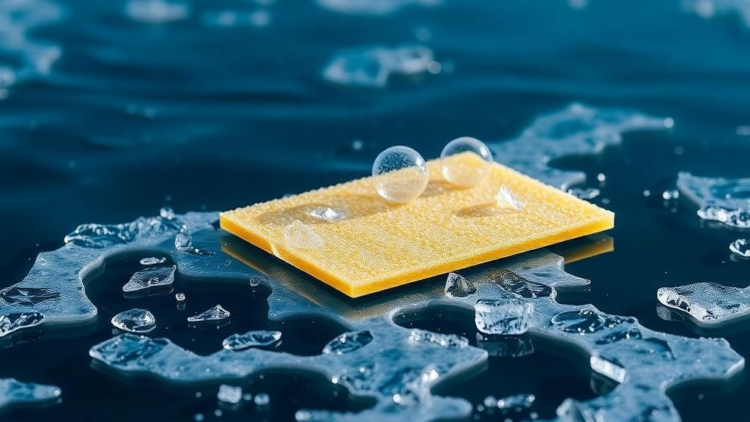
A novel approach to solar hydrogen production leverages advanced carbon materials to address a key challenge in photocatalysis. Researchers from Korea University and Tianjin University have developed a self-floating porous photocatalyst sponge using poly(3-hexylthiophene) (P3HT) combined with nitrogen-doped graphene quantum dots. This innovative material floats at the air-water interface, enhancing light absorption and facilitating hydrogen production at a rate of 7.16 millimoles per gram per hour under simulated solar conditions.
The nitrogen-doped graphene quantum dots, tiny carbon-based nanocrystals, play a crucial role in the sponge's functionality. They act as emulsion stabilizers, structural templates, and electronic partners to the polymer, enabling the creation of a monolithic, hierarchically porous architecture. This design integrates light harvesting, buoyancy, and charge separation, overcoming the limitations of previous floating photocatalysts that required multiple additives and structures.
The fabrication process utilizes a Pickering emulsion, where solid particles stabilize the emulsion instead of molecular surfactants. The researchers dispersed water droplets into a chloroform solution containing P3HT, with the quantum dots forming a protective shell around each droplet. This robust structure withstands freezing, allowing the emulsion to be freeze-dried into a sponge with interconnected spherical cavities, maximizing light capture and facilitating gas movement.
The sponge's optical properties are particularly noteworthy. The interconnected cavities scatter light internally, increasing the optical path length and enhancing absorption by the P3HT. This configuration allows the sponge to remain partially submerged, optimizing exposure to sunlight and contact with water, thus resolving a common trade-off in photocatalysis.
The study highlights the potential of organic photocatalysts like P3HT, which are tunable and free from scarce noble metals. The Pickering emulsion and ice-templating method offers a scalable, cost-effective pathway for producing robust, self-floating photocatalysts. While challenges remain, such as ensuring long-term stability under real-world conditions, this approach represents a significant step forward in the development of sustainable hydrogen generation technologies.
Source: Emerging Nano Carbons