Glasgow and Sydney uni researchers map damage in 3D printed lattices
Researchers from Glasgow and Sydney universities embedded carbon nanotubes in 3D printed plastic to monitor damage progression under load.
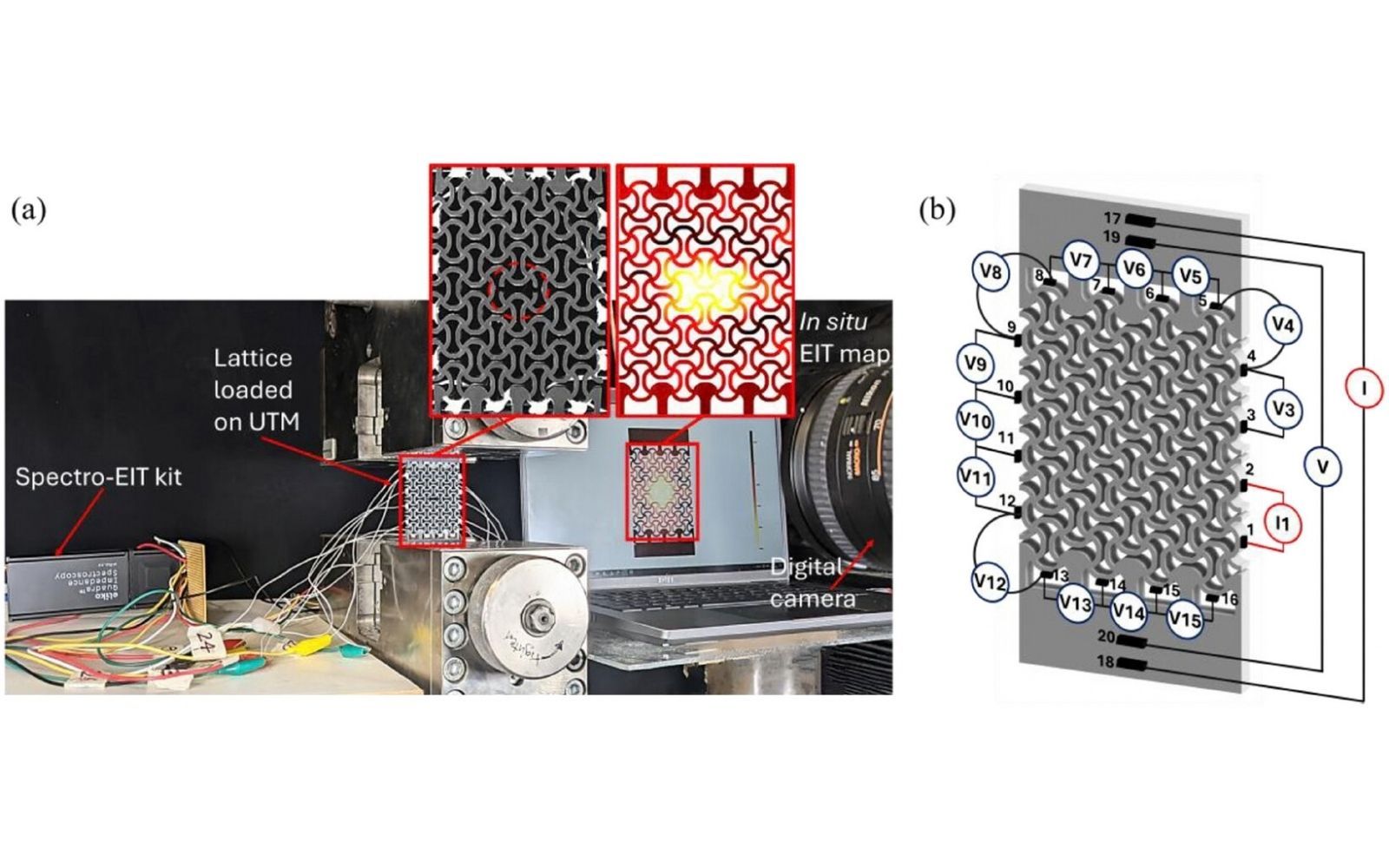
Researchers at the University of Glasgow and the University of Sydney have utilized electrical impedance tomography (EIT) to map damage in 3D printed lattice structures. This study marks the first application of in situ EIT for monitoring damage in 3D printed architected metamaterials, as detailed in a paper published in Advanced Functional Materials.
The research team integrated carbon nanotubes into plastic lattices, which were printed with specific arrangements of struts and spaces. By passing current through the nanotubes and measuring voltage differences with external electrodes, they were able to stretch 48-millimeter specimens to failure. An algorithm then converted these voltage changes into real-time conductivity maps.
These maps illustrated where damage developed and progressed, even away from the electrodes, and where it accumulated before the lattice structure failed. Direct observations confirmed the accuracy of these maps, which located damage within approximately one strut of its actual position. Additionally, the researchers introduced tiny cracks into some struts and monitored their spread under increasing strain.
This work builds on a 2024 modeling framework from the University of Glasgow’s Sustainable Multifunctional Materials and Additive Manufacturing (SM2AM) Lab, which predicted changes in lattice conductivity under stress. Professor Shanmugam Kumar of the James Watt School of Engineering at the University of Glasgow, who leads the SM2AM Lab, explained that their approach allows for real-time mapping of electrical changes across an entire 3D printed lattice structure.
The technique provides a detailed view of how different parts of the lattice respond under strain, surpassing conventional methods that only offer localized or averaged structural health indications. This method could potentially be applied in structural health monitoring and advanced engineering systems, although further development is necessary for practical application scaling.
Source: Carbon Nanotubes Feed