Graphene-backed nickel cobalt oxide composite doubles as supercapacitor
Researchers created a hybrid electrode with nickel cobalt oxide and cadmium oxide on reduced graphene oxide, achieving 2700 coulombs per gram in charge storage for supercapacitors.
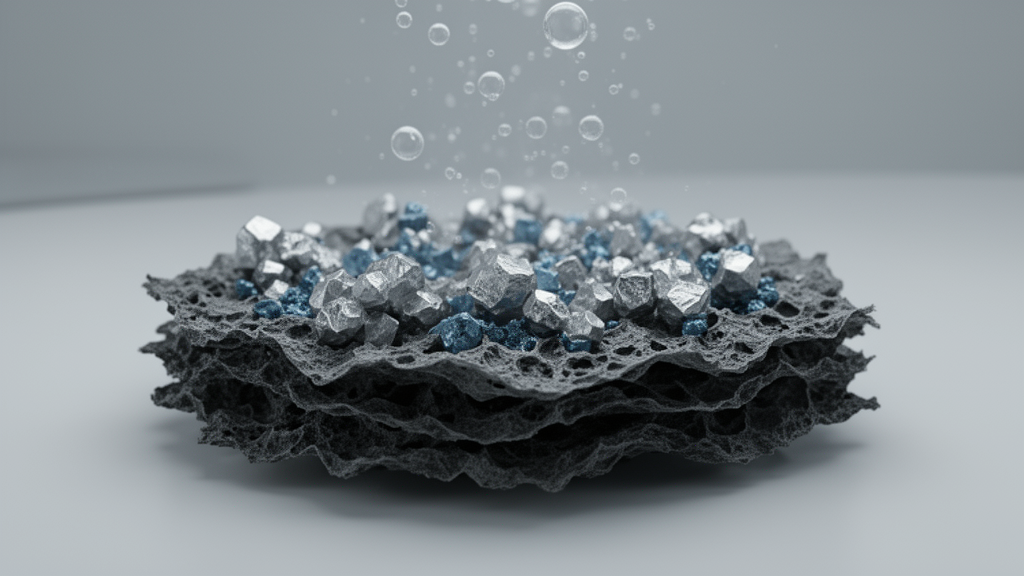
Researchers have developed a hybrid electrode material that integrates nickel cobalt oxide and cadmium oxide nanoparticles onto reduced graphene oxide, enhancing its functionality in both energy storage and hydrogen production. This composite, detailed in the Journal of Materials Science, leverages the exceptional electrical conductivity of reduced graphene oxide to support its dual role as a supercapacitor and a catalyst for hydrogen evolution. The material was synthesized through a hydrothermal method, a cost-effective and environmentally friendly process.
The composite's bifunctionality is noteworthy. Supercapacitor electrodes and hydrogen evolution catalysts typically require distinct properties: rapid redox activity for energy storage and efficient hydrogen adsorption for water splitting. By embedding nickel cobalt oxide, known for its rich redox chemistry, and cadmium oxide, which adds electroactive sites, onto reduced graphene oxide, the researchers created a structure that balances these needs. This design could simplify the materials used in integrated energy devices.
Performance metrics for the composite are impressive. At a current density of 2 amperes per gram, it achieved a specific capacity of 2700 coulombs per gram. It also recorded an energy density of 71.2 watt-hours per kilogram and a power density of 1600 watts per kilogram. These figures address the challenge of increasing both energy and power density in supercapacitors, which traditionally store less energy than batteries.
The composite also demonstrated durability, maintaining a coulombic efficiency of 89.87 percent over 1000 charge-discharge cycles. This resilience is attributed to the reduced graphene oxide matrix, which enhances charge transport, preserves structure, and supports the oxide nanoparticles. Reduced graphene oxide, derived from graphite oxide, prevents nanoparticle agglomeration and facilitates electron transfer, crucial for the composite's performance.
Nickel cobalt oxide's spinel structure and cadmium oxide's conductive properties contribute to the composite's electrochemical activity. The combination of these oxides on a carbon scaffold enhances electron transfer and redox activity, making the material suitable for both energy storage and hydrogen production. The composite required an overpotential of 190.22 millivolts for hydrogen evolution, with a Tafel slope of 67.22 millivolts per decade, indicating efficient catalytic performance.
This research, published on October 16, 2026, highlights a promising approach for developing hybrid electrode systems for electrochemical applications. The study involved international collaboration and was supported by various institutions, including Princess Nourah bint Abdulrahman University. While challenges remain, such as addressing cadmium's toxicity, the design principle of dispersing redox-active oxides on a conductive carbon network is gaining traction in the energy materials field.
Source: Graphene Feed