Graphene oxide layer enables low-cost SPR detection of mercury, lead, and zinc in water
Researchers have designed a graphene oxide-based SPR sensor for detecting mercury, lead, and zinc in water. The simulated sensor achieved angular sensitivities up to 338°/RIU.
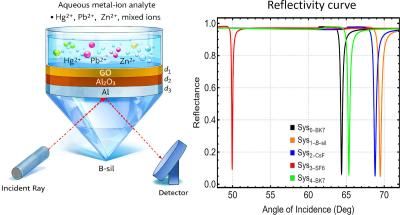
Researchers from Universidad Técnica Particular de Loja, Escuela Superior Politécnica de Chimborazo, Università della Calabria, and Universidad Ecotec have developed a computational model for a surface plasmon resonance (SPR) sensor. This sensor is designed to detect trace amounts of mercury, lead, and zinc ions in water using a graphene oxide sensing layer. The graphene oxide is applied atop an aluminum/aluminum oxide plasmonic stack on a borosilicate glass prism.
The team evaluated four carbon nanomaterials as potential sensing layers: graphene oxide, reduced graphene oxide, pristine graphene, and semiconducting single-walled carbon nanotubes. They assessed each material for angular sensitivity, resonance linewidth, and detection limit using transfer-matrix modeling. Although single-walled carbon nanotubes and reduced graphene oxide showed larger angular shifts, they also caused significant resonance broadening. Graphene oxide provided the most balanced performance, offering a measurable resonance shift with a narrow and well-defined resonance dip.
In the optimized sensor configuration, a 60 nm aluminum film and a 32 nm aluminum oxide layer support the graphene oxide coating. This setup achieved simulated angular sensitivities of up to 338°/RIU and detection limits around 10⁻⁵ refractive-index units (RIU) for individual and binary mixtures of mercury, lead, and zinc ions. Aluminum was selected as a cost-effective alternative to the conventional gold plasmonic layer, with the aluminum oxide layer preventing oxidation and tuning the optical response.
The research is currently at the simulation stage, and the sensor has not been fabricated or tested with actual water samples. The authors emphasize that the modeled detection limit is an optical metric in refractive-index units, not a validated concentration threshold. They also acknowledge that factors such as interference from other ions, pH, temperature, and organic matter were not considered in the current model. Future steps include analyzing fabrication tolerances, enhancing ion specificity through selective surface functionalization, and conducting experimental validation with real water samples.
Source: Graphene Feed