KAIST develops anode-free EV battery to boost range
KAIST researchers have developed an anode-free battery technology using patterned copper foil and MXene coating to improve lithium deposition, potentially extending battery life and efficiency for electric vehicles.
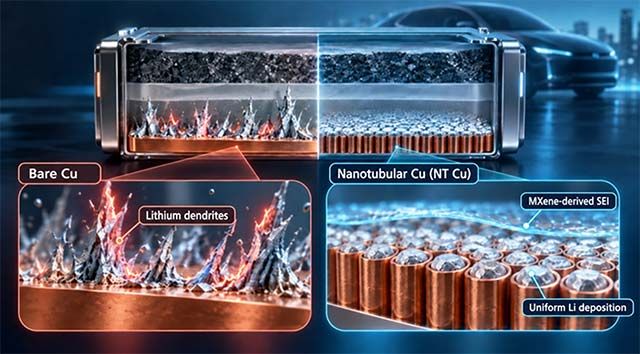
Researchers at the Korea Advanced Institute of Science and Technology (KAIST) have developed a new battery technology that could enhance the range of electric vehicles by using smaller and lighter battery packs. The team has addressed a significant challenge with anode-free batteries: the uneven buildup of lithium during charging, which leads to degradation.
The KAIST researchers, led by Professors Jinwoo Lee and Hee-Tae Jung from the Department of Chemical and Biomolecular Engineering, collaborated with Kyungpook National University and the National NanoFab Center. Their findings, published on September 1 in Advanced Functional Materials, combine semiconductor manufacturing techniques with an ultrathin protective coating to promote even lithium deposition and form a stable protective layer, potentially extending battery life without adding weight or bulk.
Traditional lithium-ion batteries use graphite or similar materials for the anode, where lithium is stored during charging. Anode-free batteries eliminate this separate anode material, allowing lithium to deposit directly onto a thin copper current collector. This can reduce battery weight and thickness while increasing energy storage, which could lead to more compact battery packs and improved driving range in electric vehicles.
However, anode-free batteries face challenges. During repeated charging and discharging, lithium can accumulate unevenly on the copper surface, forming dendrites that reduce efficiency, accelerate degradation, and increase the risk of short circuits. The protective layer around deposited lithium can also become unstable, contributing to battery deterioration.
Previous solutions have included adding extra lithium or applying thicker protective coatings, but these add weight and volume, negating the benefits of anode-free designs. The KAIST team focused on engineering the copper surface itself. They developed a specially patterned copper foil with microscopic tube-like structures to encourage uniform lithium deposition. These structures were fabricated using secondary sputtering lithography (SSL), a technique adapted from semiconductor processing.
Each tube measured approximately 300 nanometers in diameter and 150 nanometers in height, offering four times the surface area for lithium deposition compared to conventional flat copper foil. This increased surface area helps spread lithium across more deposition sites, reducing localized buildup and dendrite formation.
The researchers also applied a 10-nanometer-thick MXene coating to the engineered copper surface. This two-dimensional material promotes the formation of a stable protective layer during battery operation. In the experiments, the MXene surface encouraged the development of a lithium fluoride (LiF)-rich layer, which limits unwanted chemical reactions and suppresses damaging lithium structures.
By combining uniform lithium deposition with improved chemical stability, the design addresses two major causes of capacity loss and shortened battery life. The team used advanced analytical techniques, including X-ray photoelectron spectroscopy, time-of-flight secondary ion mass spectrometry, and transmission electron microscopy, to examine the electrode’s surface and internal structure, confirming the formation of a uniform protective layer and the role of the MXene coating.
This research offers a potential way to improve anode-free battery durability without sacrificing high energy density and reduced material requirements. For electric vehicle manufacturers, longer-lasting anode-free batteries could provide greater driving range from smaller battery packs, reducing vehicle weight and potentially lowering manufacturing costs.
However, further development and validation are needed to determine how the engineered electrodes perform under practical conditions, including long-term cycling, different temperatures, fast charging, and large-scale manufacturing. Battery performance depends on factors such as the electrolyte, cell design, operating conditions, and manufacturing consistency.
Professor Jinwoo Lee emphasized that the research demonstrates how ultrafine semiconductor manufacturing techniques can create uniform lithium deposition sites and a stable protective layer without changing the bulk electrolyte formulation or adding excess lithium. The team hopes their findings will accelerate the development of high-energy anode-free batteries for future applications, including electric vehicles.
KAIST researchers Eunji Kim, Hyunju Jung, and Jinuk Kim served as co-first authors. The project received support from South Korea’s National Research Foundation, the National NanoFab Center, and related semiconductor and battery technology development programs. If the approach can be successfully scaled, it could help overcome key barriers to anode-free batteries and bring lighter, more energy-dense battery systems closer to practical use in future electric cars.
Source: MXenes