Machine learning uncovers elemental clues behind persistent free radicals in biochar
Researchers have used machine learning to predict the concentration of persistent free radicals and g-Factor in lignocellulose-derived biochar based on its elemental composition.
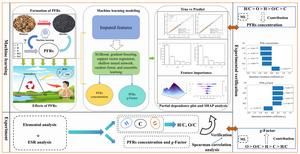
Researchers have utilized machine learning to explore how the elemental composition of biochar affects persistent free radicals (PFRs), potentially aiding in the prediction of biochar's reactivity and environmental impact. Biochar, a carbon-rich material produced by heating biomass in low-oxygen conditions, is known for its applications in soil enhancement and pollution control. However, it can also contain PFRs, which may persist for extended periods and influence both pollutant degradation and oxidative stress in organisms.
A team from Kunming University of Science & Technology applied six machine-learning techniques, including XGBoost and random forest, to analyze existing data on biochar. They identified the hydrogen-to-carbon ratio (H/C) and oxygen content as key factors influencing PFR concentration. Additionally, oxygen content and the oxygen-to-carbon ratio (O/C) were significant in predicting the g-Factor, a measure used to differentiate free radical types.
The study revealed that simple elemental data could provide insights into PFR behavior in biochar. Wenmei Tao, the study's corresponding author, emphasized that combining machine learning with experimental validation enhances understanding of radical formation, supporting informed biochar design and risk assessment.
The researchers compiled 263 records of PFR concentration and g-Factor from previous studies. Their models achieved R² values of 0.7797 for PFR concentration and 0.7647 for g-Factor, demonstrating high accuracy in distinguishing samples with varying values. Further analysis showed that lower H/C values and oxygen content correlated with higher PFR concentrations, while increased oxygen content and O/C were linked to higher g-Factor values, indicating a shift towards oxygen-centered radicals.
To validate their findings, the team produced biochars from various biomass sources at different pyrolysis temperatures. Experimental results confirmed the predicted trends, with Spearman correlation analysis highlighting H/C and oxygen content as the strongest predictors of PFR concentration, and oxygen content and O/C as key for g-Factor.
This research offers a data-driven approach to understanding the link between elemental properties and PFR behavior in biochar, potentially guiding the development of biochars optimized for environmental remediation.
Source: Biochar Feed