Microwave biochar could help turn waste biomass into cleaner water and safer soils
A review published in the journal *Biochar* compared conventional and microwave-assisted pyrolysis as production routes for biochar, finding that microwave-derived biochars typically exhibit higher surface area, stronger mesoporosity, and greater retention of functional groups relevant to pollutant capture. For the advanced carbon materials sector, the findings highlight biochar's expanding role beyond remediation into electrode materials and catalysis, while noting that reactor scale-up and energy balance challenges must be resolved before microwave-assisted pyrolysis reaches industrial viability.
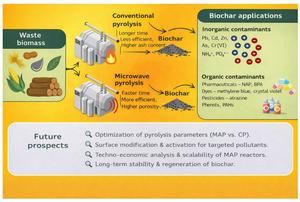
Biochar, a carbon-rich material derived from organic waste, is gaining attention for its potential in environmental remediation. A recent review in the journal Biochar compares conventional pyrolysis and microwave-assisted pyrolysis, two methods of biochar production, highlighting how these processes influence the material's structure and effectiveness in pollution removal.
Biochar is produced from various organic wastes, including agricultural residues, forestry by-products, and sewage sludge. These materials, instead of being discarded, are transformed into porous carbon materials that can adsorb pollutants, enhance soil quality, and sequester carbon. The production method significantly affects the biochar's performance.
Lead author Atta Rasool emphasizes that biochar is more than just waste-derived charcoal. It is a versatile environmental material, and its production method dictates its ability to capture pollutants and stabilize metals. The review suggests that microwave-assisted pyrolysis can create biochars with more active surfaces and improved pore structures.
Conventional pyrolysis involves external heating, which can result in uneven thermal distribution and limited pore development. In contrast, microwave-assisted pyrolysis uses electromagnetic energy to heat biomass from within, promoting uniform pore formation and reducing processing time. This method often results in biochars with higher surface area and enhanced functional groups for pollutant binding.
The structural advantages of microwave-derived biochars are significant for environmental cleanup. The review outlines various mechanisms through which biochar captures contaminants, including ion exchange and surface complexation. Microwave-derived biochars have shown efficacy in removing heavy metals and organic pollutants such as dyes and pharmaceuticals.
Beyond water treatment, biochar has potential applications in soil amendment, carbon sequestration, and catalysis. However, the review notes challenges in scaling up microwave-assisted pyrolysis, including reactor design and energy balance issues.
Rasool calls for further research to validate the benefits of microwave-assisted pyrolysis under real-world conditions. Future studies should focus on reactor design, biochar properties, and long-term environmental impacts.
The review provides a comprehensive roadmap for developing advanced biochars that address waste management, pollution control, and resource recovery.
Journal Reference: Rasool, A., Brožová, K., Chromíková, J. et al. Conventional and microwave-assisted pyrolysis biochars: comparative mechanistic insights, structural evolution, and environmental remediation applications. Biochar 8, 98 (2026).
Source: Biochar Feed