New dry-cathode tech removes bottlenecks in thick lithium-ion EV batteries
A South Korean research team created a dry cathode method incorporating porous graphitic carbon nitride to improve lithium-ion EV batteries.
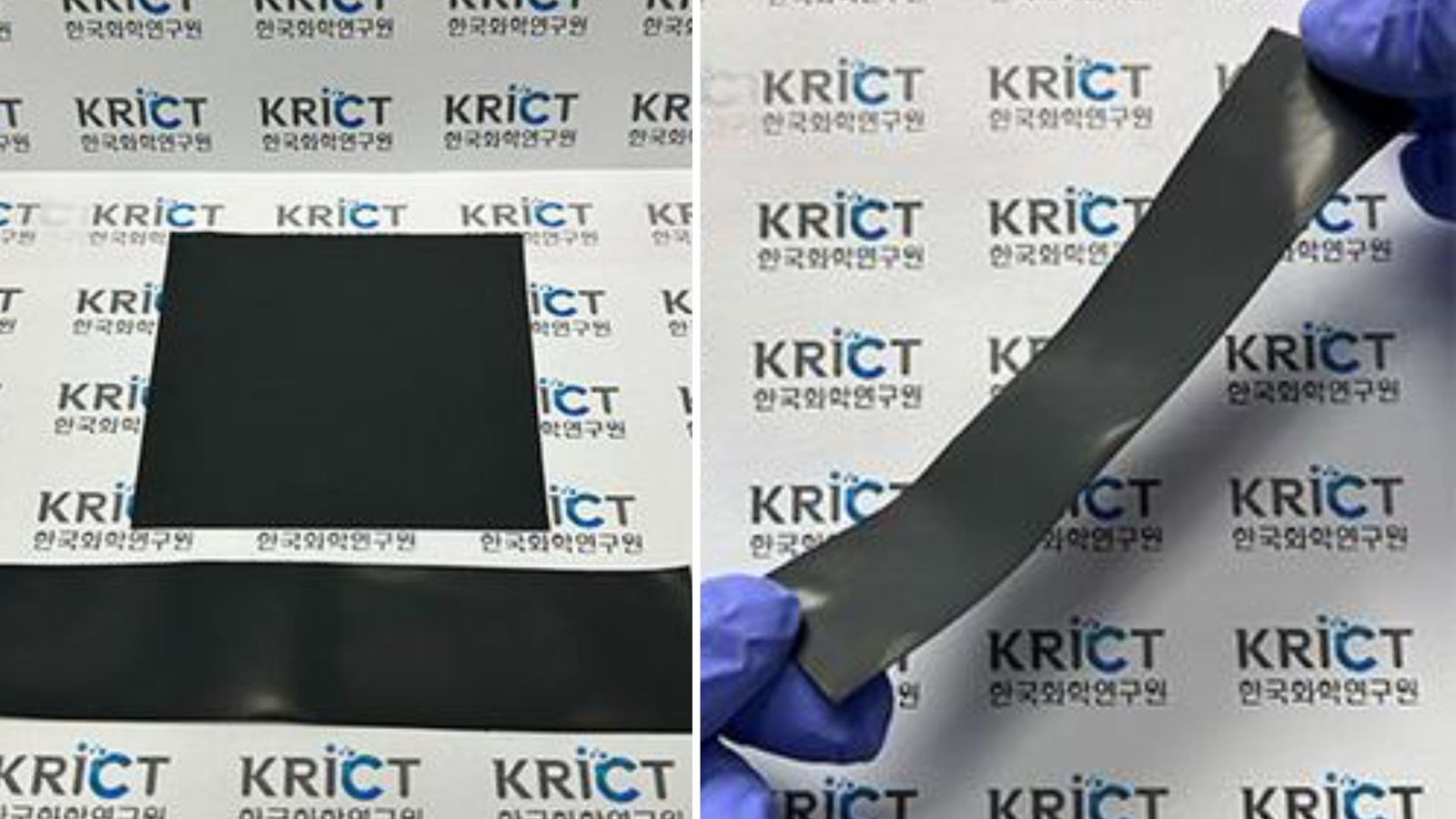
Researchers in South Korea have developed a dry thick-film cathode technology that utilizes porous graphitic carbon nitride as a cathode additive, addressing challenges in thick-electrode battery manufacturing. This innovation enhances energy density, making it suitable for long-range electric vehicles.
The issue of "ion traffic jams" in thick, energy-dense batteries is a significant challenge for electric vehicles. When multiple lithium ions attempt to pass through the battery's thick cathode simultaneously, they become stuck near the surface, reducing power output and leaving potential energy trapped within the battery.
Led by Dr. San Moon and Dr. Jungdon Suk at the Korea Research Institute of Chemical Technology (KRICT), the research team has incorporated a specialized compound into dry battery manufacturing. This additive acts as a molecular guide, facilitating smoother ion movement through the cathode.
A small addition of 0.5 percent by weight of graphitic carbon nitride (g-C3N4) to a 68-micrometer-thick dry cathode reduced the energy required for lithium-ion movement by 56 percent. This modification significantly increased the battery's high-speed discharge capacity by 165.9 percent, from 58.8 to 156.2 mAh/g, nearly tripling power density.
The nitrogen atoms on the surface of the g-C3N4 structure play a crucial role. They form temporary lithium-nitrogen bonds with passing lithium ions, removing bulky electrolyte solvent molecules and guiding them efficiently into the cathode active material.
The technology also addresses a major manufacturing challenge: transitioning to dry electrode production. Traditional battery manufacturing relies on a wet process, which is slow and energy-intensive. Dry manufacturing eliminates the need for solvents and ovens, reducing factory size and energy consumption. However, early dry electrodes faced high internal resistance when built thick, a problem mitigated by KRICT's nitrogen-rich guide.
In long-term testing, pouch-type full cells using the new dry cathode retained 81.3 percent of their capacity after 600 cycles, outperforming typical additive-free electrodes, which retained 72.9 percent. However, the balance of the additive is crucial, as too much graphitic carbon nitride can increase resistance due to its poor conductivity.
While further testing is required to confirm mass-production yields and cost savings, this technology offers a promising path for next-generation energy storage. By optimizing internal ion flow, it enables longer-range, faster-charging EV batteries with improved power retention.
Source: Graphite Feed