Nitrogen-doped graphene underlayer reduces overpotential in aluminum-doped systems
Researchers found that nitrogen-doped graphene underlayers significantly reduce the overpotential of aluminum-doped hematite photoanodes to 0.54 volts, enhancing water oxidation efficiency.
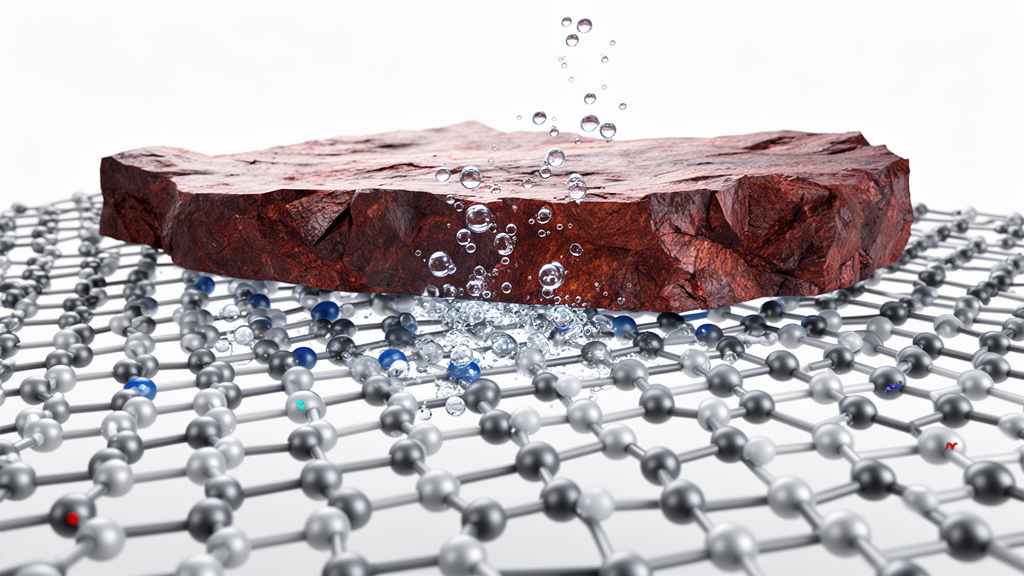
A recent study published in Discover Catalysis highlights a novel interface engineering strategy to enhance the efficiency of solar-driven water oxidation on hematite photoanodes. Researchers Labanya Bhattacharya and Maytal Caspary Toroker explored the impact of heterostructuring aluminum-substituted nanostructured hematite with graphene and nitrogen-doped graphene underlayers on photoelectrochemical water splitting performance. Hematite, an iron oxide mineral, is a promising candidate for photoanode fabrication due to its abundance, non-toxicity, visible light absorption up to 560 nanometers, and a theoretical solar-to-hydrogen conversion efficiency of 15.4 percent. However, pure hematite faces challenges such as low electrical conductivity, rapid electron-hole recombination, and slow oxygen evolution reaction kinetics, which require high driving voltages. Density functional theory calculations with Hubbard U corrections showed that aluminum doping in a hematite monolayer increases the theoretical overpotential from 0.77 volts to 0.96 volts.
To mitigate this thermodynamic barrier, the researchers designed two-dimensional heterostructures supporting the aluminum-doped hematite monolayer on pristine graphene and nitrogen-doped graphene underlayers. The bulk hematite crystal was cleaved along the stable (0001) facet, preferred under aqueous electrochemical conditions. Aligning this oxide monolayer with a two-by-two graphene supercell resulted in an average in-plane lattice constant of 5.008 angstroms, minimizing interfacial lattice mismatch and preventing mechanical strain. Bond length calculations confirmed minimal shifts in carbon-carbon and carbon-nitrogen distances within the graphene lattice upon contact with the metal oxide slab. Similarly, internal iron-oxygen and aluminum-oxygen bond distances remained largely unchanged. The equilibrium interlayer separation was 2.42 angstroms for the pristine graphene composite and slightly contracted to between 2.38 and 2.40 angstroms for nitrogen-doped systems, indicating that weak van der Waals forces maintain structural integrity while enabling electronic interaction.
The complete oxygen evolution reaction at the photoanode surface was modeled as a five-step proton-coupled electron transfer pathway under alkaline conditions. Starting with a surface oxygen vacancy as the primary water adsorption site, the catalytic cycle proceeds through sequential deprotonation events driven by photogenerated holes from the semiconductor and hydroxide anions from the basic electrolyte. This process yields adsorbed hydroxyl, oxo, and hydroperoxo intermediates before releasing molecular oxygen and regenerating the vacant catalytic center. By computing reaction Gibbs free energies with zero-point energy corrections and entropic contributions at 298 Kelvin and standard pressure, the authors confirmed that the second deprotonation step—the transformation of the adsorbed hydroxyl intermediate into the oxo species—requires the largest energy input. Since trivalent aluminum substitutes for trivalent iron without introducing extrinsic charge carriers, the neutral hydroxylated surface maintains the same thermodynamic bottleneck seen in pristine hematite, providing a controlled baseline for evaluating underlayer modifications.
Thermodynamic evaluations showed that introducing a pristine graphene underlayer beneath the aluminum-doped hematite monolayer reduces the theoretical overpotential from 0.96 volts to 0.63 volts, a gain of 0.33 volts. Incorporating graphitic nitrogen dopants into the underlying graphene sheet further accelerated catalysis, depending on the specific atomic position of the dopant. Among three evaluated graphitic nitrogen arrangements, the configuration designated as graphitic-N_3 achieved the lowest theoretical overpotential of 0.54 volts, which is 0.42 volts lower than unsupported aluminum-doped hematite and surpasses previously evaluated pristine graphene-hematite interfaces. This improvement is attributed to extended electronic delocalization across the heterointerface. While aluminum substitution contracts adjacent metal-oxygen bonds due to the smaller ionic radius of trivalent aluminum (0.54 angstroms versus 0.65 angstroms for trivalent iron), creating localized ionic interactions that impede surface reactions, the underlying graphene sheets induce non-local charge density distributions that smooth intermediate energy differences.
Calculations of electronic work function provided critical insights into the mechanisms enhancing photoelectrochemical performance. The work function, representing the energetic barrier preventing an electron at the Fermi level from escaping into the vacuum, indicates electrochemical surface reactivity. The isolated aluminum-doped hematite monolayer exhibited a work function of 5.24 electron volts, which increased slightly to 5.53 electron volts when supported on pristine graphene. In contrast, incorporating electron-rich, n-type nitrogen atoms into the graphene underlayer significantly reduced the work function, lowering it by 1.41 electron volts compared to the graphene-supported counterpart and by 1.12 electron volts relative to bare aluminum-doped hematite. This reduction decreases the local electrostatic potential barrier governing charge extraction, enhancing photoanode reactivity and facilitating electron departure from the catalytic interface under applied working potentials.
Three-dimensional charge density difference mapping and Bader net atomic charge analyses revealed the microscale electronic reorganizations underlying this catalytic enhancement. For the hydroxyl intermediate, planar charge density difference plots showed that interactions between surface hydrogen atoms on hematite and carbon atoms in the graphene underlayer promote non-local charge sharing while causing localized charge depletion across catalytic oxygen centers. During the critical second deprotonation step, the formal oxidation state of the active iron site shifts from trivalent to divalent, as corroborated by reductions in Bader net atomic charges and localized magnetic moments. In both pristine and nitrogen-doped graphene heterostructures, the dehydrogenated surface oxygen atom retained more electronic density, losing only 0.305 and 0.291 elementary charges, respectively, compared to 0.325 elementary charges in undoped hematite. This reduced charge depletion indicates attenuated surface state trapping, preventing photogenerated holes from becoming immobilized at sluggish surface defect sites.
Projected density of states calculations further explained how underlayer engineering modulates charge carrier availability and optical absorption. The bulk-like hydroxyl-terminated aluminum-doped hematite monolayer maintained a fundamental band gap of 2.34 electron volts, nearly identical to the 2.32 electron volt gap of pure hematite, as the filled s and p orbitals of aluminum do not hybridize with valence iron 3d and oxygen 2p bands near the band edges. Coupling hematite with pristine graphene narrowed this band gap to 1.08 electron volts. Remarkably, supporting the catalyst on nitrogen-doped graphene collapsed the band gap almost entirely to 0.015 electron volts, creating a nearly metallic electronic state characterized by abundant carbon and nitrogen mid-gap states flanking the Fermi boundary. Furthermore, the occupied valence manifold of mixed iron 3d and oxygen 2p character shifted approximately 1.4 electron volts deeper below the Fermi level, facilitating photon-induced electronic excitation and providing continuous conduction channels for charge migration.
To investigate charge carrier dynamics directly, the researchers simulated quantum wave packet propagation toward the photoanode surface using an effective Hamiltonian approach and a second-order split-operator fast Fourier transform technique. Propagating one-dimensional Gaussian wave packets across density functional electrostatic potential profiles over a 0.50-femtosecond simulation window allowed direct quantification of the cumulative transmission probability for holes traversing toward the reaction interface. The nitrogen-doped graphene composite consistently achieved the highest cumulative transmission probability across both the initial hydroxyl and rate-limiting oxo intermediates. This enhanced transmission probability results from elevated initial valence band energy levels (-1.35 electron volts for hydroxyl and -1.94 electron volts for oxo species) combined with the vanishing band gap. Under the Landauer conductance formalism, which equates one-dimensional carrier conductance directly to interfacial transmission probability, these elevated values confirm superior hole conductivity toward the catalytic surface.
The kinetic feasibility of the potential-determining deprotonation step was additionally verified through climbing-image nudged elastic band calculations incorporating an explicit chlorine sink to capture the departing proton during oxygen-hydrogen bond cleaving. For bare hematite and aluminum-doped hematite monolayers, computed reaction activation energies were 0.66 electron volts and 0.75 electron volts, respectively, with corresponding Gibbs free energy differences of 0.13 electron volts and 0.19 electron volts. The higher activation barrier in aluminum-doped hematite reflects the more pronounced ionic character and stronger negative charge (-1.300 elementary charges) localized on the oxygen atom, which impedes proton detachment. Incorporating a pristine graphene underlayer lowered the activation energy to 0.55 electron volts. Applying Marcus electron transfer theory to calibrate activation energies against thermodynamic reaction free energies yielded values of 2.10 electron volts for bare aluminum-doped hematite, 1.74 electron volts for graphene-supported hematite, and a minimal 1.66 electron volts for the nitrogen-doped graphene heterostructure.
These comprehensive computational findings demonstrate that while naturally occurring aluminum substitution in hematite photoanodes initially imposes thermodynamic and kinetic penalties on water oxidation, interface engineering with two-dimensional carbon supports effectively reverses these limitations. By combining the earth-abundance, non-toxicity, and visible light responsiveness of nanostructured hematite with the pronounced electronic delocalization, reduced work function, and near-zero band gap of nitrogen-doped graphene, the composite architecture lowers the oxygen evolution overpotential to 0.54 volts, suppresses parasitic surface states, and maximizes hole transport kinetics. The researchers emphasized that their atomistic models, performed under spin-polarized periodic boundary conditions and validated through solvent and dipole correction assessments, provide a transferable theoretical roadmap for designing high-performance photoelectrochemical anodes. These insights show that tailoring underlying substrate interactions offers a powerful, scalable pathway to overcome...
Source: Graphene Feed