Scientists create wind turbine blades 80% lighter using 4D-printing technology
Researchers at Concordia University have created carbon-fiber composite wind turbine blades that are approximately 80% lighter than standard blades.
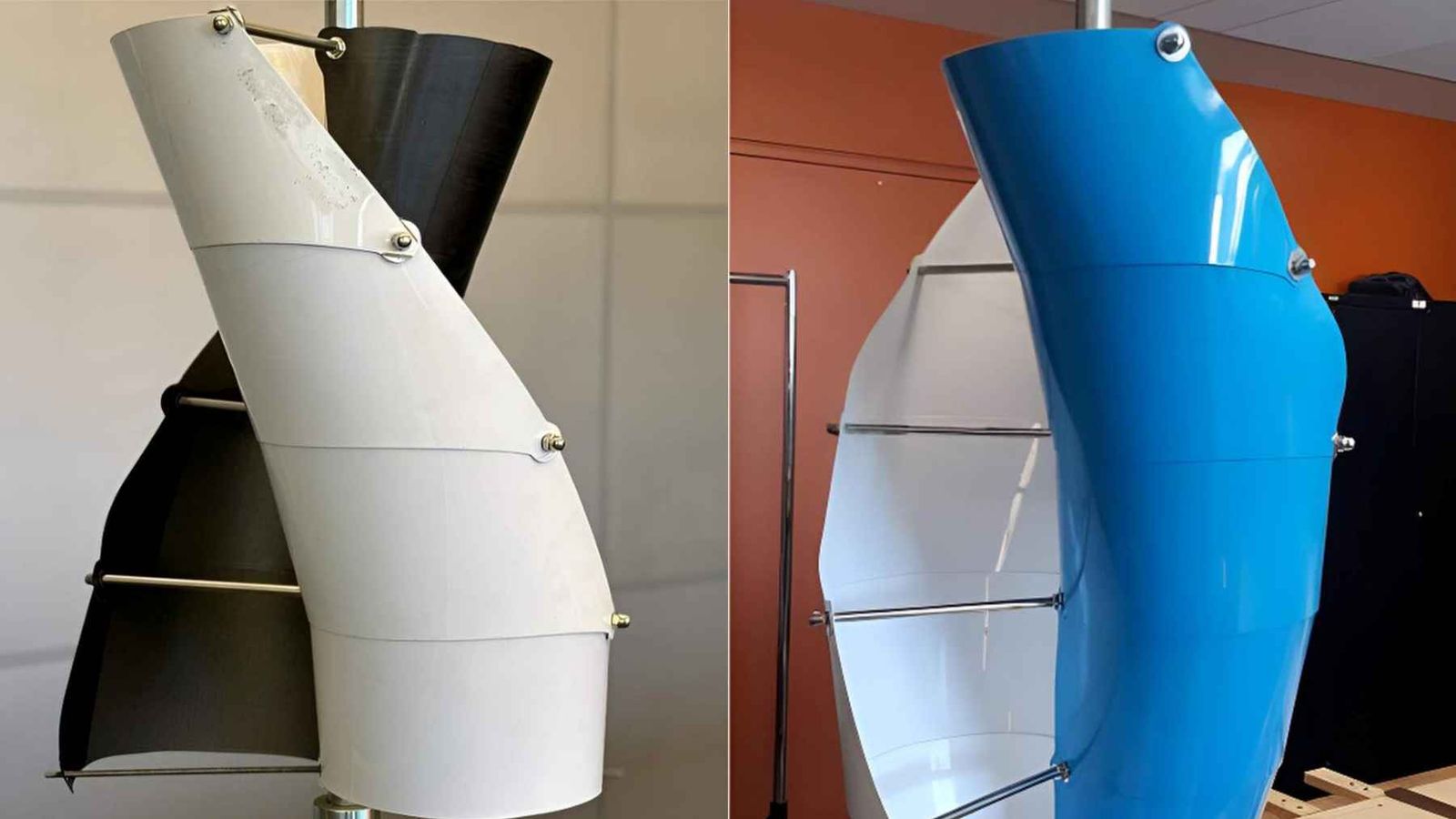
Researchers at Concordia University in Canada have developed carbon-fiber composite wind turbine blades that weigh approximately 80% less than their aluminum counterparts and demonstrate faster rotation speeds in laboratory tests. This advancement in blade manufacturing utilizes a method known as '4D printing of composites,' where flat carbon-fiber and epoxy panels are designed to curve into shape as they cool, eliminating the need for complex curved molds.
The process involves an 'inverse' design approach, where the desired blade geometry is defined first, and then the fiber layer orientations are calculated to achieve that shape. The resulting blade segments are composed of only three composite layers, each about 0.018 inches thick, and demonstrate consistent dimensional accuracy within 1% across samples.
While the lighter rotor mass allows for quicker acceleration and higher speeds under the same airflow conditions, the study did not measure electrical output, focusing instead on the manufacturing potential. The aluminum blades achieved rotation speeds of 27, 48, and 71 revolutions per minute at three fan settings, while the composite blades reached 30, 52, and 76 revolutions per minute, indicating speed gains of 11%, 8%, and 7%, respectively.
The prototype is based on a small vertical-axis wind turbine, suitable for rooftops and industrial sites where large horizontal-axis turbines are impractical. The flat mold manufacturing process could reduce development cycles and tooling costs, although the study did not provide a full cost analysis.
Before these blades can be considered for industrial use, further examination of bending stiffness, fatigue behavior, environmental durability, and safety under operational loads is necessary. Cost comparisons, repair needs, and end-of-life options for carbon-fiber versus aluminum blades also require further investigation.
The broader implications of this manufacturing technique extend beyond wind energy, potentially benefiting aerospace, automotive, and construction industries that require strong, lightweight curved structures. However, these applications would necessitate their own testing and validation. For now, Concordia's work serves as a proof of concept, demonstrating significant weight reduction and increased rotational speed, but not yet proving enhanced energy production or field durability.
Source: Carbon Fiber Feed