Self-powered graphene transistor mimics synapses for wearable sensors
Researchers developed a flexible graphene neural interface that mimics synapses, integrating transistors and rGO electrodes for wearable sensing applications.
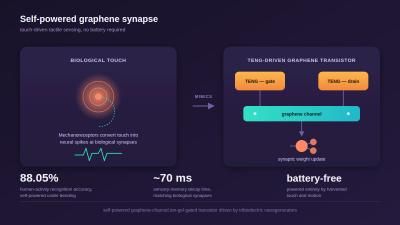
Researchers at Dongguk University in South Korea have developed a flexible graphene transistor that operates without a battery, mimicking biological synapses to recognize human activity. This self-powered graphene-channel transistor utilizes triboelectric nanogenerators to function without external power.
The graphene-channel ion-gel-gated transistor (g-IGT) is built on a flexible PET substrate. It features monolayer CVD graphene as the channel and an ion-gel electrolyte, based on the ionic liquid EMIM-TFSI, as the gate dielectric. Two triboelectric nanogenerators (TENGs) are integrated with the transistor: one connected to the gate provides pre-synaptic spikes, while the other connected to the drain provides post-synaptic spikes. These TENGs generate voltage pulses through contact and separation from touch or mechanical motion, driving ion migration within the gel and modulating the graphene channel's conductance. This process replicates synaptic signaling using harvested mechanical energy, eliminating the need for an external power source.
The device successfully reproduces memory behaviors observed in biological neural networks. It demonstrates sensory memory with a decay time of approximately 70 milliseconds, short-term memory decaying over 0.2–0.45 seconds, and transitions toward long-term memory with decay times exceeding 2 seconds under repeated stimulation. Additionally, the device exhibits spike-rate-dependent plasticity, where synaptic strength varies between potentiation and depression based on the firing rates at the gate and drain. This behavior remains stable under 1.1 MPa of bending stress.
In practical testing, the device's synaptic response was incorporated into a single-layer perceptron trained to classify six human activities, including walking, sitting, and standing, using the UCI Human Activity Recognition dataset. The self-powered, TENG-driven device achieved an 88.05% classification accuracy under bending, closely matching an ideal software model, and maintained over 75% accuracy even with high simulated signal noise.
Potential applications for this technology include self-powered wearable health monitors, electronic skin, smart prosthetics, and human-machine interfaces.
Source: Graphene Feed