Yonsei researchers create unclonable security keys from graphene light patterns
Yonsei University researchers created graphene diffractive zone plates that convert light patterns into unclonable binary security keys using a vision transformer-based model. The system shows promise for optical authentication.
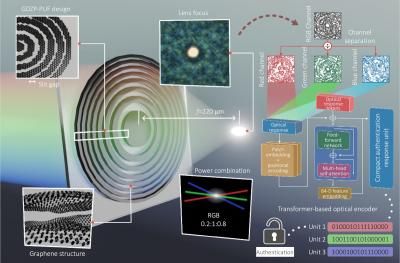
Researchers at Yonsei University have advanced the field of hardware authentication by developing graphene diffractive zone plates (GDZPs). These plates generate spectrally programmable optical responses, which are then converted into binary security keys using a vision transformer-based readout model.
The GDZP-PUF system operates by having RGB light strike the graphene zone plate, producing wavelength-dependent diffraction patterns. These patterns are transformed into compact binary authentication keys by the model. This innovation addresses a limitation of optical physical unclonable functions (PUFs), which traditionally produce analog images that are challenging to convert into stable digital outputs.
The graphene zone plates focus light through diffraction, a process highly dependent on wavelength. This results in different focal and interference patterns based on the RGB composition of the incident light. The diffraction pattern serves as a physical response shaped by the zone geometry and variations in the multilayer graphene structure. The vision transformer model converts these high-dimensional images into numerical representations, extracting stable components for 16-bit binary response units.
Testing showed the system's ability to generate repeatable binary responses with low error rates and clear separability across different spectral challenges. This establishes a proof-of-concept for programmable spectral-spatial optical authentication. Future work will focus on scalable fabrication and integrated optical readers for broader application.
Potential applications include optical security tags, anti-counterfeiting technologies, and hardware roots of trust for AI and connected devices, where reliance on software credentials is insufficient.
Source: Graphene Feed