SusWIND white paper outlines path to low-carbon RGF
The NCC-led SusWIND program reports that recycled wind turbine blade glass fiber can achieve a carbon footprint similar to virgin fiber if recyclers improve pyrolysis efficiency and polymer recovery.
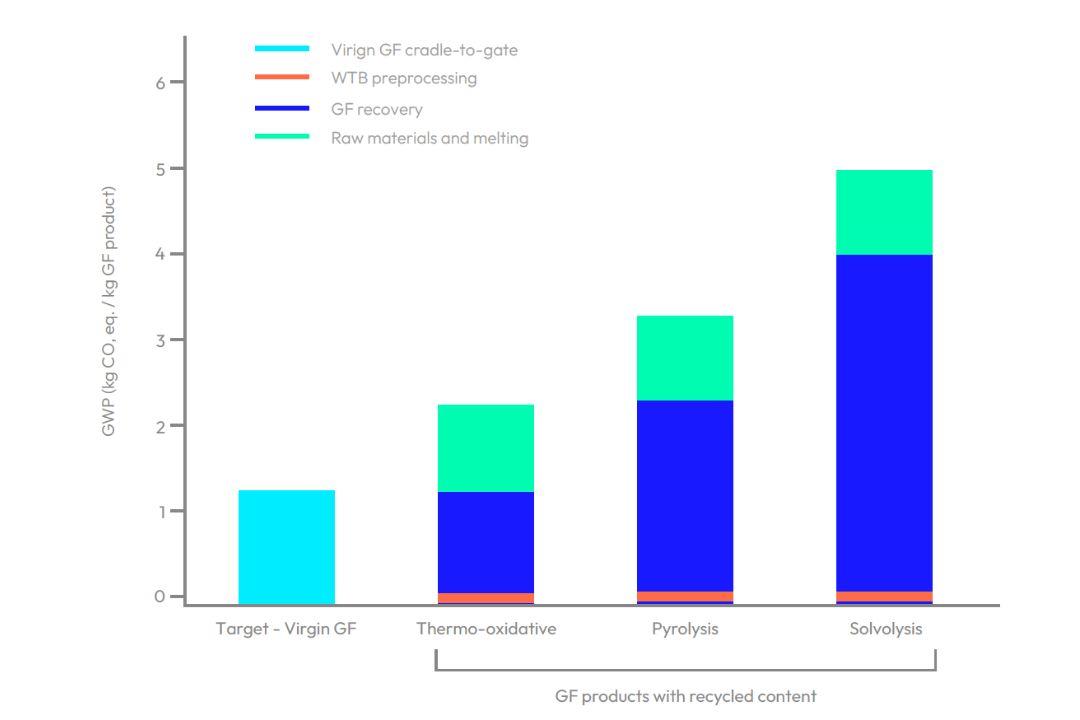
A recent white paper from the National Composites Centre (NCC) in Bristol, U.K., highlights the potential for recycled glass fiber from wind turbine blades to achieve a carbon footprint comparable to that of virgin glass fiber. This is contingent on recyclers adopting lower-energy recovery methods and enhancing polymer recovery during pyrolysis. The report, "Greener Glass Fibre: Closing the Loop on Wind Turbine Blade Recycling," is part of NCC's SusWIND initiative, in collaboration with the Offshore Renewable Energy (ORE) Catapult in Glasgow, U.K.
The study notes that reclaimed glass fiber from wind turbine blades is currently limited to lower-value applications due to its discontinuous form and diminished mechanical properties. As most wind turbine blades are constructed from glass fiber-reinforced polymer (GFRP), the volume of end-of-life blade waste is expected to increase significantly over the next two decades.
SusWIND conducted a life cycle assessment (LCA) of a two-phase closed-loop process involving the reclamation of glass fiber from wind turbine blade waste and its preparation for melting. The process aims to produce glass fiber with 50% recycled content by combining reclaimed material with virgin raw materials in a melt furnace. The analysis evaluated three recycling technologies—thermo-oxidative, pyrolysis, and solvolysis—using life cycle inventory data from Owens Corning.
The study found that glass fiber with recycled content currently has a higher carbon footprint than virgin glass fiber across all three recycling methods, primarily due to the recovery step. However, the melting phase is less carbon-intensive for recycled fiber. For pyrolysis, achieving energy self-sufficiency and recovering pyrolysis organics as secondary products could align its carbon footprint with that of virgin glass fiber. Detailed modeling results and target figures are available in the white paper.
The report recommends developing lower-value petrochemical applications for pyrolyzed polymer byproducts in the short term, while focusing on separation and purification techniques to enhance the quality of recycled polymers for higher-value applications in the long term. SusWIND's next phase will involve scaling the approach for large-scale demonstration, supported by further data collection.
Launched in 2021, SusWIND collaborates with wind energy OEMs, operators, developers, and recyclers to establish a circular supply chain for turbine blades. Partners include Vestas, SSE Renewables, EDF Renewables, Shell, the Net Zero Technology Centre, TotalEnergies, Owens Corning, bp, Scottish Power Renewables, The Crown Estate, Crown Estate Scotland, RenewableUK, BVG Associates, Zero Waste Scotland, and Scottish Renewables.
Source: Carbon Fiber Feed