Turning sargassum waste into high-performance carbon capture material
Researchers at Nankai University have developed Sar-KOH, a Sargassum-derived biochar with a CO2 adsorption capacity of 120.5 mg/g, using potassium hydroxide treatment before pyrolysis.
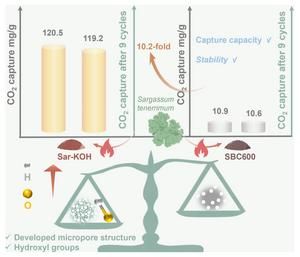
Researchers have developed a high-performance biochar from Sargassum tenerrimum, offering potential for carbon dioxide capture. The study, published in Biochar X, highlights the transformation of this marine biomass into a carbon adsorbent with enhanced CO2 adsorption capacity, rapid uptake, and strong regeneration stability. The process involves modifying the seaweed with potassium hydroxide (KOH) before converting it to biochar at 400 °C.
Lina Liu of Nankai University, the corresponding author, emphasized the importance of engineering both pore structure and surface chemistry to create an effective carbon adsorbent. The research demonstrated that preserving surface chemical groups that interact with CO2 is as crucial as creating more pores.
The study explored pyrolysis temperatures from 400 to 700 °C and different sequences of KOH modification. The optimal material, Sar-KOH, was produced by treating the seaweed with KOH before pyrolysis at 400 °C, achieving a CO2 adsorption capacity of 120.5 mg per gram at 313 K. This was significantly higher than untreated biochars, with the material retaining 98.9% of its capacity after nine cycles.
Microscopic and surface analyses revealed that KOH activation increased the biochar's specific surface area to 569.66 m²/g, compared to 1.14 m²/g for untreated biochar at 400 °C. The material's micropores, especially those smaller than 0.7 nanometers, are particularly effective for trapping CO2 molecules. The moderate pyrolysis temperature preserved hydroxyl groups on the biochar surface, enhancing chemical interactions with CO2.
The sequence of treatment was critical. Applying KOH after biochar formation resulted in a CO2 capacity of only 40.0 mg/g. Pre-pyrolysis treatment allowed KOH to interact effectively with the forming carbon structure, creating a more extensive porous network. Sar-KOH reached adsorption equilibrium in about 11 minutes, faster than untreated biochars.
This approach not only addresses carbon capture but also offers a sustainable use for marine biomass from harmful macroalgal blooms. Instead of treating Sargassum as waste, it can be a renewable feedstock for carbon-based adsorbents. Further research is needed to evaluate performance under realistic conditions and optimize production at larger scales.
The study provides a strategy for designing sustainable adsorbents, linking waste valorization with carbon capture, and addressing marine biomass challenges.
Source: Biochar Feed