Twisting 2D nanomaterials unlocks exotic quantum phases of matter
Researchers are studying exotic quantum phases in 2D nanomaterials by twisting them into moiré superlattices, with superconductivity in graphene observed at a 1.1° twist angle.
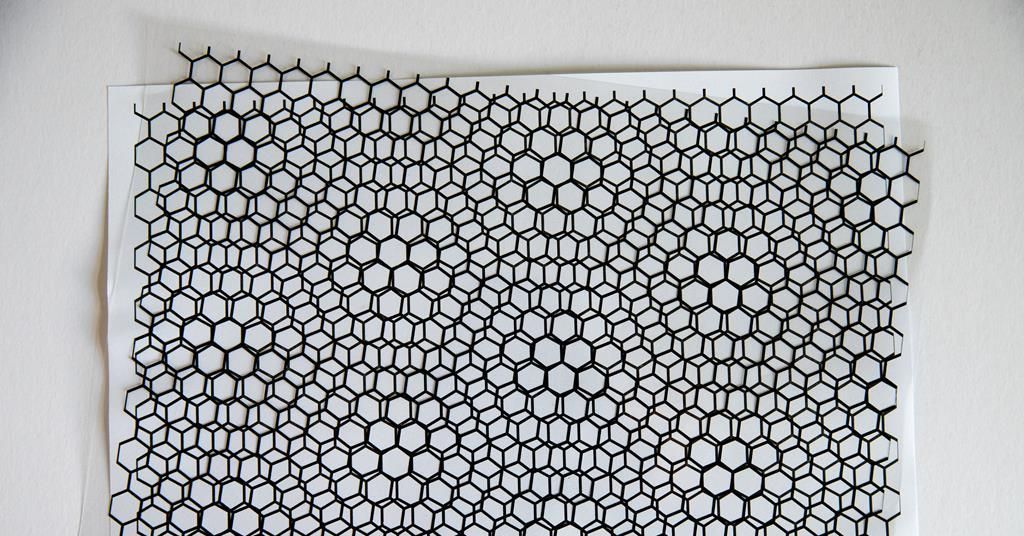
Graphene, a two-dimensional carbon nanosheet, is renowned for its distinctive honeycomb structure. Despite its familiarity, graphene continues to reveal new properties. When two graphene sheets are layered and twisted out of atomic alignment, the resulting moiré superlattice structures exhibit unique electronic properties. This phenomenon has captured the attention of both chemists and physicists.
The twisting of 2D nanomaterials like graphene can lead to significant changes in their properties. A slight twist can transform a non-magnetic material into a magnet or an insulator into a conductor. In graphene's case, a twist of approximately one degree can induce superconductivity. This discovery has spurred further research into the properties of twisted 2D materials.
In 2026, physicists Eva Andrei, Pablo Jarillo-Herrero, and Allan MacDonald received the Kavli prize in nanoscience for their work on superconductivity in magic angle moiré superlattice graphene. Their research has inspired further exploration into exotic quantum phases of matter in twisted 2D nanomaterials.
Chemists are now exploring the effects of twisting more complex 2D nanomaterials, such as covalent organic frameworks and MXenes. These efforts aim to uncover new properties and potential applications. For instance, Letian Dou at Emory University is investigating twisted bilayer 2D perovskites, which have shown unusual behaviors when probed with lasers.
Dahlia Klein from the University of Chicago has been developing a quantum twisting microscope to study these materials. This tool allows researchers to twist 2D nanomaterial bilayers in situ, providing new insights into their electronic structures. The ability to manipulate the twist angle offers a novel way to explore electronic properties beyond traditional chemical synthesis.
The study of moiré superlattice structures in 2D nanomaterials opens up new possibilities for tuning electronic properties. These structures allow for the addition of electrons in ways not possible with conventional materials, offering a new dimension of control over electronic behavior.
Source: Graphene Feed