Can restoring land create jobs? These young entrepreneurs are proving it
Young entrepreneurs in Ecuador, Senegal, Nigeria, and Bangladesh are transforming land restoration into economic opportunities, supported by the Youth Ecopreneur Programme. Their projects integrate technology and sustainable practices to boost productivity and market viability.
A new generation of entrepreneurs is transforming land restoration into economic opportunity, with a focus on advanced carbon materials. From Ecuador to Bangladesh, these innovators are demonstrating that restoring land can generate income and improve livelihoods, supported by a United Nations-backed initiative.
In Ecuador, Carlos Alfredo González Vargas founded Pacchar in 2021 to address declining agricultural productivity and the waste of forestry and agricultural residues. Pacchar converts these residues into biochar, a type of charcoal that enhances soil by retaining water and nutrients, while also storing carbon for extended periods. The company collaborates with cocoa, banana, rose, and vegetable producers across several provinces, impacting over 100 farming communities and restoring more than 500 hectares of land.
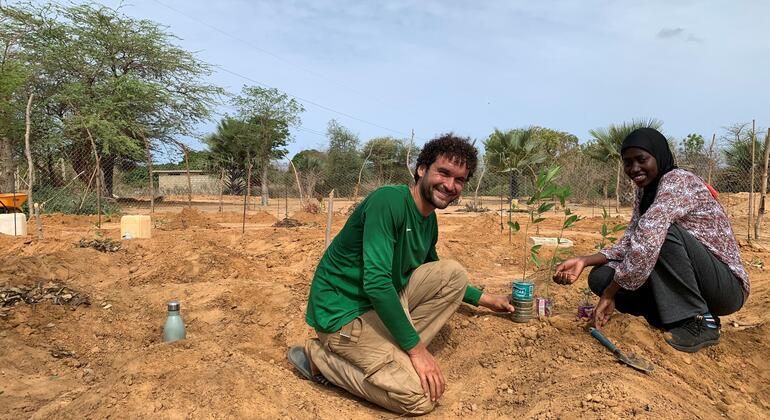
In Senegal, Daniel Halman leads Féro, which integrates high-productivity greenhouses with agroforestry systems. This model allows for quick crop sales while planting fruit trees and native species elsewhere, balancing production with restoration. Halman emphasizes the need for economic viability in restoration efforts, combining restoration with greenhouse crops to meet market demands.
Ritkatmun Bwemana, co-founder of Green Eden Farms in Nigeria, developed ScareGrow, a solar-powered precision agriculture system. This technology aids farmers in making informed decisions about water and inputs, ensuring efficient resource use. Bwemana stresses that restoration must offer tangible benefits to land-dependent communities.
In Bangladesh, Mashrur H. Shurid developed Aunkur, a system that uses data on soil, weather, and farm conditions to guide small producers in crop management. Aunkur supports over 33,000 farms and connects producers with buyers and financial institutions, enhancing decision-making and market access.
These entrepreneurs participate in the Youth Ecopreneur Programme (YECO), an initiative of the International Trade Centre and UNCCD’s G20 Global Land Initiative. The program supports young people in developing environmental businesses, aiming to create a restoration economy that generates livelihoods and market opportunities. The initiative's broader goal is to make restoration sustainable through community-driven solutions that activate markets.
Source: Biochar Feed