Carbon nanotube offers EMI shielding and heat concealment
Researchers have developed multifunctional films using Ti3C2Tx and carbon nanotube fibers to protect military electronics by providing EMI shielding and heat management.
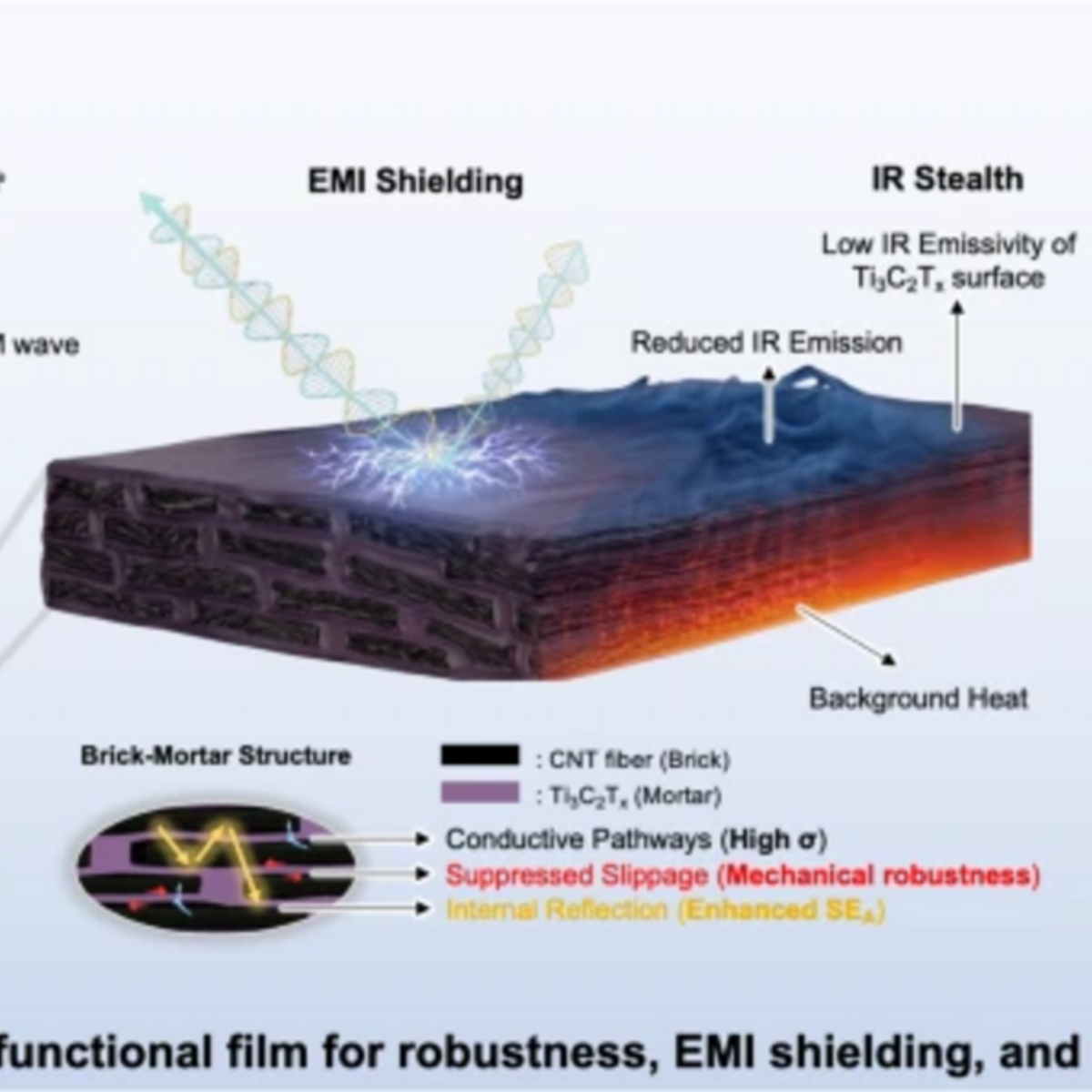
Researchers have developed a composite film utilizing carbon nanotube fibers and MXene to provide electromagnetic interference (EMI) shielding, infrared stealth, and high mechanical strength. This film is primarily intended for military electronics protection but may also be applicable in 5G/6G and wearable devices.
Traditional metallic shielding materials are often heavy, rigid, and prone to corrosion. In contrast, carbon nanotube fibers offer a lightweight and mechanically robust alternative with effective EMI shielding properties. However, their fibrous form poses challenges for assembly into larger structures. MXene, known for its low infrared emissivity, is suitable for stealth applications but lacks mechanical strength and stability.
The new hybrid composite film integrates the strengths of both materials. The process involves treating carbon nanotube fibers with amine groups to enhance bonding with MXene. These fibers are then passed through a MXene solution and wound together to form a film. In this structure, the CNT fibers act as the structural "bricks," while MXene serves as the conductive "mortar" filling the spaces between.
The MXene mortar enhances mechanical strength by preventing fiber slippage and creates continuous electrical pathways that improve EMI shielding. Additionally, the MXene coating reduces infrared emission, making the material less detectable by infrared systems like thermal imaging cameras. The film is only 17.5 micrometers thick, about one-fifth the thickness of a human hair, and achieves an EMI shielding effectiveness of approximately 90 decibels, blocking over 99.9999999% of electromagnetic waves in communication and radar frequency bands.
With a tensile strength of 1.02 gigapascals, comparable to high-strength steel, the film performs well under high-temperature and high-humidity conditions. Although not yet cost-effective, it is compatible with continuous fabrication processes, suggesting potential for large-scale production in the future.
Source: MXenes