Curved carbon from cobalt framework enhances fast-charging battery anodes
Researchers at the North University of China have optimized nitrogen-doped carbon nanotubes for lithium-ion battery anodes by pyrolyzing ZIF-67 at 700 degrees Celsius, enhancing fast-charging capabilities.
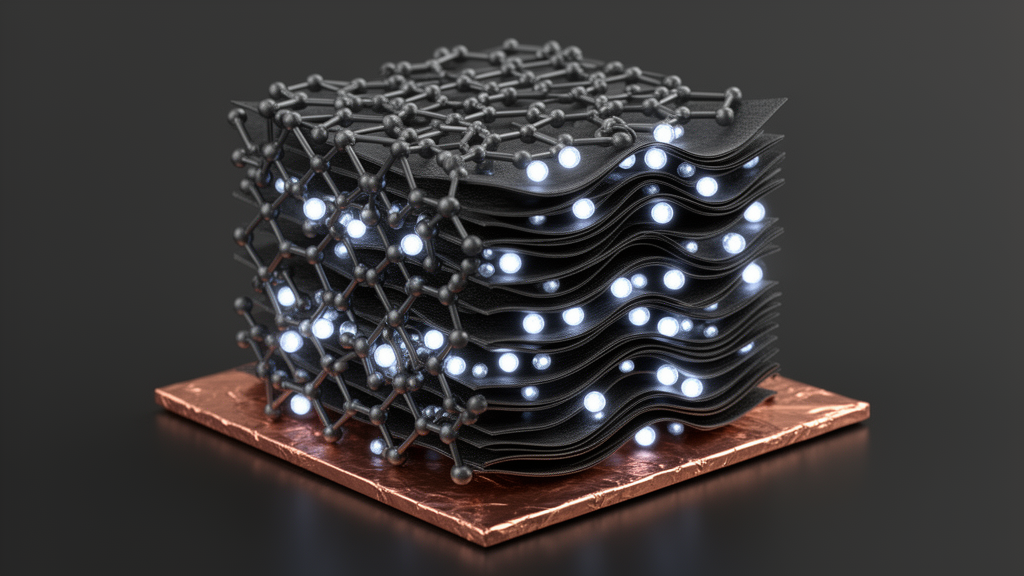
Researchers at the North University of China in Taiyuan have demonstrated that the pyrolysis temperature of a cobalt-based zeolitic imidazolate framework (ZIF-67) significantly influences the performance of nitrogen-doped carbon nanotubes (N-CNTs) as lithium-ion battery anodes. The study, published in the journal Ionics, reveals that heating ZIF-67 at 700 degrees Celsius yields N-CNTs with superior lithium storage capabilities, outperforming those produced at 500 and 900 degrees Celsius.
ZIF-67 consists of cobalt ions linked by organic imidazolate ligands, forming a porous structure. When heated, the framework collapses, catalyzing the growth of carbon nanotubes and incorporating nitrogen atoms. This process results in a composite material with enhanced conductivity and catalytic properties, essential for efficient battery anodes. The researchers found that the 700-degree sample, labeled N-CNTs-700, achieved the optimal balance of microstructure and chemical composition.
The study highlights the unique atomic geometry of the carbon in N-CNTs-700. Unlike traditional graphite with flat hexagonal sheets, this material exhibits an expanded interlayer spacing due to five-membered carbon rings, creating curved regions known as Riemann surfaces. These structural features facilitate lithium ion storage by providing additional binding sites and space for ion movement.
Electrochemical tests showed that N-CNTs-700 delivers a reversible capacity of 970.1 milliampere-hours per gram at 0.1 amperes per gram, significantly surpassing commercial graphite. It maintains 356.2 milliampere-hours per gram at 8 amperes per gram and retains 130 milliampere-hours per gram after 1,000 cycles at 3 amperes per gram. This performance is attributed to the conductive nanotube network and nitrogen defects, which introduce extrinsic pseudocapacitance, enabling fast charge-transfer reactions.
The material also forms a bilayer solid-electrolyte interphase (SEI) with an inorganic-rich inner layer and an organic-rich outer layer. This architecture reduces the energy barrier for lithium ion desolvation and minimizes interfacial charge-transfer resistance, crucial for fast charging.
These findings connect to broader battery research trends, emphasizing the importance of surface interactions in determining charging speed. By controlling pyrolysis temperature, the study offers a scalable approach to optimizing carbon anodes for high-rate applications, highlighting the role of atomic-scale curvature and interfacial chemistry in advancing battery technology.
Source: Carbon Nanotubes Feed