Dynamic terahertz wavefront control with stretchable single-wall carbon nanotubes
Researchers from China and Russia have developed stretchable metasurfaces using single-walled carbon nanotube (SWCNT) film, achieving dynamic terahertz wavefront manipulation at 0.35 THz. This advancement is significant for the development of smart, wearable THz components in 6G communication and intelligent sensing applications.
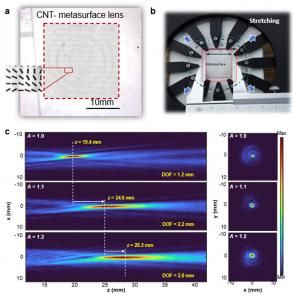
Researchers from China and Russia have developed stretchable metasurfaces using single-walled carbon nanotube (SWCNT) film, enabling dynamic terahertz (THz) wavefront manipulation. These metasurfaces, designed for focal-length tuning and controllable beam deflection, achieve continuous tuning at 0.35 THz through mechanical stretching. This advancement supports the development of smart, wearable THz components for 6G communication and intelligent sensing.
The THz frequency range, positioned between microwaves and infrared light, holds potential for advancements in wireless communication, security imaging, and non-destructive sensing. However, the lack of compact, tunable components has hindered progress. While metasurfaces offer control over electromagnetic waves, most remain static post-fabrication, limiting their dynamic application.
In a study published in Light: Advanced Manufacturing, a team led by Professor Yan Zhang from Capital Normal University, alongside collaborators from Beijing Jiaotong University and several Russian institutions, demonstrated a novel approach. They created stretchable THz metasurfaces from SWCNT film on a silicone substrate, allowing dynamic wavefront control via mechanical deformation. Unlike conventional plasmonic metasurfaces that crack under strain, the SWCNT-based design maintains optical functionality due to the nanotubes' elasticity and conductivity.
The first device, a focal-length-tunable metasurface lens, shifts its focal point backward as stretching strain increases, resulting in a significant focal length increase. The second device, a dynamic beam-steering off-axis metasurface lens, achieves both longitudinal focal point displacement and lateral beam deflection through mechanical stretching. Experimental results confirm the capability of these devices for mechanically tunable THz beam steering.
This technique paves the way for smart, lightweight, and wearable THz components. Researchers anticipate the evolution of this platform into programmable and adaptive photonic systems, crucial for future 6G networks, real-time security screening, and intelligent human-device interfaces.
Source: Carbon Nanotubes Feed