Graphene-powered soft lens may lead to smarter glasses, cameras, and medical devices
Researchers at Queen Mary University of London have developed a graphene-based soft lens that can electronically change focus without bulky parts, potentially advancing medical devices and cameras.
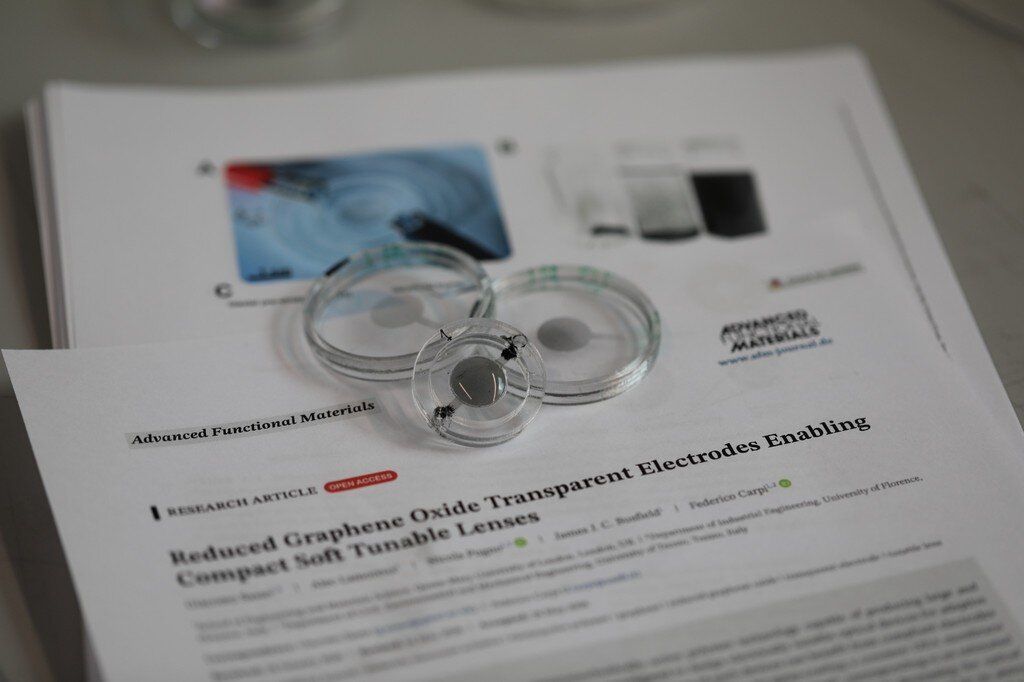
Researchers at Queen Mary University of London have developed a transparent graphene-based material that enables soft lenses to electronically change focus without bulky moving parts. Led by Professor James Busfield, the team has addressed design constraints in electrostatically actuated lenses, paving the way for compact medical imaging devices, autofocus cameras, and wearable displays.
Published in Advanced Functional Materials, the study showcases ultrathin transparent electrodes made from reduced graphene oxide integrated into a soft, electrically driven lens. This innovation allows the lens to alter its focal distance by applying a small electric field, mimicking the flexibility of a living eye.
Unlike traditional lenses that use opaque electrodes, the new design incorporates transparent electrodes directly onto the expanding actuator beneath the lens. This reduces the device's size and complexity while maintaining optical clarity.
The research team carefully balanced the amount of graphene on the soft membrane to achieve the necessary electrical performance and optical clarity. The prototype successfully adjusted its focus across various distances, demonstrating the potential for a new generation of adaptive optical devices.
Although still in the research phase, this technology could lead to thinner, quieter, and more energy-efficient optical systems. Potential applications include autofocus cameras, wearable displays, virtual and augmented reality headsets, and miniature medical imaging devices.
The study also highlights the role of soft robotics and advanced materials in transforming technology. Electrically active polymers, similar to artificial muscles, change shape in response to electrical signals, offering a novel approach to optical system design. Further work is needed to enhance the transparency and performance of the graphene electrodes, but the findings show that soft, electrically tunable lenses can be manufactured using simple techniques and affordable materials.
Source: Graphene Feed