MXene-NiO-PPy composite absorbs microwaves and resists corrosion
Researchers created a MXene-NiO-PPy composite achieving both microwave absorption and corrosion resistance, with optimal performance at 16.16 GHz and a thickness of 7.6 mm.
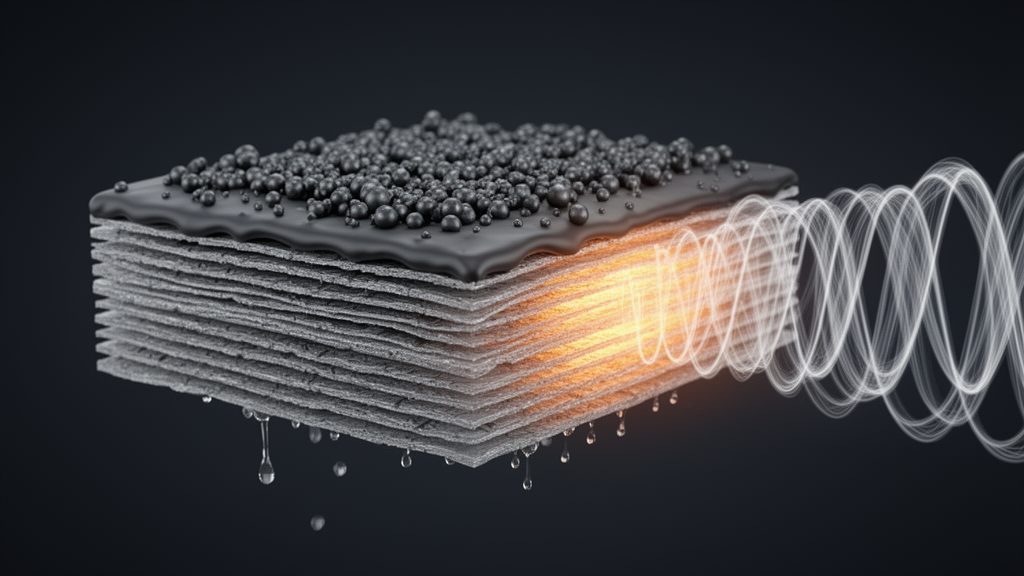
A new ternary composite material combining MXene, nickel oxide (NiO), and polypyrrole (PPy) has been developed to offer both strong microwave absorption and long-lasting corrosion protection. This material, detailed in the Journal of Materials Science, features a unique "sheet-wire" architecture. In this structure, NiO nanowires and polypyrrole coatings are uniformly anchored on MXene layers through in situ polymerization. The innovation addresses the dual demands for electromagnetic interference control and durable metal protection, which have increased with the proliferation of 5G communication, radar detection, and marine equipment.
Traditional microwave absorbing materials often face challenges such as high density, poor impedance matching, or inadequate corrosion resistance. Binary composites typically lack the multifunctional synergy needed for these applications. The researchers optimized the ternary composite by adjusting the mass ratio of its components. The formulation with an MXene:NiO:PPy ratio of 1:1:0.75 demonstrated the best microwave performance, achieving a minimum reflection loss of −36.80 dB at 16.16 GHz with a thickness of 7.6 mm.
The study attributes the enhanced microwave absorption to dielectric loss linked with conductive loss, interfacial polarization, and dipolar polarization. These factors, along with optimized impedance matching and multiple reflection effects within the heterogeneous network, contribute to the material's performance.
NiO plays a crucial role by creating abundant heterogeneous interfaces and regulating the local dielectric environment. This supports interfacial polarization and facilitates impedance matching, enhancing the composite's effectiveness.
In terms of corrosion protection, when the composite was integrated into waterborne epoxy coatings at a 1.5 wt% loading, it provided excellent long-term resistance. In tests, after 60 days of immersion in a 3.5 wt% sodium chloride solution, the coating exhibited a charge transfer resistance of 1.285 × 10⁵ Ω·cm², indicating its ability to block electrochemical reactions that cause metal corrosion.
The research findings are based on laboratory measurements of engineered composites and coatings under specific test conditions, including a fixed salt concentration and immersion period. While the study highlights the composite's performance in these tests, broader questions about durability, cost, and large-scale manufacturing remain unaddressed. Nonetheless, the research presents a design strategy for multifunctional coatings that combine microwave absorption and anticorrosion capabilities in a single material system.
This study was published on October 27, 2026, in the Journal of Materials Science by a team of researchers including Qingsong Zhu, Yongtao He, Siyu Hao, Peng Wang, and Zimeng He.
Source: MXenes