Natural clay channels exhibit responsive ion transport at the angstrom scale
Researchers at the National Graphene Institute demonstrated that vermiculite clay channels can control ion flow in response to pressure, voltage, and pH, mimicking biological ion channels.
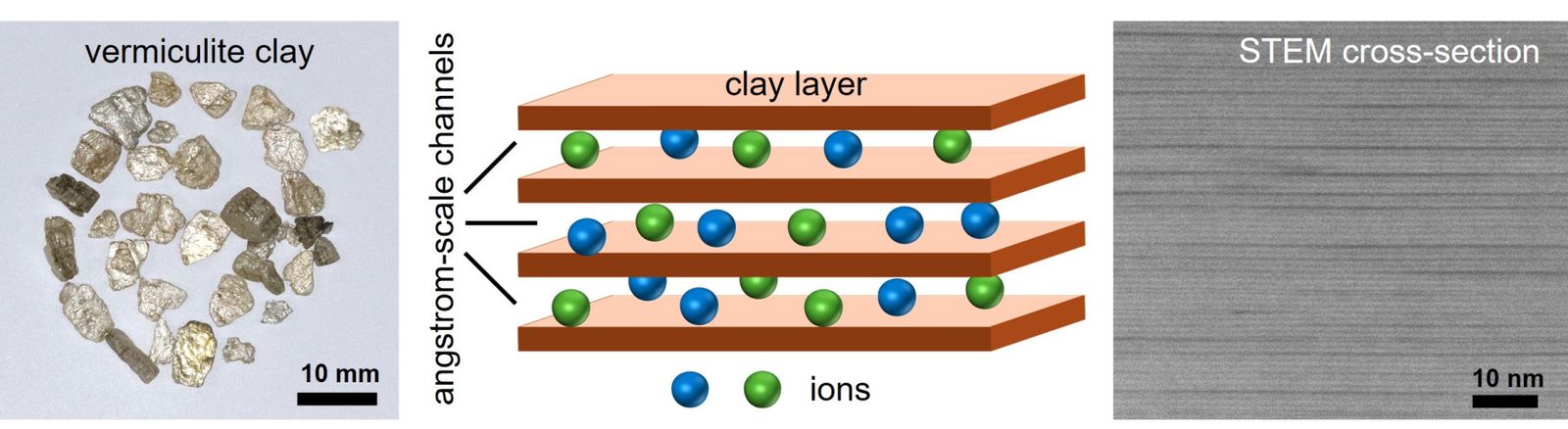
Researchers at the National Graphene Institute have demonstrated that naturally occurring channels within vermiculite, a common clay mineral, can respond to pressure, voltage, and pH. This discovery opens up possibilities for controlling ion movement through extremely small, confined spaces. The study, published in Advanced Materials, highlights vermiculite's structure, which contains channels only a few angstroms high, providing naturally confined pathways for ion transport.
Inspired by biological ion channels, which respond to multiple environmental signals to regulate ion movement across cell membranes, the researchers explored whether vermiculite's angstrom-scale channels could exhibit similar responsive ion transport. They found that the channels could alter both the amount and direction of ion flow depending on the applied stimuli, such as mechanical, electrical, and chemical signals.
The channels in vermiculite naturally favor positively charged ions. By adjusting the acidity of the surrounding solution, the researchers could influence this selectivity. Pressure and electrical voltage also affected ion travel through the channels, revealing a complex interplay between different stimuli.
Dr. Raj Kumar Gogoi, the study's first author, noted that applying pressure and voltage together could change ion behavior in ways not observed when each stimulus was applied separately. Under certain conditions, the direction of the pressure-driven current could even reverse, showcasing the system's sensitivity to multiple environmental inputs.
To understand these phenomena, the researchers combined laboratory experiments with computational modeling. Prof. Narayana R. Aluru from the University of Texas-Austin explained that conventional models could not fully explain the observations. They introduced a modified surface-charge regulation model, where pressure, voltage, and ion concentration influence ion distribution inside the channels and modify the charge at the channel surface, affecting ion transport.
This new approach, unlike conventional models that consider surface charge as a function of ion concentration alone, incorporates the combined effects of voltage, pressure, and concentration. The findings suggest that naturally layered materials could offer a versatile platform for studying and controlling ionic transport at extremely small scales. While future applications could include adaptive nanofluidic systems, energy conversion devices, and bioelectronic platforms, these were not explored in the current study.
The research was conducted by scientists from the Department of Physics and Astronomy, National Graphene Institute, and Photon Science Institute at The University of Manchester; the Department of Mechanical Science and Engineering and Beckman Institute for Advanced Science and Technology at the University of Illinois Urbana-Champaign; and the Walker Department of Mechanical Engineering at The University of Texas at Austin.
Source: Graphene Feed