Self-healing PU coating protects electronics
Researchers in South Korea have created a self-healing waterborne polyurethane coating that shields electronics from electromagnetic interference. The coating repairs damage with heat or near-infrared light.
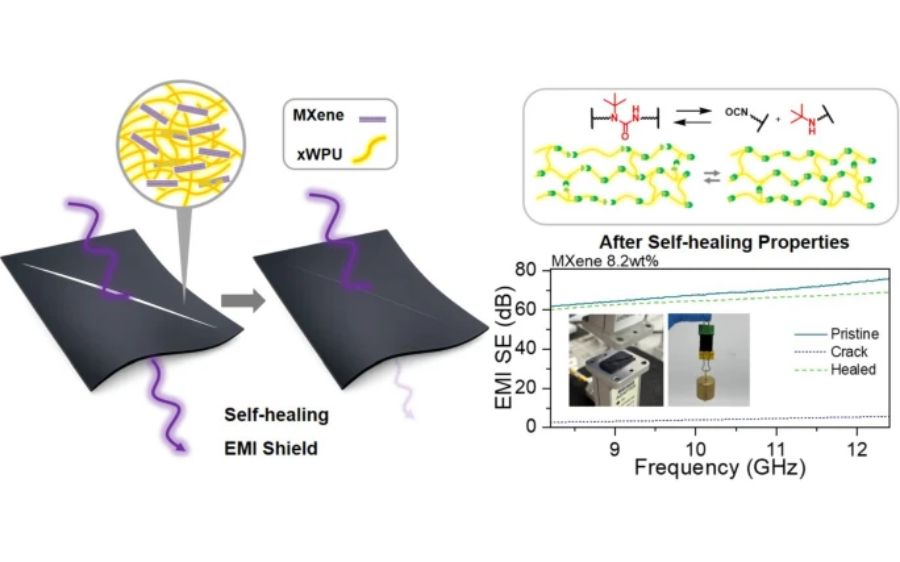
Researchers in South Korea have developed a waterborne polyurethane coating that offers electromagnetic interference (EMI) shielding and can self-repair using heat or near-infrared light. This innovation is particularly relevant for flexible electronics where EMI shielding must endure repeated mechanical stress.
The coating integrates a dynamically crosslinked waterborne polyurethane with Ti3C2Tx MXene, an electrically conductive two-dimensional material. This combination is designed to maintain shielding effectiveness despite bending, scratching, or other mechanical damage. Conductive coatings typically protect electronic devices by reflecting or absorbing electromagnetic radiation, but damage can disrupt the conductive network, reducing performance.
To address this, researchers constructed the polyurethane using reversible hindered urea bonds. These bonds enable the polymer network to rearrange when heated, closing cracks and restoring mechanical properties. The polyurethane also provides hydrogen-bonding sites that interact with MXene surfaces, enhancing the dispersion of conductive particles and improving load transfer.
The composite achieved its electrical percolation threshold at a MXene loading of 1.6 wt%. Beyond this threshold, a continuous electrical network forms through the coating. At 8.2 wt% MXene content, the composite demonstrated an EMI shielding effectiveness of 55.6 dB, with tensile strength and Young’s modulus increasing by 55% and 335%, respectively, compared to unfilled polyurethane.
The coating showed good adhesion to various plastic substrates, crucial for applications in electronic housings, flexible devices, and automotive components. Damage repair is possible by heating the coating, which allows hindered urea bonds to exchange and polymer chains to reorganize, nearly restoring original properties.
Localized repair using near-infrared irradiation was also demonstrated. MXene converts incident light into heat, enabling targeted repair without affecting the entire component. The dynamic polyurethane network allows the material to be thermally reprocessed multiple times, retaining almost all of its mechanical properties, which could reduce material waste during manufacturing.
Potential applications include flexible and wearable electronics, electronic enclosures, and components for electric vehicles, where electromagnetic compatibility is increasingly critical. The research was conducted by the Korea Institute of Science and Technology, Korea University, the University of Science and Technology, and KCC Corporation.
The study, “High-performance and self-healable electromagnetic interference shielding coatings based on waterborne dynamic polyurethane and Ti3C2Tx MXene composites,” was published in Advanced Composites and Hybrid Materials on July 25.
Source: MXenes