Teijin develops new thermosetting carbon fiber-reinforced plastic with self-healing properties
Teijin Limited has developed a thermosetting carbon fiber-reinforced plastic with a self-healing function and high recyclability, aiming to provide samples by 2028.
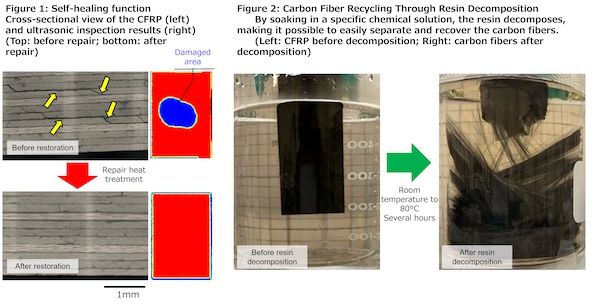
Teijin Limited has introduced a new thermosetting carbon fiber-reinforced plastic (CFRP) that integrates a heat-activated self-healing function with high recyclability, while maintaining mechanical properties comparable to traditional CFRPs. This development allows damaged areas to be repaired through brief heating, extending product life and minimizing resource use.
The new CFRP from Teijin can be recycled using a straightforward chemical decomposition process, supporting circularity. Its strength and light weight make it suitable for applications in aircraft, automobiles, and sporting goods. The demand for products that reduce greenhouse gas emissions throughout their lifecycle is increasing. Conventional CFRPs, made by impregnating carbon fiber with thermosetting resin, cannot be remolded, and their waste is often incinerated or landfilled, highlighting the need for environmentally friendly alternatives.
Teijin has been working to lower greenhouse gas emissions and waste through initiatives like Tenax Next, its carbon fiber brand based on circular feedstocks. The company has now developed a new resin that retains the mechanical properties of conventional materials while enabling recycling through resin decomposition and featuring a self-healing function. This resin is incorporated into a circular thermosetting CFRP that reduces environmental impact while providing the strength and rigidity of traditional CFRPs.
If the resin layer of the CFRP is damaged, it can be repaired by heating it at a specified temperature for a short time. This feature allows the continued use of deteriorated CFRP material, preventing premature disposal and waste. Unlike conventional CFRPs, which cannot be remolded due to the non-melting nature of the thermoset resin, Teijin’s new CFRP exhibits flowability when heated within a specified temperature range, allowing for recycling through compression molding and other methods.
Traditionally, separating carbon fiber from recovered thermosetting CFRP requires thermal decomposition of the resin at high temperatures, a process with a significant environmental impact. Teijin’s CFRP can be decomposed by soaking in a specific chemical solution, enabling easy separation of long carbon fibers from the thermoset resin. This method is less energy-intensive and environmentally burdensome.
Teijin plans to provide samples of this CFRP product by 2028 and will continue research and development in collaboration with universities and research institutions. The company aims to expand the use of this CFRP in various applications, particularly in aircraft, automobiles, and industrial machinery, where weight reduction, durability, and reduced environmental impact are crucial.
Looking ahead, Teijin will focus on optimizing material formulation, component design, and recycling processes for mass production and social implementation of the new CFRP. The company is also seeking joint development projects to advance application development and build a supply chain with partner companies. Teijin remains committed to minimizing environmental and social impacts while enhancing the performance of its solutions.
Source: Carbon Fiber Feed