The Graphene Commercialization Maturity Journey
Terrance Barkan of The Graphene Council published a framework mapping the commercialization maturity journey of graphene through stages from discovery to mature commercialization, identifying nine recurring obstacles including capital access, regulation, standardization, and value chain complexity. The framework positions graphene as approaching proven commercial viability in multiple application areas—including composites, construction materials, and thermal management—while arguing that its "killer application" lies in broad adoption as a performance-enhancing additive across sectors rather than in any single use case.
Terrance Barkan*
The Graphene Council, New Bern, NC, USA
*Corresponding author: Terrance Barkan – [email protected]
ABSTRACT
Human history has been defined by the dominant materials in use at that time, from the stone age until the age of silicon. As new, disruptive materials have been either discovered or developed, they have had to earn their place in society. Graphene and other new nanomaterials are no different. The Graphene Commercialization Maturity Journey is a review of the different stages of development that virtually all new materials have had to navigate on the road to commercial viability. The paper also identifies and reviews a common set of obstacles that must be addressed, any one of which can be a cause of failure for a material to become a commercial success. In this paper we define the stages of development, the associated challenges, and how they evolve over time. We have also provided examples for comparison and to illustrate the point. This framework will help assess graphene’s current position in its journey toward commercialization and can be applied to any of the many new advanced 2D nanomaterials that are currently at the early stages of development.
The Graphene Commercialization Maturity Journey
The commercialization maturity journey, whether for graphene or for almost any other material since the beginning of time, is an evolution through a common progression of stages. In addition to these development stages, new materials also face an almost universal set of “obstacles” on the path to commercial adoption.
However, the specific obstacles encountered, as well as the duration of each stage, are not uniform. The timeline from a material's discovery to its widespread commercial use varies significantly. Some materials are swiftly replaced by superior alternatives—such as the transition from stone tools to metals—while others, like glass, continue to find new applications even after 4000 years.
In the following sections, the stages of development, the associated challenges, and how they evolve over time are outlined. This framework will help assess graphene’s current position in its journey toward commercialization.
Emergence of New Materials
New, disruptive materials often arise from unintended discoveries. For example, Charles Goodyear’s discovery of vulcanized rubber in 1839 occurred when he inadvertently dropped a mixture of rubber and sulfur onto a hot surface. Instead of melting, the material hardened, resulting in a more durable and heat-resistant form of rubber.[1]
A similar instance of serendipity occurred with the development of the Post-it note adhesive. In 1968, Dr. Spencer Silver at 3M was attempting to develop a strong adhesive but ended up with a low-tack formula. Initially considered a failure, the material later became the basis for Post-it notes after years of being overlooked.[2]
These examples are not unique. Many materials and technologies remain underutilized or unrecognized when first discovered due to the lack of an immediately obvious application. Tom Eagar’s article in MIT Technology Review highlights several cases where there were delays of up to 20 years between the discovery of a material and its commercial adoption.[3]
In the case of graphene, its theoretical existence was first proposed by P. R. Wallace in 1947 [4], and graphene-like materials were described as early as 1962. However, it wasn’t until 2004, when Novoselov and Geim successfully isolated graphene, that the material began attracting significant attention.[5] This moment is considered the starting point for modern graphene research. Interest in the material accelerated dramatically in 2010, following the awarding of the Nobel Prize in Physics to Konstantin Novoselov and Andre Geim, and the enthusiasm surrounding graphene’s potential continues to grow to this day.
Development Stages
All new materials, from the dawn of time, face a similar set of challenges, obstacles and development stages on the journey to widespread commercial adoption. For those that succeed that is.
The stages that virtually all new materials go through on a journey to commercial adoption include:
• Discovery Stage
Discovery (intentional or accidental) is the obvious starting point for innovative materials. The ability to actually isolate graphene as a single atomic layer of sp2 bonded carbon led to huge interest in the entirely new category of two-dimensional (2D) advanced materials. This in turn has launched research into how to create other 2D or atomically thin materials including, for example, MXenes which are created from transition metals.[6-8] Global research in 2D materials is currently racing to discover the next generation of advanced 2D materials, encompassing both pure elements and combinations of atomic layers in heterostructures, offering hundreds of thousands of potential configurations. Regardless, each new material, no matter how novel or exceptional its characteristics, will still face the harsh reality of competition with legacy materials as well as market forces if it is ever to see the outside of a research laboratory, once discovered.
• Early Research
Research is primarily the realm of academia, especially when it comes to the basic research of discovering new and novel materials. Corporations have increasingly outsourced research and development activities, either to dedicated research companies or to universities.[9] Because of its now well-known properties of extremely high electrical and thermal conductivity, its inherent strength and flexibility, impermeability, high surface area, resistance to UV radiation and resistance to harsh environments, graphene has unlocked the imagination of researchers all over the world and from virtually every discipline.[10]
These versatile properties mean that graphene can be used in so many different ways; as an electrical conductor in one instance, as a thermal heat spreader in another or as an efficient sensing surface in yet another. As a result, a broad look at the body of more than 300,000 graphene research papers might give the impression that graphene can do anything and everything.[11]
However just because graphene “can” do something does not mean that graphene should be used for a particular application when compared to an existing solution or other alternatives. A great portion of the research that has been done with graphene, especially from academia and even from the European Union (EU) Graphene Flagship, represents a “technology push” as opposed to a “market pull”.[12] In the context of 2D materials, technology push refers to innovations driven by advances in materials science, such as new methods for scalable production[13], enhanced functionalization[14], and integration into composites[15]. These breakthroughs often outpace immediate market demand, emphasizing graphene's potential across diverse industries. On the other hand, market pull focuses on meeting specific industry needs, such as improved energy storage for batteries, lightweight and durable materials for transportation, better lubricants or advanced electronics.[16] This has also been discussed at length in previously published comments with respect to graphene for the graphene commercial sector.[17, 18]
• Early Development
Application development, which we define as “trying to make something intentionally that is expected to work and that solves a defined problem”, is an example of the market pull approach. Early attempts to anticipate how graphene would develop into commercial applications resulted in a series of roadmaps.[19] In many cases, these roadmaps were unable to anticipate the way graphene would (and continues to) evolve in reality based on market pull because they were an expression of a “technology push” bias.
Just as early users of aluminum as an exotic metal for jewelry or displays of wealth could not anticipate the throw away and disposable uses of aluminum as a food wrapper or container we have today (please recycle), early proponents of graphene did not foresee using graphene as an exotic nano material in commonplace construction materials like concrete or asphalt.[20, 21]
The current early application development phase is witnessing innovative used of graphene, such as in medical diagnostic sensors that have a much higher sensitivity of detection with a faster response while require much less energy. The global objective to reach a “Net Zero” economy is also driving industries and entrepreneurs to consider all the ways graphene can help reduce embedded carbon, from improved recycling of plastics to energy use reduction to developing the next generation of energy storage devices.
• Early Commercialization
Pilot trials of either production methods and/or applications often face significant challenges, and in many cases, these early attempts fail. However, we continue to see new innovations in the methods of producing graphene from a wide array of carbon-bearing raw materials. From mechanical exfoliation to chemical vapor deposition (CVD), and from graphite to other carbon precursors such as methane, researchers have explored various techniques to optimize yield, quality, and scalability.[22] Ongoing research and focused development leads to incremental improvements in production methods and applications. Occasionally, these efforts result in unexpected breakthroughs that push the boundaries of graphene's potential.
New entrants will often experiment and work with the new material in novel and unexpected ways that helps to discover new applications or new production methods. For graphene for example, concrete was never an obvious application. Early roadmaps and projections had focused on graphene’s electrical and not its mechanical properties and therefore overlooked strength related applications.
This sometimes messy stage for a new material is where original assumptions might be crushed, greater awareness is developed and knowledge is built cumulatively. There is a tug of war between inventors that try to push their technologies (example, using graphene for wearable electronics), and pull from customers (industrial or consumer) trying to solve a specific problem, for example the desire to improve textile performance.
• Commercialization Go / No Go
There comes a stage where a material is either deemed to have proven commercial utility or is abandoned—this is the “go/no go” stage. In the early days of the graphene sector, until even perhaps five years ago, one could reasonably ask, “Does graphene work?” However, the real question was, “Does it work well enough to justify changing what I am currently doing or using?” Additionally, there was the matter of whether the results could be reliably repeated. Today in many application areas the answer is a definite “Yes!”. For example, the use of graphene based cooling films in mobile phones by Chinese phone manufacturer Huawei, which employs this technology in millions of devices.[23] Another example would be use of graphene for composites in sporting goods for lightweighting of structures.[24]
Once we get past the point of proving a particular graphene solution technically works, every business, to be sustainable, must be also able to answer the questions:
“What defined problem are we solving?”
“How important is this problem? (What is it worth to solve it?)”
“How much better is graphene compared to the second-best alternative?”
“How big is the addressable market?”
“What are the legislations surrounding adoption?”
“What are the ley economic factors influencing the adoption?”
If the material works or has promise (think of Bakelite/plastics in the beginning and when the first products emerged) there can be a “Cambrian” period of explosive growth with many new start-ups as inventors, investors and founders etc. rush in to grab a stake in a new area. This could be a good description of graphene from about 2010 until present. As more and more production methods have been proven and more and more applications have been tested and brought to market, it is attracting new entrants and continues to stimulate investment in the sector.
• Mature Commercialization
At this stage, market and environmental factors will shape how fast, or slow, the industry will develop into a mature, widespread and significant industrial sector. There were periods where plastics, carbon fiber (CF), aluminum, glass fiber, etc. did not exist as commercial successes, and then there were turning points or milestones when these materials became significant industries (production and application) in their own rights.
To illustrate this further, case study of CF is discussed in further detail with key milestones. It was first prepared in 1879 by carbonization of cotton and bamboo fibers and used by Thomas Edison for incandescent light bulb filaments. However, it wasn’t until 1960s when high-strength and high-modulus CF were prepared by Union Carbide using rayon and polyacrylonitrile precursors. An important milestone for the CF industry was a joint technological venture between Toray Industries and Union Carbide in 1970 to develop PAN based CF production which holds a strong dominance in the current global market. First commercial products using CF were lightweight fishing poles introduced in 1972, which offered almost 50% reduction in weight. It wasn’t until mid 1970s that CF found its way to the aerospace industry, spurred by the demand of lightweight structures due to the oil crisis. With a gradual penetration into the commercial aviation industry by 2000s, broader adoption of CF in the aerospace industry began with key milestones being development of Boeing 787 and Airbus A350 comprising of over 50 % carbon fiber reinforced polymers (CFRP). By 2010,further CF applications were developed and demand surged due to its use in automotive, structural infrastructure, sporting goods and renewable energy sector for wind energy. Commercial adoption only accelerated after large-volume and cost effective production was possible.[25]
The time taken for each stage to be completed depends on a variety of factors. This also does not mean that all new materials take at least 20 years for commercialization. There are some key examples in the history of materials where materials have taken significantly less time to achieve commercial success for example, the solder alloy made up of Sn, Ag and Cu was first invented in 1994 and it was embraced as an industry standard in 2006, which means it took less than 12 years for it to be commercialized.[26] Another key example is the invention of Nd2Fe14B permanent magnets which were discovered in 1984 and achieved commercial production by 1986, which is just 2 years.[27]
Learning from their success, Alexander King derived some key similarities in their commercialization maturity journey.[28] The main factor was that these materials were discovered to meet the specific need of these industries rather than it being developed because their extraordinary properties were expected to find revolutionary applications. For example, Sn/Ag/Cu solder was invented to mitigate the environmental concerns posed by use of lead and mainly rose to popularity after its use was mandated by Japan and EU in 1997. In a similar way, Nd2Fe14B magnets were introduced because of shortage of cobalt in 1978 for samarium-cobalt magnets.
The examples provided by Tom Eagar which suggest that it takes almost 20 years for materials to commercialize consist of materials with exceptional new capabilities but there were no ready products in the market where they could have been “plugged-in” and used directly.[3] Their success depended on the development of new products which can take advantage of the materials’ exceptional properties.
This is the case with graphene. When it was initially discovered, it was produced using scotch-tape method by mechanically peeling off the layers. It took some years for its properties to be properly understood and methods for bulk production to be developed. In the past decade, many techniques for bulk production have emerged which have enabled the use of graphene as an additive in large-volume materials markets like polymers, cement, and textiles among the others, due to improved production quantity and acceptable costs. Since its discovery, the use of graphene has been explored across an extremely broad range of application verticals simultaneously. Due to the exceptional intrinsic properties, a lot was expected from graphene in the very beginning due to which it went through a hype cycle. This graphene hype cycle is described in literature in out previous publication.[29] Today, graphene is being used in real world applications and making a difference by delivering superior products. Similar to the case of Nd2Fe14B magnets, for which new uses have emerged, early commercial adoption in a single key application is typically the shortest route for commercialization. That one quickly successful application is often the one which is created by the new material, rather than the one where it offers only incremental improvement.[11]
Obstacles to the emergence of a new material
Each of these materials had to navigate a common set of adoption barriers at different stages of commercialization, as shown in Figure 1. These barriers to adoption are described in detail as below.
• • Capital - Access to capital (seed money, venture capital, private equity, capital markets, etc.) is essential for the launch and growth of any significant commercial initiative and graphene is no different. Because materials development takes time, investors need to calibrate their expectations on timelines. Risk appetite also differs in different regions of the world with the USA having the most dynamic capital markets compared to Europe, which can be much more risk averse.[30] The good news for the graphene sector is that the amount of capital required is relatively small compared to many other industries in terms of capital expenditure due to simplicity of some production processes which do not require pre or post-processing or use of extensive chemicals.
• Regulatory - Regulatory environments can have a significant impact on the speed to market for any new product, including new materials. Because nano materials are relatively new, the regulatory environment can pose a significant obstacle as these materials are also new to the regulators and a large body of knowledge about the potential risk factors is not complete. This is changing with graphene gaining approvals on a case-by-case basis in the US and having been approved in the EU, for example. This can also have a favorable effect on the materials adoption if the poorer alternatives are deemed to be unsafe. For example, the U.S. Tire Manufacturers Association has identified graphene as one of the potential candidates to phase out 6PPD used in tires as 6PPD is known for its harmful ecotoxic effects.[31] If it is proven that graphene indeed is a suitable candidate for this, a very large consumer market would become open for graphene due to the regulatory changes.
• Grants & Subsidies - Governmental support in the form of incentives, grants or demand (consumption) can help an industry get over critical gaps between discovery and commercial sustainability. Famously, the EU funded the Graphene Flagship, a 10 year, € 1 billion initiative which was recently completed and renewed under a different funding structure, had been successful in popularizing graphene through research and development projects.
• Health & Safety – As a nano material, graphene is being scrutinized for any potential human and / or environmental health hazards. Because graphene is primarily carbon, it is expected to be largely benign, which is what most current studies have been indicating.[32] As additional studies are completed and with good safe handling procedures, graphene should be easily managed in a safe and responsible way, especially in comparison with other materials we handle every day which have clearly toxic profiles.
• Standardization - Standards can provide transparency and trust to a market. A lack of established and accepted standards can hinder adoption by inviting confusion or a lack of trust from consumers. Today we have well defined material specifications for commonly used materials like grades of steel, glass fibers (e-glass), etc. This is not yet fully defined for graphene but the work being done by The Graphene Council through established standards bodies like American National Standards Institute (ANSI), the International Organization for Standardization (ISO), the International Electrotechnical Commission (IEC), the British Standards Institution (BSI), ASTM International (formerly the American Society for Testing and Materials) and others is making clear progress.
• Intellectual Property – Intellectual property availability or suppression can help determine if and how quickly a competitive field emerges. Although more than 150,000 patents have been filed related to graphene production and application, there are multiple paths to both make and use graphene. With more than a dozen different potential feedstocks and a dozen methods of production, no single company nor country has a stranglehold on graphene production or application. This ubiquitous availability creates a fertile environment for innovation and rapid adoption.
• Competition - Competition from legacy materials and products that are threatened or that compete with new materials, like graphene, are to be expected. In the case of graphene, another carbon allotrope, carbon nanotubes, can also be considered a competing material as well as all other materials that perform similar effects as graphene. Competition can also come from another new material or innovation that threatens the new material before it gets started. For example, if new concrete solutions eliminate the need for traditional cement, there may be no market for graphene to reduce embedded CO2 in concrete.
Adoption/Acceptance - Customer adoption or barriers to adoption can play a significant role. Some industries or markets adopt innovation and change at a fast pace, for example in the auto sector where change is perpetually in motion. Some industries and markets are quite slow or resistant to change because they have their own impediments, such as in the aerospace sector which has very long regulatory timelines to approve anything that flies. This is also well illustrated by the integration of carbon fiber as a dominant aerostructure material due to its desirable weight-to-strength ratio. It was first documented as a material in 1897 and was invented in its current form in the mid 1960s. It took more than 20 years to find its use in aerospace and more than 30 years before it became a primary material for the Boeing 787.[25] The shear inertia that confronts trying to introduce and build a new industry from scratch can be significant.
• • Market Fit - As materials and industries mature, more efficient and scalable production methods are typically adopted that squeeze out smaller and less efficient market players. Eventually, a relatively small number of the most efficient and scalable players dominate the majority of the addressable market with many smaller players that serve specialist or niche markets.
• Value chain complexity – Complexity in the material’s value chain can also inhibit the material’s adoption, especially when it requires significant realignment from key market players. A good example for this is the use of polycarbonate for automotive glazing.[33] The weight-reduction benefits are significant but it requires suppliers at different tiers to change their production processes, which in turn depends on whether or not original equipment manufacturer (OEMs) signal the need to change. OEMs on the other hand are unwilling to integrate a new material unless they see a stable supply chain. This is a situation where different players in the supply chain literally wait for the other to make the first move.
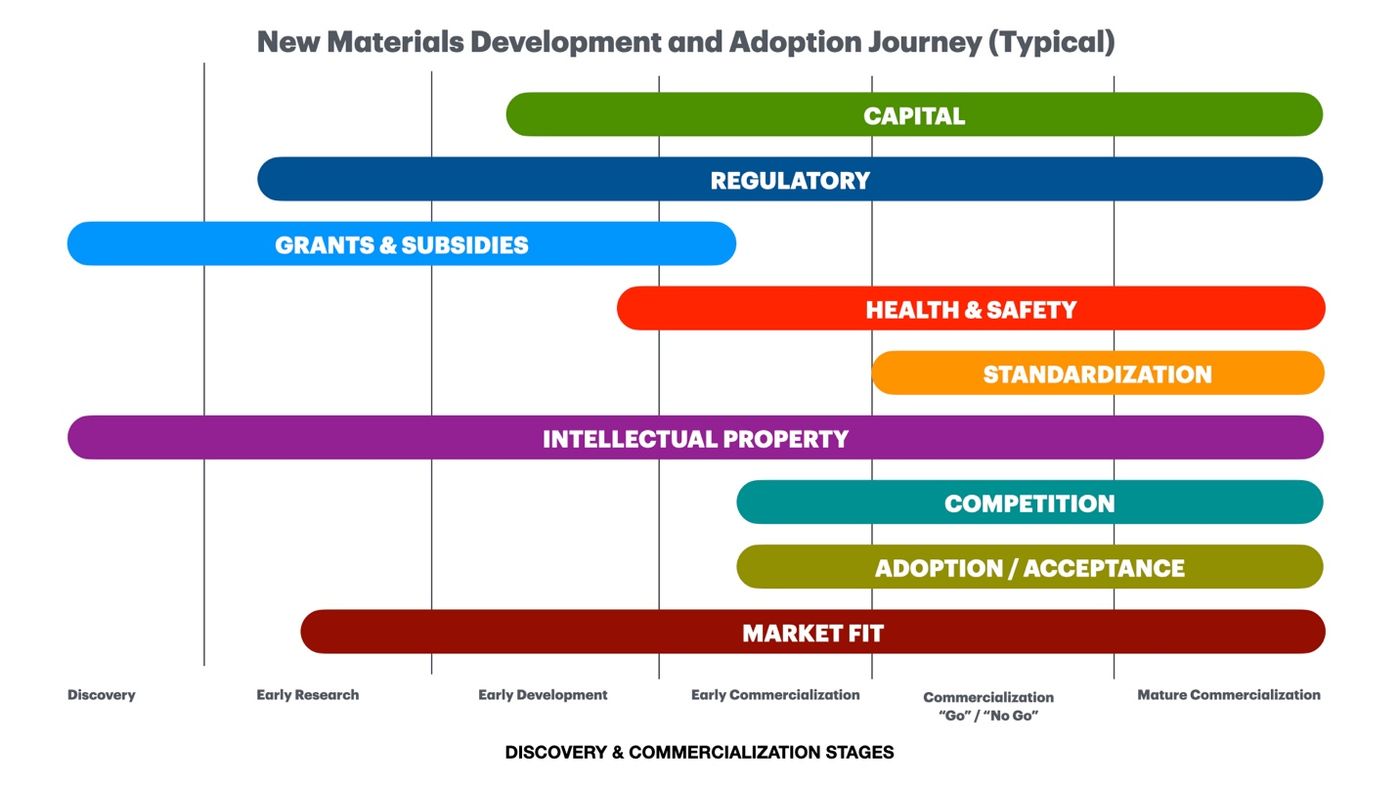
Figure 1 Commercialization pathway illustrating the obstacles encountered in the development and adoption journey for new materials
So, given all of the above, where is graphene today?
We believe that graphene will follow the traditional development stages that every other material that has ever been discovered or invented has had to follow on its journey to commercialization. We also believe that because graphene materials can be exploited for any one or more of its exceptional electrical, thermal, strength or other properties, it will find a wide array of commercial applications, in the same way that plastics or glass materials are used quite broadly today.
Graphene will not only find applications that only it can deliver, like spintronics or quantum computing, it will also be used as a component or additive in very small doses (often less than 1% by weight) to improve other materials.
The “killer application” for graphene is not a single use or product. The “killer application” for graphene is that it will find its way into many industries and will deliver an array of benefits, often in tandem (e.g. electrical and thermal conductivity, strength and flame retardation, etc.).
Graphene is rapidly (in historical terms) advancing along the commercial maturity journey. The Graphene Council is aggressively addressing key environmental obstacles, specifically regarding standards, regulations and adoption, through awareness campaigns and education.
By having all stakeholders working together (producers, customers, regulators and others), we can help accelerate graphene’s commercialization journey by attacking obstacles while focusing on those applications where graphene adds the greatest value. This will result in graphene’s commercialization journey taking years, instead of decades.
References
1. Stephens, C., A brief history of the development and use of vulcanised rubber in dentistry. British Dental Journal, 2023. 234(8): p. 607-610.
2. Nayak, P.R. and J. Ketteringham, 3M’s post-it notes: A managed or accidental innovation. The human side of managing technological innovation, 1997: p. 367-377.
3. Eagar, T.W., Bringing new materials to market. Technology Review, 1995. 98(2): p. 42-49.
4. Wallace, P.R., The Band Theory of Graphite. Physical Review, 1947. 71(9): p. 622-634.
5. Novoselov, K.S., et al., Electric Field Effect in Atomically Thin Carbon Films. Science, 2004. 306(5696): p. 666-669.
6. Anasori, B. and Y. Gogotsi, MXenes: trends, growth, and future directions. Graphene and 2D Materials, 2022. 7(3): p. 75-79.
7. Gogotsi, Y. and B. Anasori, The Rise of MXenes. ACS Nano, 2019. 13(8): p. 8491-8494.
8. Ratwani, C.R., et al., Tuning Surface Terminations and Hydration Interactions in MXene Nanosheet-Based Hydrogel Composites for Self-Healable Strain Sensors. ACS Applied Nano Materials, 2024. 7(17): p. 20196-20205.
9. Howells, J., Research and Technology Outsourcing. Technology Analysis & Strategic Management, 1999. 11(1): p. 17-29.
10. Singh, V., et al., Graphene based materials: Past, present and future. Progress in Materials Science, 2011. 56(8): p. 1178-1271.
11. Barkan, T., et al., Mapping the landscape for graphene commercialization. Nature Reviews Physics, 2024.
12. Dixon, J. The market pull versus technology push continuum of engineering education. in 2001 Annual Conference. 2001.
13. Choi, S.H., et al., Large-scale synthesis of graphene and other 2D materials towards industrialization. Nature Communications, 2022. 13(1): p. 1484.
14. Ratwani, C.R., et al., Surface Modification of Transition Metal Dichalcogenide Nanosheets for Intrinsically Self-Healing Hydrogels with Enhanced Mechanical Properties. Small, 2023. 19(22): p. 2207081.
15. Ratwani, C.R., et al., Enhanced Self-Healing in Dual Network Entangled Hydrogels by Macromolecular Architecture and Alignment of Surface Functionalized hBN Nanosheets. Advanced Materials Interfaces, 2024: p. 2400691.
16. Barkan, T., et al., Mapping the landscape for graphene commercialization. Nature Reviews Physics, 2024. 6(11): p. 646-647.
17. Reiss, T., K. Hjelt, and A.C. Ferrari, Graphene is on track to deliver on its promises. Nature Nanotechnology, 2019. 14(10): p. 907-910.
18. Barkan, T., Graphene: the hype versus commercial reality. Nature Nanotechnology, 2019. 14(10): p. 904-906.
19. Ferrari, A.C., et al., Science and technology roadmap for graphene, related two-dimensional crystals, and hybrid systems. Nanoscale, 2015. 7(11): p. 4598-4810.
20. Alateah, A.H., Graphene concrete: Recent advances in production methods, performance properties, environmental impact and economic viability. Case Studies in Construction Materials, 2023. 19: p. e02653.
21. Liu, Z., et al., Mechanism and performance of graphene modified asphalt: An experimental approach combined with molecular dynamic simulations. Case Studies in Construction Materials, 2023. 18: p. e01749.
22. Dexter Johnson, T.B., The Graphene Report. 2023, The Graphene Council.
23. Guduru, R.K. and A.A. Gupta, Consumer Applications of Graphene and Its Composites, in Handbook of Consumer Nanoproducts, S. Mallakpour and C.M. Hussain, Editors. 2022, Springer Nature Singapore: Singapore. p. 471-500.
24. Spasenovic, M., Applications of Graphene, in Surface and Interface Science. 2020. p. 513-536.
25. Zhang, J., et al., Past, present and future prospective of global carbon fibre composite developments and applications. Composites Part B: Engineering, 2023. 250: p. 110463.
26. Miller, C.M., I.E. Anderson, and J.F. Smith, A viable tin-lead solder substitute: Sn-Ag-Cu. Journal of electronic materials, 1994. 23: p. 595-601.
27. Croat, J.J., et al., Pr‐Fe and Nd‐Fe‐based materials: A new class of high‐performance permanent magnets (invited). Journal of Applied Physics, 1984. 55(6): p. 2078-2082.
28. King, A., Faster: Accelerating the Transition from Materials Discovery to Commercial Deployment. JOM. Journal of the Minerals, Metals & Materials Society, 2018. 71(IS-J-9985).
29. Barkan, T. Graphene’s coming of commercial age. 2022 [cited 2024 22/11/2024]; Available from: https://www.thegraphenecouncil.org/blogpost/1501180/476235/Graphene-s-coming-of-commercial-age.
30. Laïdi, Z., Europe as a Risk Averse Power. A hypothesis. 2010.
31. Preliminary (Stage 1) Alternatives Analysis Report Motor Vehicle Tires Containing N-(1,3dimethylbutyl)-N′-phenyl-p-phenylenediamine (6PPD). 2024, U. S. Tire Manufacturers Association.
32. Ratwani, C.R. and T. Barkan, Human trials suggest graphene inhalation may be safe. Graphene and 2D Materials, 2024. 9(1): p. 3-4.
33. Hotaka, T., et al., Industrialization of automotive glazing by polycarbonate and hard-coating. Polymer Journal, 2019. 51(12): p. 1249-1263.

Dr Chirag Ratwani is a materials scientist specializing in the integration of nanomaterials into composites, with a strong focus on 2D materials like graphene for smart materials and structural applications. He holds an MSc in Advanced Chemical Engineering from the University of Manchester and a PhD in Materials Science from Bournemouth University. His work emphasizes the commercialization and scale-up of advanced material technologies, and he has led multiple industry-focused projects. He has consulted on national strategies for advanced materials and leads the international task forces aimed at health and safety compliance and standards development for graphene.