Enhancing shape sensing of slender medical robots with carbon nanotubes
Researchers at Zhejiang University have developed a piezoresistive fiber bandage using multi-walled carbon nanotubes for shape sensing in slender medical continuum robots. This innovation provides a low-cost, highly stretchable alternative to fiber-optic systems, potentially expanding the use of carbon nanotube-based sensors in medical robotics for improved intraoperative guidance.
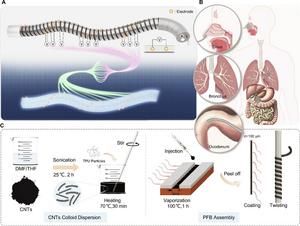
Researchers at Zhejiang University have developed a novel sensor for medical continuum robots using multi-walled carbon nanotubes (CNTs). The sensor integrates CNTs into a thermoplastic polyurethane matrix, forming a piezoresistive fiber bandage (PFB) that enhances shape sensing capabilities. This PFB is thin, flexible, and stretchable, offering a cost-effective alternative to fiber-optic systems.
The PFB, measuring 250 µm in thickness, can extend up to 400% of its original length and maintains a linear resistance-strain response up to 30% strain. When helically wrapped around a robot, the fiber's resistance shifts with the robot's bending, providing detailed deformation data. Electrodes placed every 2 cm along the fiber capture resistance changes, which are then processed by neural networks to map the robot's shape.
Professor Haojian Lu and his team divided the robot into three sections, each monitored by a separate neural network. These networks translate resistance changes into arc parameters, achieving low error rates in shape reconstruction. Tests in 3D-printed anatomical models and an ex vivo pig intestine demonstrated the sensor's effectiveness in real-time shape feedback, crucial for surgical navigation.
The sensor's design allows it to be easily added to existing robots, increasing their functionality without significant modifications. While the current prototype requires further refinement, including reducing wiring complexity and improving model accuracy, the potential for dual-purpose shape and force sensing is being explored.
This research, supported by various Chinese foundations and published in Cyborg and Bionic Systems, highlights the promise of CNT-based sensors in enhancing robotic surgery precision. The work was authored by Pingyu Xiang, Xiangyu Mi, Hongye Zhang, Fei Wang, Xiong Yang, Yue Wang, Rong Xiong, Song Liu, and Haojian Lu.
Source: Carbon Nanotubes Feed