Review Explores Uranium Separation Using Biochar Strategies
Researchers reviewed biochar materials for uranium separation, noting amino-functionalized biochar's adsorption capacity of 368 mg/g. Sorption was identified as the most effective separation method.
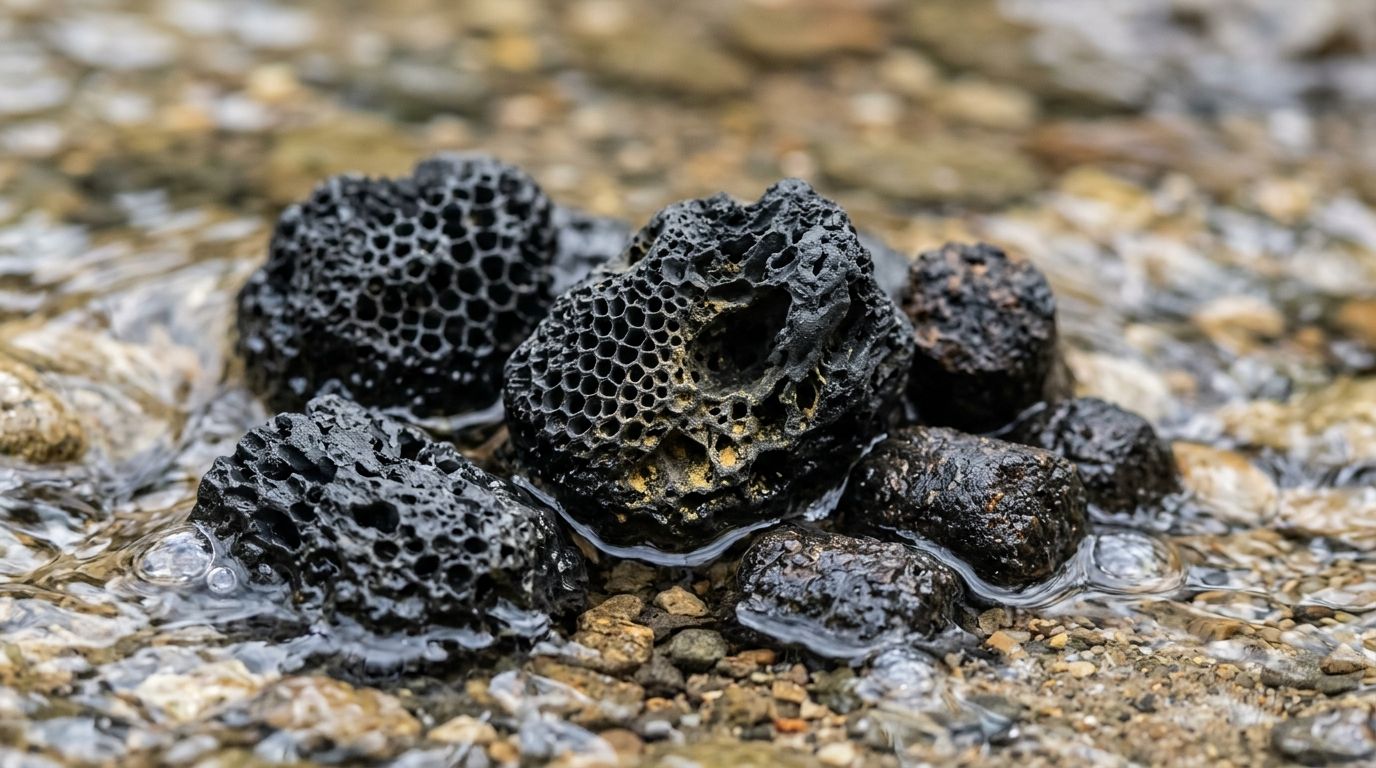
A detailed review published in the journal Biochar in June 2026 explores the use of biochar-based porous materials for the selective separation of uranium from aqueous solutions. Led by Zhenli Sun and colleagues, the study compiles recent research on how these materials can be employed through sorption, precipitation, photocatalysis, and electrocatalysis. The authors highlight the growing demand for efficient uranium recovery methods due to the expansion of nuclear energy, particularly from complex sources like natural seawater and salt lakes, to support sustainable nuclear power plant operations.
Biochar and its modified composites are noted for their potential in practical applications due to their cost-effective synthesis, environmental friendliness, and high surface areas. These materials have abundant functional groups that enable strong uranium ion binding, along with high stability and reusability. The review points out that while raw biochar has limited selectivity for uranium amidst competing metal ions, surface modification with functional groups such as amidoxime or phosphate is essential for achieving selective separation. This selectivity is primarily driven by ligand-specific coordination, electrostatic interactions, and redox transformations under catalytic conditions.
Sorption is identified as the simplest technique for uranium separation, suitable for low-concentration systems and large-scale operations. The review describes studies where biochar was functionalized to enhance adsorption capacity. For example, amino-functionalized biochar achieved a uranium adsorption capacity of 368 mg g⁻¹ at pH 5.0, with chemical complexation involving carboxyl, hydroxyl, and amino groups contributing to high selectivity. Another study with phytic acid-functionalized biochar reported a sorption capacity of 625 mg g⁻¹ at pH 6, demonstrating high selectivity even with competing ions like calcium, magnesium, and copper.
Advanced spectroscopic techniques, such as Fourier-transform infrared spectroscopy and X-ray photoelectron spectroscopy, have elucidated the mechanisms of sorption, revealing that surface complexation, electrostatic attraction, and ion exchange are key pathways for uranium binding. For instance, in phosphorus-doped biochar, uranium ions complex with phosphate groups and are attracted to the negatively charged surface. Column experiments have shown these materials can reduce uranium concentrations in wastewater, with potential for regeneration using dilute hydrochloric acid.
Precipitation strategies are effective at high uranium concentrations, where uranium-containing precipitates immobilize the radionuclide on the biochar surface. The review discusses biochar modified with hydroxyapatite or other inorganic compounds to form stable precipitates like Ca(UO₂)₂(PO₄)₂·6H₂O. In one instance, biochar@chitosan-polyethyleneimine composites with 3D structures achieved selective separation through surface complexation and precipitation. The presence of calcium and phosphate ions promotes dissolution-precipitation reactions, effectively removing uranium from the solution.
Photocatalysis provides a continuous extraction method at low concentrations, using light to generate electron-hole pairs or hydrogen peroxide. These active species can reduce uranium(VI) to uranium(IV) oxide or react with adsorbed uranium to form studtite precipitates. The review highlights that incorporating metal oxides or doping single metal atoms into biochar enhances photocatalytic activity by improving light absorption and charge separation. For example, a biochar/g-C₃N₄/MoS₂ photocatalyst showed high sorption efficiency and photocatalytic reduction capability, with the Z-scheme composite facilitating efficient electron transfer to adsorbed uranium ions.
Electrocatalysis offers another promising method for continuous uranium extraction, where soluble uranium ions migrate to the cathode under voltage. Electrode functional groups bind uranium with high selectivity, and electrons reduce the adsorbed uranium to form solid precipitates. The review notes that electrocatalytic extraction products depend on electrode properties and solution conditions, such as competing metal ions. In some cases, uranium is reduced to unstable uranium(V) species, which are re-oxidized to form stable precipitates in high sodium concentrations.
The integration of machine learning into biochar material evaluation marks a significant advancement. Data-driven approaches predict uranium sorption performance and identify key factors. Studies have used regression models and neural networks to analyze the relationship between biochar properties and experimental conditions. Feature importance analysis shows that experimental conditions and specific surface area have a stronger effect on uranium sorption than biochar's chemical composition. These models provide insights and guide the design of high-performance adsorbents.
Despite progress, challenges remain for large-scale application of biochar-based materials. The review highlights the need for enhanced selectivity in complex systems, improved photocatalytic activity under visible light, and better antibacterial properties for use in natural seawater. The potential release of nanoparticles from biochar materials could pose eco-toxicity risks, and the stability of these materials under extreme conditions requires further investigation. Cost-effectiveness and reusability are also critical for practical implementation.
The authors conclude that while biochar-based composites show promise for uranium separation, further research is needed to address limitations. Combining techniques like sorption with photocatalysis or electrocatalysis may improve removal efficiency in real conditions. Developing interpretable machine learning frameworks will be essential for uncovering structure-performance relationships and accelerating the design of targeted uranium separation strategies. This review provides a comprehensive summary of the current state of the art, offering a roadmap for future research in uranium recovery using biochar-based materials.
Uranium recovery is driven by resource constraints and changing energy targets. Nuclear energy provides electricity with minimal carbon dioxide, sulfur oxides, and nitrogen oxides emissions. Uranyl extraction depends on solution speciation: dioxouranium dominates under acidic conditions, while carbonate complexes prevail at neutral to alkaline pH, affecting affinity. To improve native selectivity, chemical treatments modify porous structures. For example, treating biochar with potassium permanganate creates mesoporous channels, increasing uranium capacity to 979 mg g⁻¹ at pH 4 compared to 370 mg g⁻¹ for raw biochar. Similarly, biochar loaded with magnesium oxide nanoparticles achieved 906 mg g⁻¹ at 298 Kelvin and pH 5 through cation exchange with deprotonated hydroxyl groups.
Precipitation pathways show distinct structural transformations based on composite additives and solution chemistry. Functionalizing zero-valent iron onto biochar enables direct reduction of hexavalent uranium into insoluble uranium dioxide solids with phosphate complexation. When bismuth oxide is incorporated, sunlight triggers photocatalytic reduction while exchanging cations with calcium sites. Pyrolyzed pig manure modified with phosphate and microbes yields stable crystalline precipitates identified as hydrated hydrogen uranyl phosphate. In experiments using hydroxyapatite-modified biomass biochar, uranium removal reached 557 mg g⁻¹ at pH 5.0, where diffraction confirmed metaautunite phases alongside ion exchange between calcium and uranyl ions. While background sodium, potassium, and magnesium showed negligible influence on extraction, competing calcium and aluminum significantly decreased uptake. Despite qualitative spectroscopic identification of these phases, quantitatively distinguishing the exact contributions of precipitation, adsorption, and ion exchange remains an unresolved analytical challenge.
Operational enhancements emerge when biochar is integrated into catalytic heterojunctions or driven by combined energy inputs. In carbon nitride and biochar composites, pairing biochar reduced the semiconductor bandgap from 2.63 to 2.14 electron-volts, accelerating visible-light absorption, charge separation, and electron migration to achieve 99.6 percent uranium separation in 30 minutes. Heterojunctions combining bismuth tungstate, carbon nitride, and biochar under visible light generated superoxide radicals and electrons that formed stable metastudtite deposits, capturing 3.2 mg g⁻¹ over seven days in natural seawater and removing about 86 percent from simulated nuclear wastewater. Combining photocatalysis with electrocatalysis results in even greater kinetic gains. When copper single atoms were supported on carbon nitride, a photoelectric cooperative configuration separated approximately 98 percent of uranium within five minutes at pH 6. This photoelectric rate exceeded electrocatalysis alone by a factor of 13 and outpaced standalone photocatalysis by a factor of 23.
Electrochemical reduction and biological mechanisms diversify the toolkit while clarifying critical design tradeoffs. Using single gallium atoms embedded in nitrogen-doped porous carbon, square-wave electrochemical conversion produces pure uranium dioxide in the presence of transition or alkaline earth metals, but precipitates bimetallic oxides when treating solutions with actinide or lanthanide ions. In biological systems, modifying biochar with nitric acid yielded roughly a 57 percent boost in microbial uranium reduction by Desulfovibrio vulgaris, driven by oxygen-centered persistent free radicals in the biochar leachate that accelerate extracellular electron transfer. Finally, data-driven comparisons reveal that physical dimensions alone do not dictate performance.
Source: Biochar Feed