Graphene's remaining barrier to adoption is customer education, says ACC
In a recent briefing for an investment group, ACC Executive Director Terrance Barkan traced graphene's path from laboratory isolation in 2004 to industrial supply, reviewed the barriers already cleared and explained why demand curves for an additive material can be unusually steep.
Today, graphene producers have learned to make the material at scale and at a commercially acceptable price. However, there remains a significant barrier to full commercial adoption: end-user education, according to Terrance Barkan, Executive Director, Advanced Carbons Council (ACC).
Barkan gave that assessment during a bespoke webinar in October 2026 for an investment group that had asked for an overview of the graphene sector. He presented and then answered written questions submitted by participants.
Barkan opened with disclaimers. No nonpublic information would be shared, nothing presented was to be read as an investment recommendation and, for antitrust compliance, pricing would be discussed only as general trends. He stated that ACC holds no financial interest in any company it covers or counts as a member, receives no incentives and does not serve on any company board. "We're completely neutral with the information that we provide," he said. The council has operated for 13 years. It is incorporated in the U.S., in Manchester, U.K., and in Zug, Switzerland, with support staff in India and Madrid, Spain.
Three categories of engineered carbon
ACC's stated focus is the commercialization gap between discovery and large-scale commercial adoption. Barkan explained that the council groups engineered carbons into three categories. Nanoscale carbons include graphene, carbon nanotubes (CNT), fullerenes, MXenes and nanodiamonds. Structural or macroscale carbons that include carbon fiber, carbon-carbon composites and natural or synthetic graphite. The third category covers sustainable and renewable carbons, e.g., biochar made by pyrolysis of forestry or agricultural biomass, reclaimed carbon black from tires and carbon fiber recovered from wind turbine blades.
He then walked through ACC's ecosystem map, which runs from raw sources such as biomass and petroleum feedstocks, through intermediates and processing routes, to advanced materials and finally to end applications (Fig. 1). The map illustrates a sample of 28 application areas while Barkan said there are at least 45. "I like to say it's easier to identify things where they cannot be applied than it is to list all of the areas that they can be applied," he said.
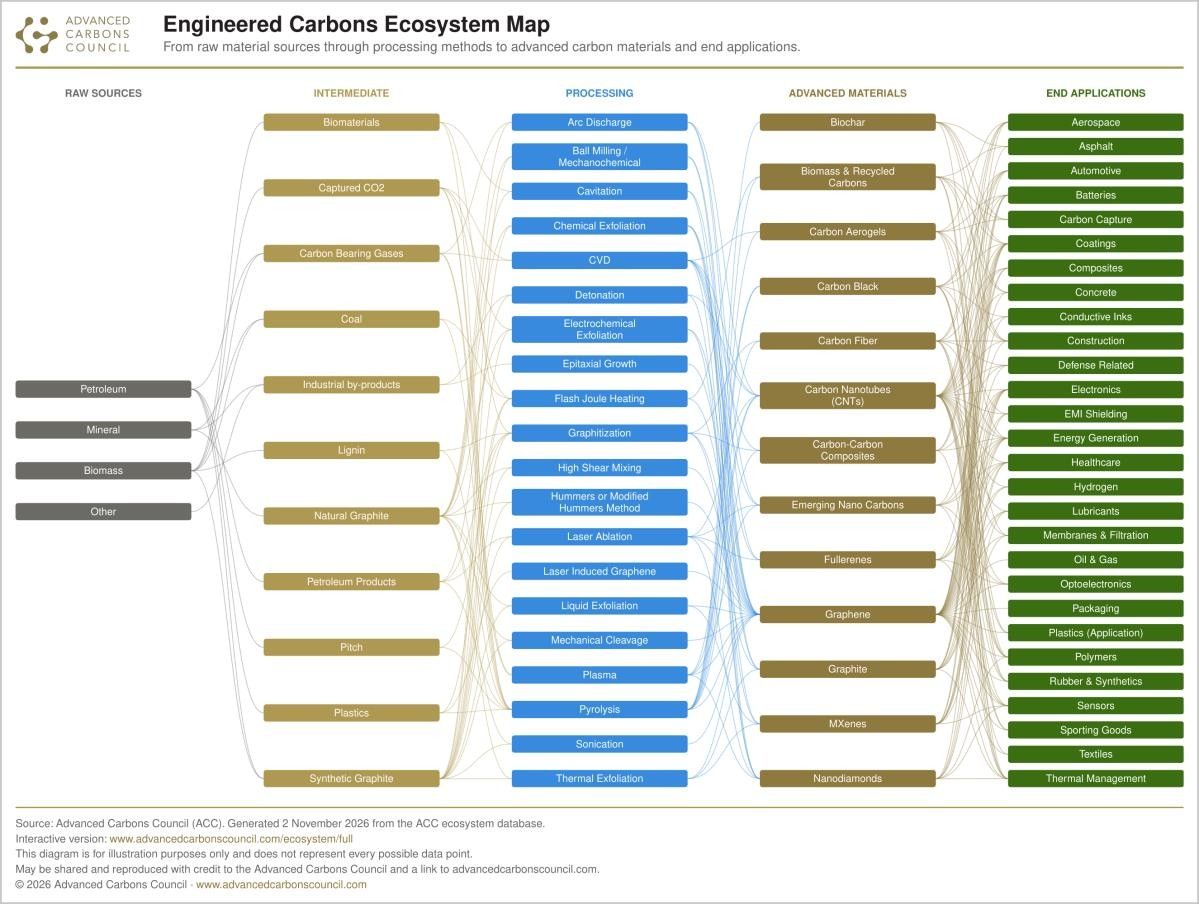
Figure 1. ACC's Engineered Carbons Ecosystem Map traces raw sources through intermediates and processing methods to advanced carbon materials and 28 end-application areas. The map is illustrative and does not show every possible pathway. Source: Advanced Carbons Council.
Two decades from isolation to scale
Graphene was first isolated as a two-dimensional material in 2004 at the University of Manchester (Manchester, U.K.), and the discovery was recognized with the 2010 Nobel Prize in Physics. Barkan noted that the prize set off a wave of research and company formation. The European Union (EU) followed with the Graphene Flagship, a €1 billion program run over 10 years to move graphene from academic research into commercial use. That program has concluded. Expectations around 2013 ran well ahead of what producers could deliver. "It takes longer to make inroads into commercial markets and it's more difficult to produce than people hoped for," Barkan said, adding that this holds for every new material discovery.
ACC formed in August 2013 as The Graphene Council. Over 10 years it has run four global industry surveys using largely the same questions, which Barkan described as the only longitudinal data on how the sector has evolved. The results are compiled in the 2026 Global Graphene Industry Survey. The resulting maturity curve (Fig. 2) places 2026 at the start of a full commercialization phase.
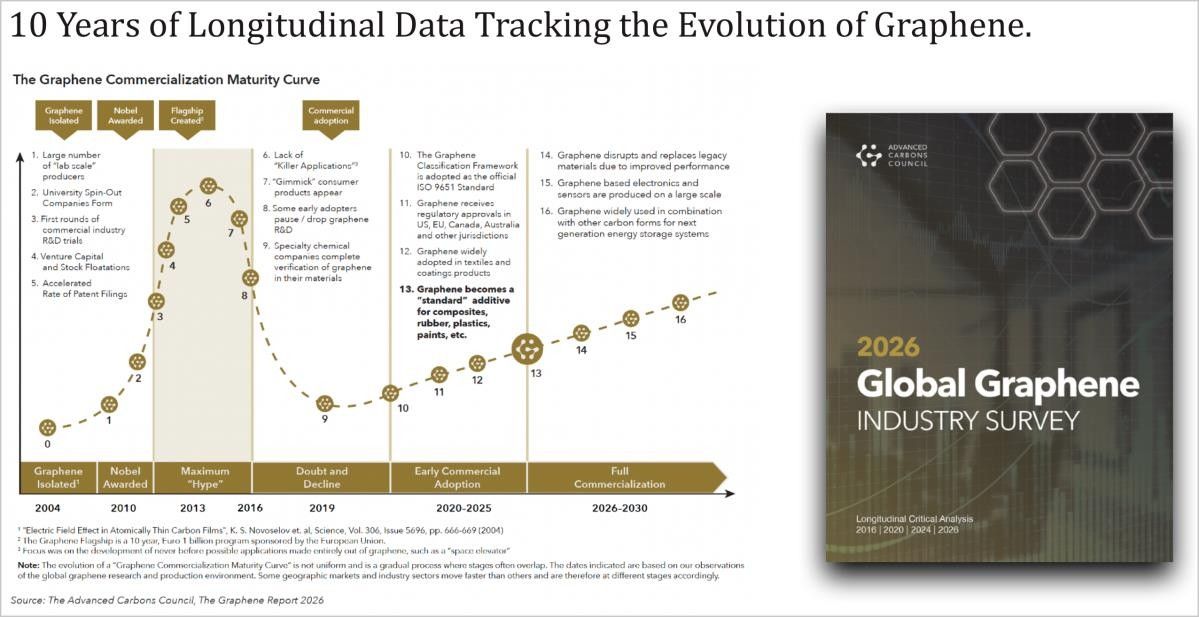
Figure 2. ACC's graphene commercialization maturity curve, built from four industry surveys conducted between 2016 and 2026, tracks the sector from isolation in 2004 through the 2013 hype peak and a period of doubt to early commercial adoption. Source: Advanced Carbons Council.
A family of materials
Barkan stressed that "graphene" describes a family of materials rather than one material. ACC, then operating as The Graphene Council, wrote the classification framework and granted the International Organization for Standardization (ISO) a no-cost copyright license to publish it as ISO 9651 - Graphene Classification Framework. "We felt it was extremely important for the industry, and it would help remove an additional barrier to commercial adoption," he said. Under that definition, commercial graphene is sp²-bonded carbon of one atomic layer and up to 10 layers in total.
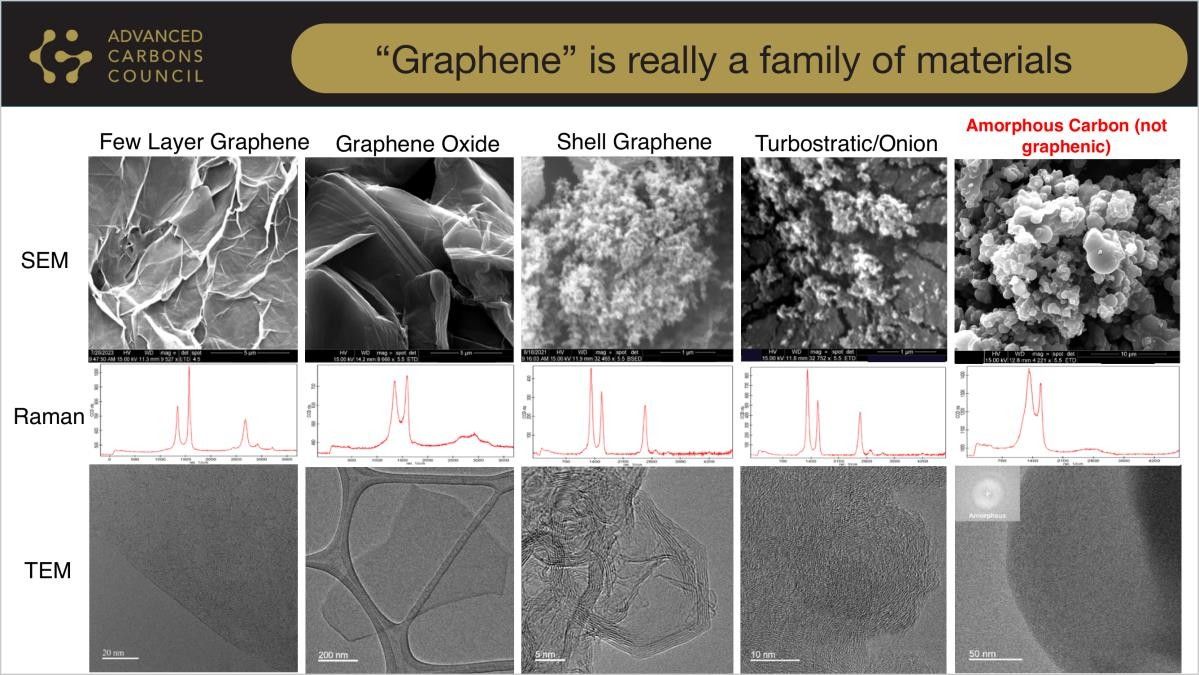
Figure 3. SEM, Raman and TEM characterization of five carbon materials. Four belong to the graphene family; amorphous carbon, at right, is not graphenic. Source: Advanced Carbons Council.
Secondary benefits from one additive
Barkan listed graphene's properties, including thermal and electrical conductivity, strength, UV resistance and reduced flammability in host materials. Normally, he said, gaining one attribute means sacrificing another. With graphene, users often get secondary benefits. His example came from mining, where polyurethane sacrificial liners protect metal buckets. Graphene made the liners last longer. It also made them less flammable, which matters when welding takes place near polymer parts. "That's just one example, and there's dozens," he said.
He attributed these improved properties to the strong yet flexible sp² bonds between carbon atoms. Graphene adds strength even at loadings below 1 wt%, and unlike ceramics it does so without increasing brittleness. Low resistance to phonon transport gives high thermal conductivity, and the lack of resistance to electron movement gives high electrical conductivity. CNTs, which he described as graphene rolled into a tube, are used in batteries for the same reason. The same material serves energy storage for its surface area and conductivity and serves motor oil because the flakes slide over one another.
Four barriers, now addressed
Barkan cited a paper ACC published in "Graphene and 2D Materials Journal" on commercialization timelines, which found that a newly discovered material typically takes about three decades to commercialize. "With graphene, we're a little over two decades in. We're basically right on schedule or ahead of schedule," he said. He named four barriers (Fig. 4). Development cycles are long; proving a single characteristic can take three years. Scale-up from laboratory quantities to hundreds or tens of thousands of metric tonnes is an engineering problem. Buyers expect standards and grades like those for steel or aluminum, which new materials lack. Finally, a novel material must still be cost competitive against incumbents. "All four of these have been addressed today, and now it's simply customer education and rollout for greater adoption," he said.
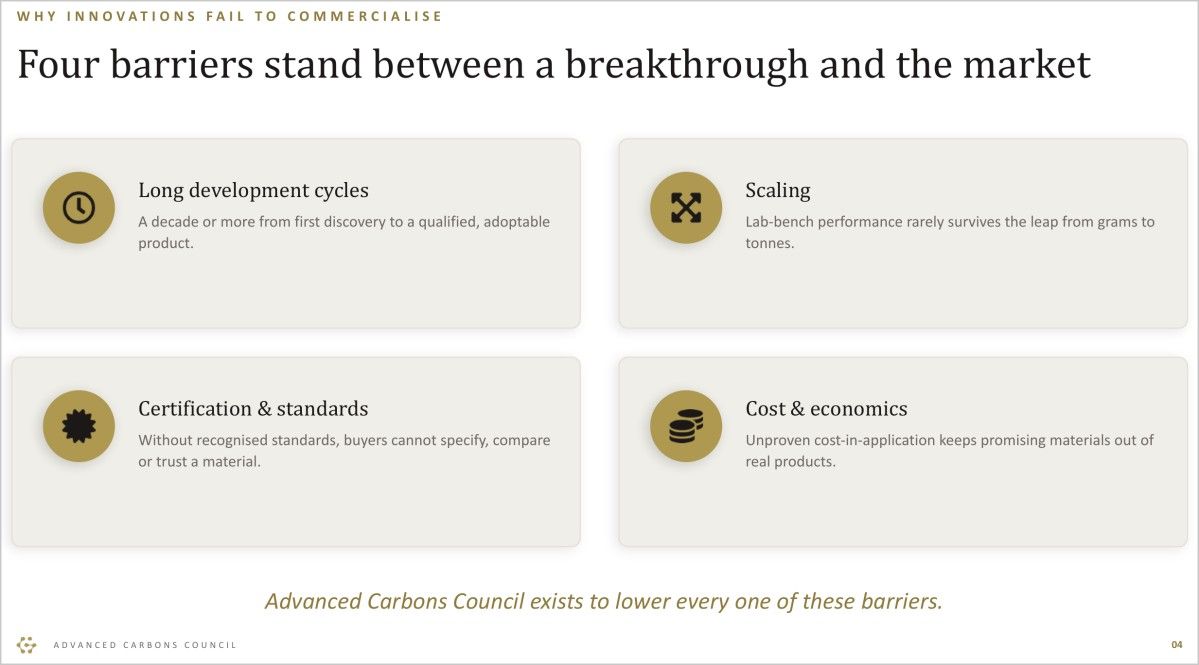
Figure 4. The four barriers between a materials breakthrough and the market, as presented by ACC. Source: Advanced Carbons Council.
He described ACC's work with four stakeholder groups: carbon producers, end users, investors and government agencies. End users, he said, often "know extremely little to nothing about these materials." For investors, the council performs technical due diligence on-site, testing materials and evaluating health and safety and quality control practices. "The only thing that we do not do is make investment recommendations," he said. On the government side, ACC shared the classification framework with U.S. regulators and works with the U.S. Environmental Protection Agency (EPA) and, for food-contact applications, the U.S. Food and Drug Administration (FDA).
Independent application data
On application testing, Barkan said customers distrust university data as gathered under ideal conditions and distrust producer data as showing only the best results. "Almost nobody wants to be first. They want to be first to be second," after someone else has proven the results, he said. ACC therefore runs application development projects (Fig. 5). In one example, for a manufacturer of hydrogen pressure vessels storing gas at 700 to 750 bar (10,150 to 10,900 psi), a small amount of graphene was added to the polyamide 11 (PA11) liner. Each permeation test takes a full week. Graphene improved the barrier property by 50%, which Barkan said would allow less liner material and a lower vessel cost. Other projects covered carbon fiber/epoxy thermoset systems for aircraft and graphene in low-melt polyaryletherketone (LMPAEK) thermoplastic for electric vertical takeoff and landing (eVTOL) rotor blades.
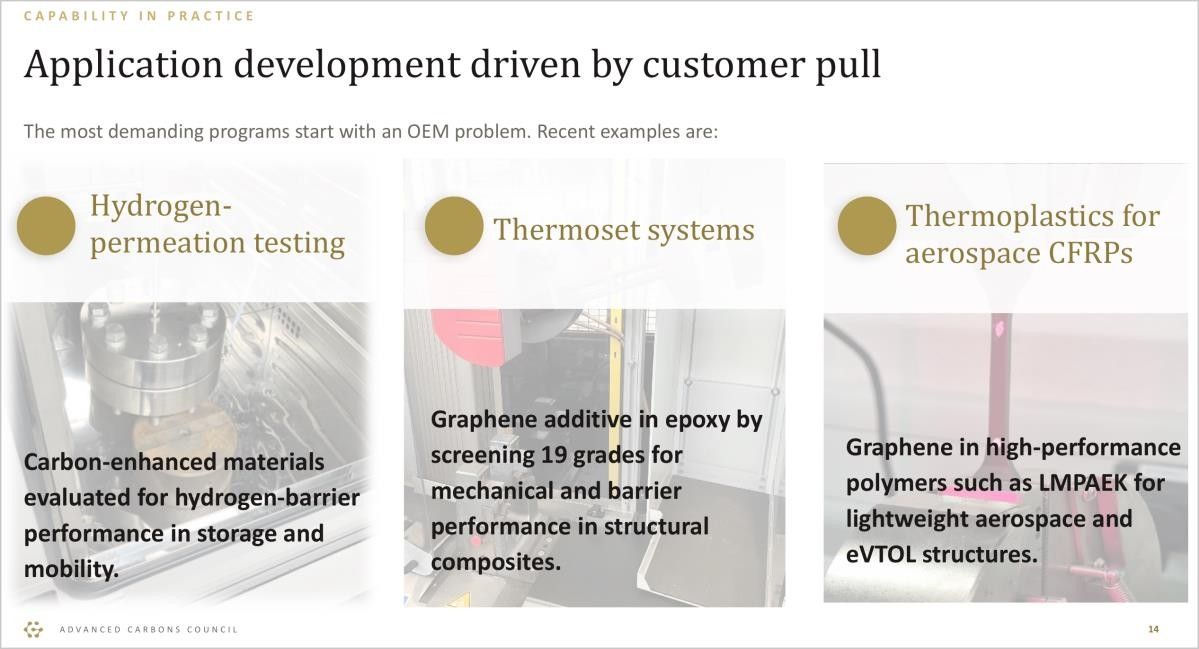
Figure 5. ACC application development projects include hydrogen permeation testing, screening of 19 graphene grades in epoxy and graphene in LMPAEK for aerospace and eVTOL structures. Source: Advanced Carbons Council.
Barkan then reviewed four market segments (Fig. 6). Battery demand will keep growing with electrified transportation, renewable generation and backup storage for data centers. Composites benefit wherever weight matters, including aircraft, drones and satellites. "Anything that goes in the air, you want a lightweight," he said. In thermal management, heat is the leading cause of electronic failure, and graphene and expanded graphite serve as heat spreaders. In coatings, at least five companies already sell graphene anti-corrosion paints for bridges, petroleum plants and ships.
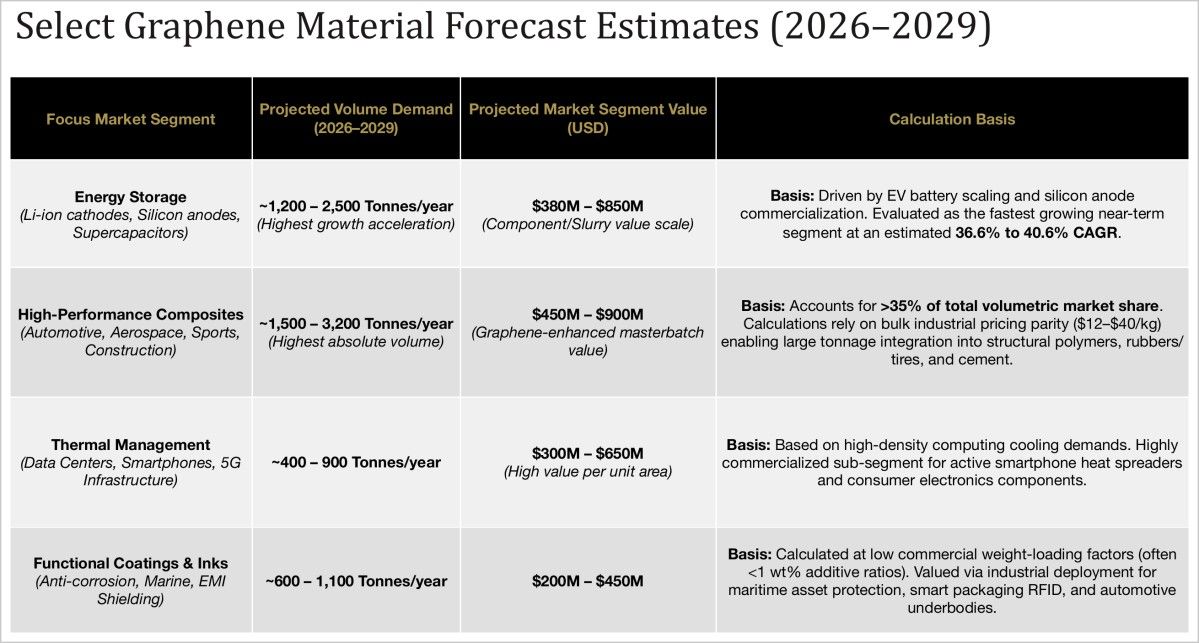
Figure 6. ACC forecast estimates for four graphene market segments, 2026 to 2029. High-performance composites carry the largest projected volume, 1,500 to 3,200 metric tons (1,650 to 3,530 short tons) per year. Source: Advanced Carbons Council.
Verification of producers & products
Roughly 300 companies worldwide claim to produce graphene, Barkan said, and graphene cannot simply be identified by looking at a material. For example, he wore a shirt with graphene in the fiber, citing better thermal transport, longer wear proven in abrasion testing and antibacterial properties. However, without independent testing, a customer might not know if they are receiving bona fide graphene materials, or if a product actually contained graphene?
ACC's verification program audits producers on-site from raw material intake until material leaves the facility. Auditors review books and records to confirm claimed volumes and take samples from the production stream for full characterization. Verified companies are reverified every three years, and the presentation listed those currently verified (Fig. 7). "Only a small number of companies have actually been through the process," he said.
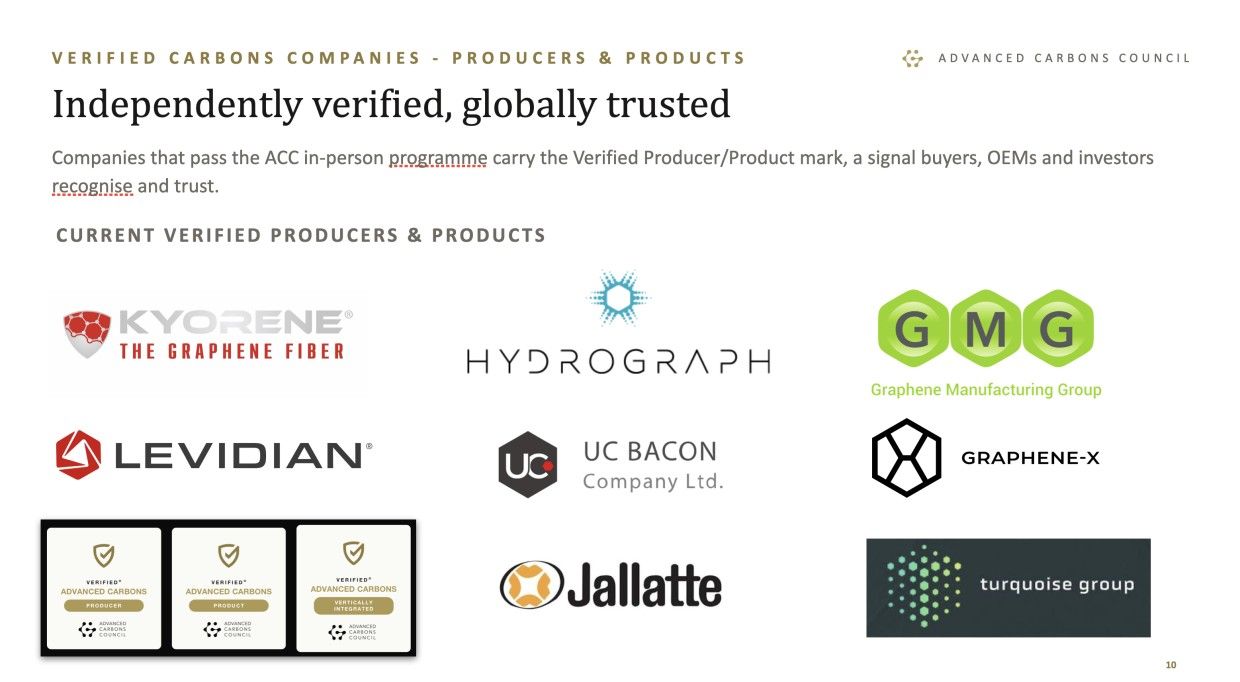
Figure 7. Producers and products that have completed the ACC in-person verification program and carry the Verified Graphene Producer or Verified Graphene Product mark, as shown in the presentation. Source: Advanced Carbons Council.
Due diligence, dispersion and regulation
In the question period, a participant asked which metrics matter in due diligence. Barkan pointed to technical data sheets; ISO 9651 includes a template covering layer count, chemical composition, morphology and micrographs. "Some of the companies will simply say, yeah, we make graphene. It's a black powder, and our material is seven to ten layers. Trust us," he said. Incomplete information is a red flag.
Asked where graphene cannot be applied, he referenced inclusion of graphene in actual food products, while noting work is currently being on food packaging. He singled out polyethylene flexible film, the most consumed plastic, where graphene can reduce material use by about 30% for the same performance. That application alone, he said, would require more graphene than is produced today. On defective graphenes and different graphene forms, he said defects are not always bad because they provide attachment sites and surface area. "It's not going to be a winner takes all kind of concept for one graphene form, and it doesn't need to be," he said.
On FDA approval, Barkan said compliance for food-contact substances can be easier than obtaining EPA approval under the Toxic Substances Control Act (TSCA), because the applicant agrees a specific set of test methods with the agency. ACC is working on one such case; details are confidential. On processing problems, he said graphene is often added at 0.1 wt% or even 0.01 wt%, so uniform dispersion is critical and is a specialist skill. Users who see poor results often add more. Lower loadings frequently work better. "You actually want to get down to the lowest load factor where you have maximum performance," he said.
Scale and the legacy-material contest
He estimated that the majority of current, small-scale producers cannot scale fast enough for large markets. "If a tire company came and said, I need four thousand tons of graphene, where do you get it today?" he asked. Large buyers also want more than one supplier. "The problem is not one graphene company competing with another graphene company," he said. "The competition lies with dislodging legacy materials."
His example was 6PPD, an antiozonant in tire rubber that is toxic to salmon in the U.S. Pacific Northwest. Tire makers have been mandated to find a replacement, and functionalized graphene is among the candidates being tested, with positive results so far. If adopted, he estimated about 100,000 metric tons (110,000 short tons) would be needed to begin serving that market. Because graphene enters existing markets as an additive, "you have to go from zero to a hundred in one step," he said. "We're not creating novel markets for graphene. We're gaining access to existing markets [like tires]."
Other answers covered wastewater treatment, where he said the obstacle is filter form factors: graphene filter media must fit existing infrastructure rather than require a plant redesign. He also advised most customers against handling graphene as a dry powder. "It can be handled safely. That's not the problem," he said; most facilities are simply not set up for nanomaterials. He recommended masterbatch formulations that remove the inhalation risk and act as drop-in products. On recycling, he said graphene does not reduce the recyclability of plastics and can in fact upgrade end-of-life plastics.
On a more strategic level, he also noted an ACC position paper proposing engineered carbons as a platform technology and the basis for a U.S. national advanced manufacturing strategy.
Consolidation ahead
Asked how confident he was in mass adoption, Barkan said, "I'm extremely confident of graphene being adopted. My scenario for when this is a huge success is when graphene is in everything and nobody talks about it." He compared the sector to early U.S. tractor manufacturing, when hundreds of companies built tractors before the market consolidated to a few leaders. "Unfortunately, as the markets mature, many of the current companies will go away because they can't compete," he said, acknowledging that the remark was hard to make as an organization whose members include producers. Consolidation will take years to play out but is the sign of a healthy ecosystem.
On interchangeability, he said ACC holds an inventory of more than 1,000 graphene types that have been produced and used commercially, and grades from different producers are not interchangeable today. "There is no standard graphene today, and I don't think there's ever going to be a standard graphene," he said, although dominant types could emerge. On commoditization, he expected some high-volume, lower-cost grades and price pressure but not commoditization across the board. Graphene, he said, should be thought of "more like a specialty chemical," with a wide range of grades suited to specific uses. He closed by offering ACC's technical due diligence and information services to participants.
Contact
Terrance Barkan
Executive Director, Advanced Carbons Council
[email protected]
For more information visit www.advancedcarbonscouncil.com