NIT Rourkela secures patent for advanced 3D-reinforced composite technology
NIT Rourkela has patented a 3D-reinforced composite technology that boosts Fibre-Reinforced Polymer strength and durability, with potential applications in aerospace and automotive industries.
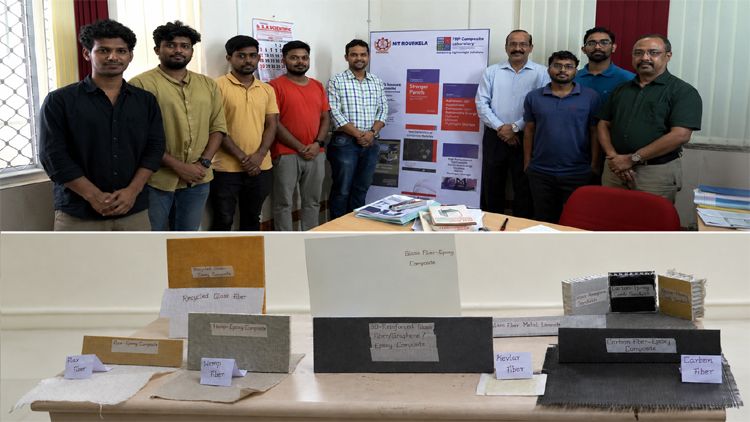
The National Institute of Technology (NIT) Rourkela has patented a three-dimensional (3D) reinforced composite manufacturing technology that enhances the strength, durability, and damage tolerance of Fibre-Reinforced Polymer (FRP) composites. This development represents a significant advancement in materials research.
Researchers at the FRP Composite Laboratory in the department of metallurgical and materials engineering developed the technology, which has potential applications in aerospace, automotive, renewable energy, defense, marine engineering, and hydrogen storage. The team includes Dr. Rajesh Kumar Prusty, Prof. Bankim Chandra Ray, and research scholar Mr. Parimal Jana from NIT Rourkela, collaborating with Dr. Dinesh Kumar Rathore from MNIT Jaipur.
FRP composites are valued for their high strength-to-weight ratio, corrosion resistance, and design flexibility, making them suitable for use in aircraft, defense systems, launch vehicles, high-speed rail, wind turbines, and pressure vessels. However, conventional composites often face issues with internal delamination and crack propagation under heavy loads, which can compromise long-term performance.
To address these challenges, the researchers developed a hybrid composite by integrating glass fibers with graphene nanoplatelets, aligned through the material's thickness. A notable aspect of the patented process is the use of a standard 50 Hz alternating current electric field at 800 volts during curing, which ensures uniform alignment of graphene within the composite through a simple modification of existing manufacturing techniques.
Dr. Rajesh Kumar Prusty highlighted the technology's wide-ranging applications in areas requiring lightweight yet damage-tolerant materials, such as aircraft panels, automotive crash structures, wind turbine blades, marine structures, and pressure vessels.
Laboratory tests conducted according to ASTM standards demonstrated significant performance improvements, including a 37% increase in tensile strength, a 30% improvement in flexural strength, a 63% enhancement in flexural modulus, a 24% improvement in interlaminar shear strength, and up to a 53% increase in fracture toughness, along with a 55% higher storage modulus at 40 degrees Celsius.
Prof. Bankim Chandra Ray stated that the innovation could reduce maintenance costs, improve energy efficiency, and support sustainable manufacturing, aligning with India's Atmanirbhar Bharat mission in advanced materials. The research team is now focused on testing the material in larger structural components and seeking industry partnerships and technology licensing for commercial deployment.
Source: Graphene Feed